









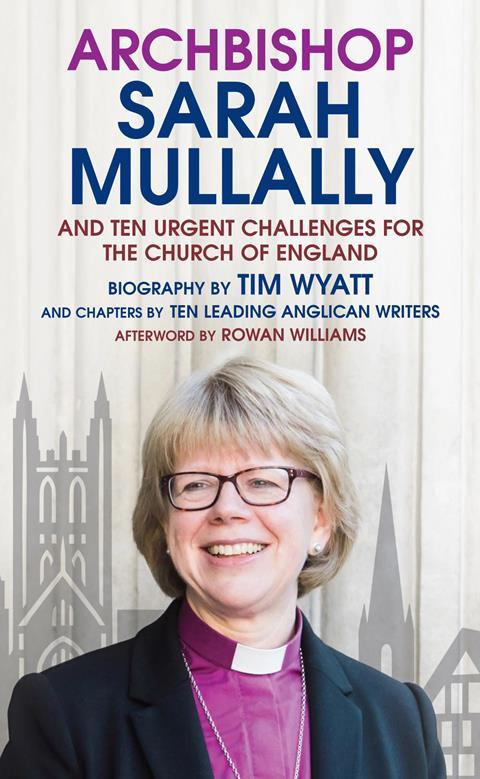
Ten leading Anglican voices offer advice and prayers for Archbishop Sarah Mullally in this multi-author volume. And yet the book also overlooks some of the Church’s most pressing priorities, says our reviewer
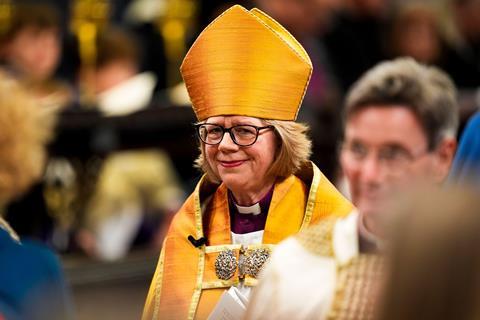
The most interesting part of Archbishop Sarah Mullally and Ten Urgent Challenges for the Church of England was the biographical introduction about Sarah Mullally offered by Tim Wyatt.
Having met Sarah Mullally when she was Bishop of London, I found her to be warm, gentle and easy to talk to. I knew she was previously a high-ranking nurse, but I hadn’t grasped the scale of her professional achievements and ambition. Learning that she had become Chief Nursing Officer aged 37, when she had two small children and was training for ordination, revealed a drivenness and work-ethic I hadn’t grasped, and which helped me understand how she had broken another ‘stained-glass ceiling’ to become the first female Archbishop.
While largely factual, this introduction offered a helpful sense of her leadership approach – for instance, mentioning that as successor to Richard Chartres she “swiftly ditched his chauffeur-driven car and tried to cycle to most of her appointments”. Praised for her engagement in the Grenfell tragedy, she was described as: “personally warm and caring, but primarily a serious colleague, deeply professional and utterly committed.”
The book continues with chapters about, what it calls, ‘urgent challenges for the Church of England’ – for instance: racism, ableism, inclusion for LGBT people, climate change and division in the global Anglican communion. Each chapter has a different author, who draws on their expertise to offer suggestions as to how Bishop Sarah might address such challenges.
I found Mark Oakley’s chapter: ‘Spirituality and the Church of England’ the most compelling. He writes prophetically, arguing that the “soul of the Church, and the longing to keep it healthy and honest, needs to be Sarah’s immediate and long-term focus.” In concentrating firmly on spiritual matters, he names the tragedy of us being a “flat-tyre community, too secular in our preoccupations and conduct, in a spiritually hungry society” and uses the word ‘respair’ (recovery from despair) as our greatest need.
This call to spiritual vision came too in the chapter on racism and nationalism, and I found myself agreeing wholeheartedly with Eileen Harrop’s analysis that: “the people of England are hungry for the Church’s spiritual leadership…and there is a deep hope that the Church would show moral courage in proclaiming the good news of Christ”.
Apart from the odd sentence like this, the gaping omission from this book was the lack of engagement with the urgent tasks of mission and evangelism. If the Church’s primary calling is to “go and make disciples”, it felt a glaring absence not to have chapters exploring the need for the Church to grow in confidence and effectiveness in proclaiming the Gospel. A rare reference was found in Bishop Amatu Christian-Iwuagwu’s contribution, where he writes that: “unity requires that we re-centre mission and discipleship as our common ground. The early Church did not survive because it solved every doctrinal dispute, it survived because it preached Christ and formed disciples.” Yes and Amen!
The book needed more of this – and the absence of chapters about the urgent challenge to articulate the Gospel of Christ afresh, for this and future generations felt a missed opportunity. For evangelical readers, lack of engagement with this topic will feel problematic. Similarly, it felt a significant oversight not to engage with the urgent challenge the Church of England faces in engaging young people – particularly as the most recent Statistics for Mission cite the average number of under-18s in a Church of England parish as being less than 7.
With these omissions in mind, many of the issues-based chapters were a challenge to read. The entries on same-sex marriage and trans and non-binary people offered only a progressive perspective, when of course the root of the challenge facing the Church of England is that there are a variety of perspectives we need to listen to.
Andrew Graystone’s chapter on abuse and safeguarding was helpful and his call to repentance felt appropriate. He is right that the Church needs to spend more time in confession than in committees: “many well-meaning initiatives in safeguarding polity are flawed because they stem from the same excess of self-importance that leads to abuse in the first place…the Church needs to attend scrupulously to the wounds of victims for a long time until it is convinced of its own helplessness.” The prayers at the end of each chapter were also useful for confessional reflection, and reminded me repeatedly that the most important call on every Anglican is to pray for our new Archbishop.
Overall, this title offered some helpful context and analysis to Archbishop Sarah’s leadership. Having said this, the ‘10 leading Anglican writers’ chosen to contribute largely represented one ‘stable’ of the Church of England and some broader perspectives, and priorities, would have more accurately reflected the breadth of the church Sarah Mullally has been called to lead.

























2 Readers' comments