









As toxic leadership cultures continue to be exposed across denominations, Rich Johnson’s timely book offers a biblical framework for leading well and sustainably in the church, says our reviewer

Across almost all Christian denominations in recent times, a wholesale dismantling of leadership has occurred. Unhealthy and toxic leadership cultures and behaviours have been exposed in ways which have been deeply painful and hugely disappointing.
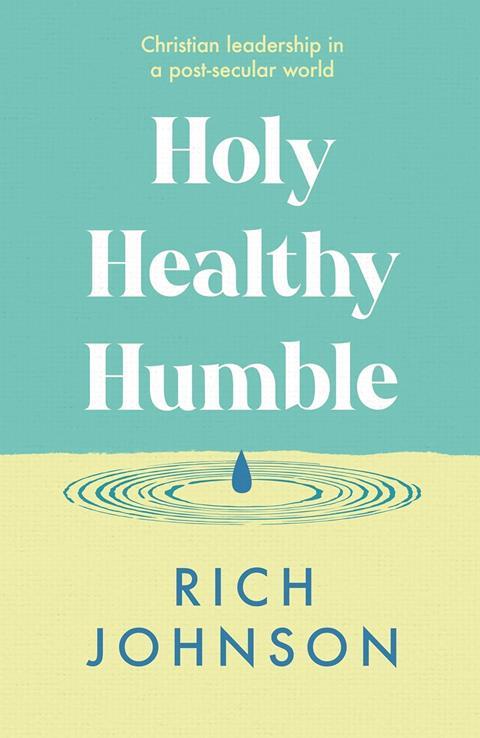
In the midst of such dismantling, we desperately need some re-envisioning as to what healthy, biblical leadership can look like. Thankfully the national leader of New Wine and vicar of All Saints Worcester Rich Johnson – drawing on decades of hard-won experience and learnings – has written a book to help us. Summarised in a sentence – Holy, Healthy, Humble addresses the question: what does it look like to lead well, and sustainably, in the church?
As a church leader myself, I found Johnson’s context-summarising introduction a helpful starting point. He begins where many of us are, by asking the question: ‘what on earth is going on?’ His answer suggests we’re leading through a concoction of post-secular, post-covid complexities alongside an exciting spiritual awakening.
The structure of the book is well thought-through. Each of the three sections (holy, healthy, humble) begins with a summary of this posture (the ‘why’) before deep-diving into the life of a biblical leader (Peter, Daniel, Ruth) then concluding with suggested ‘practices and postures’ (‘the how’). For many leaders, the logic of each chapter will be a useful framework with which to teach these postures in local contexts. For instance, in reading this I quickly imagined evolving the content into a preaching series, small group resource or framework for 1:1 mentoring.
The Bible studies on Peter, Daniel and Ruth are strong and Johnson has done good work for us: explaining how and why these characters are holy, healthy and humble. There are surprises too – indeed, I wouldn’t previously have considered Peter as particularly holy, framed as he often is as impulsive and inconsistent. Yet the author shows convincingly how Peter grew in holiness over time as he “gave himself wholeheartedly to Jesus” and consecrated himself in submission to Christ (1 Peter 2:13-18).
The closing parts of each section contain practice and postures which highlight the depth of Johnson’s experience, both in local and national church leadership. I found this book motivated me to change because refreshingly, the style is never preachy. If anything, Johnson is reassuringly vulnerable in sharing his own weaknesses and mistakes. Reading this never made me feel guilty (though at times, I was helpfully challenged) but rather inspired me to take small steps to grow in these leadership postures.
Of all three sections, I found ‘Healthy’ the most compelling. The seemingly relentless stories of unhealthy Christian leadership has, in recent times, left my church leader peers and I grasping for healthy role models. And yet, Johnson reminds us that sustained leadership health is possible and maps out how we might get there.
The trend to view health and wellbeing more holistically in both society and the Church is valuable – after all, we are mind, body and soul, and if we don’t attend to the health of all the parts of us, we will never be well. Johnson casts a vision for resilient health which is not caught or taught but rather formed as we “intentionally attend to our health” – which includes emotional, social, spiritual, physical and relational health.
He includes a simple, but stark reminder: “a simple fact I cannot ignore is that all the healthy leaders I know are very intentional about their health as leaders….in every aspect of their lives…they leave nothing to chance”. Again, when I think of my peer group, all of us would agree with this statement but most of us would struggle to make it our lived reality. For me, the sub-headings here were helpful prompts: undertaking regular health checks, robust self-care, seeking blend not balance and embracing pre-decisions – all helpful tools in my quest to become more consistent and able to resist temptation.
Finally, Johnson casts a vision for “humble leadership” and by this point it was clear to me that he has genuine authority with which to teach this. It is not easy to write “be humble, like me!” so he doesn’t – instead, there is something about the writing style, self-deprecation and authentic vulnerability throughout that makes this section both credible and palatable. I found much I’ll draw on here in my leadership and Johnson’s reflections on feedback culture and challenge, growing an undefended posture and building more structured systems of accountability are valuable.
Having said that Christian leadership needs to be healthier, the role of being a church leader is hard and I enjoyed a footnote, tucked away at the end, which some readers may miss.
Here, Johnson writes: “I am a big believer in encouragement and the benefits of seeking and receiving positive feedback” along with some tips for how to ask for, and receive this healthily. This is an important place to land: while we as leaders need to push ourselves to become holier, healthier and humbler – we also need people to regularly praise, encourage and cheer us on.
Holy, Healthy, Humble: Christian Leadership in a Post-Secular World (IVP) by Rich Johnson