









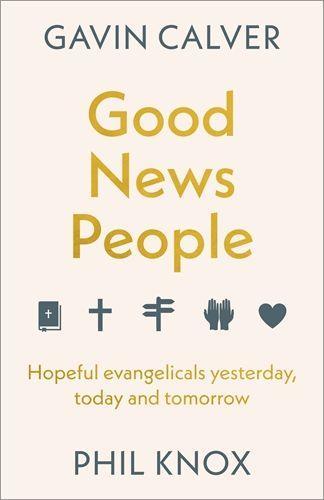
It’s time to confidently own the ‘evangelical’ label. That’s the argument of Good News People, a new book by Evangelical Alliance leaders Phil Knox and Gavin Calver. Our reviewer says it’s an important and timely title

It was not until I read Good News People (IVP) that I realised how apologetic, both in my mind and in conversation, I had become about the word ‘evangelical’. As someone raised in an evangelical home, discipled by evangelicals and now leading a large evangelical church - this was interesting to notice. I was glad of the challenge to engage as to why this was the case, and imagine many other evangelicals like me would benefit from reflecting on this too.
Phil Knox and Gavin Calver, both leaders in the Evangelical Alliance and men who describe themselves as “evangelical to their core” have written a book which draws on their friendship and collective leadership experience. This book doesn’t just defend evangelicalism, but rather casts hopeful vision as to why evangelicals need to confidently own the label, the tradition and the practice of evangelicalism.
I found Part One – ‘What we believe’ – to be a most helpful introduction. Here the authors lay out, succinctly and clearly, who UK evangelicals are and what they believe. They tackle head on false assumptions made about ‘evangelicals’, engaging tactfully with expressions of American evangelicalism where: “political, nationalistic and theological views have been fused together” in such ways which have been problematic for British evangelicalism. Similarly, their reminder of what the word ‘evangelical’ means (the Greek word evangel translates as ‘good news’) and the working definition they offer – “a good news person in a bad news world”, is compelling.
Even after these first few pages I found myself pausing and imagining conversations I could have where this definition would bring me fresh certainty to articulate myself, and the church I lead, as confidently ‘evangelical’.
The second chapter draws from our vast evangelical heritage to outline what, for the authors, are the ‘non-negotiable’ aspects of the tradition. A strength of this book is the accessibility of everything explored, which will enable the title to reach a wider audience. For example, they outline J.I.Packer and David Bebbington’s theses (now 50 years old), which defined evangelical characteristics as: bibliocentric, cruciocentric, conversionist and activist and go on to unpack these unfamiliar words: “put another way, we believe in the authority of the Bible, the significance of the cross, the need to make a decision and the desire to make a difference.” It is these latter turns of phrase which will equip UK evangelicals to speak with the confidence Calver and Knox long to see.
The stories and anecdotes accompanying the teaching points in the book are enjoyable. For example, Gavin’s recollection of a trip to Sudan where he witnessed Christians worshipping with incredible fervour or Phil’s reflections on his upbringing where: “if you were to lift the metaphorical floorboards you would find scripture permeating the foundations”. As a historian, I found chapter 3, which outlines the history of the Evangelical Alliance interesting and helpful – though other readers may find this less engaging.
The second, longer part of the book outlines a vision for how evangelicals should live. I valued here the balance between confidence and care articulated in each chapter – with the authors encouraging readers to be both “brave and kind”, “hopeful and realistic”, “united and diverse”. They succeed in explaining why this matters, particularly for pockets of the evangelical church which could be accused of not listening well or failing to respond with love to people with a different perspective. One anecdote in particular stood out. Gavin relays a recent conversation with a friend who had decided: “not to be an evangelical anymore”. He recalls: “listening intently for the rationale and reason behind all this change” – a posture and approach sometimes missing from evangelical leaders. For all the zeal, passion and godly expectation that both authors carry, reading this book did not feel like ‘being hit over the head’ and there is a warmth and grace throughout the pages which is refreshing.
A couple of aspects of this book detracted from what is an important and timely title.
First, a couple of spoken-word pieces, written by Phil, were included without context in such a way that felt clunky.
Second, and more importantly – both authors speak affirmingly about their wives as Christian leaders, and the warm foreword by Bishop Jill Duff suggests their appreciation for female evangelicals both past and present. Having said this, I found myself tiring, as the book went on, of the authors not working harder to make space for female evangelical voices. For instance, it felt like a missed opportunity that the vast majority of references in the ‘Recommended reading’ sections at the end of each chapter were written by men.
Despite this, I commend this book highly to any UK evangelicals looking for a framework, and language, to own their evangelical identity with fresh confidence.
Good News People is also available as a podcast on premier.plus
























1 Reader's comment