












Hazel Southam explores how outdoor spaces are being transformed by congregations across the UK in order to build bridges that reach out to the local community and point upwards towards God
There are more than 20,000 churchyards in the UK, and they are often liminal spaces. For those who might find it difficult to enter an actual church building, the grounds surrounding it can provide a bridge between sacred and secular.
Often, these areas are frequented by dog walkers, joggers or people searching for a bit of peace on their lunchbreak. And, as we saw during the Covid-19 pandemic, anyone who wanted to quietly inhabit a green space and still their troubled spirit.
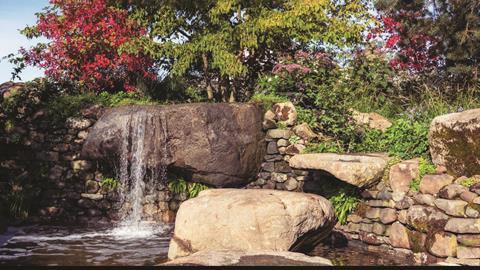
In 2021, I had the privilege of working on a project with Bible Society to create a garden at the RHS Chelsea Flower Show (see photo, top). Together with landscape designer Sarah Eberle and architect Mark Gregory, the garden depicted Psalm 23. It embodied the psalm through a waterfall leading to still waters, surrounded by trees, shrubs and herbaceous perennials that created a place of arrival and peace.
The garden drew huge media attention and many who visited it were moved to tears. Thanks to the skill of its creators, it won a Gold Medal, Best Sanctuary Garden and Best Construction award.
After Chelsea, the garden was transplanted and now lives on at Winchester Hospice, providing a place of peace and reflection for patients and their families facing the end of life.
One aim of the Psalm 23 garden was to inspire churches and schools across the country to create similar sacred spaces that bridge the gap, whether they had a tiny yard or plenty of space. Bible Society provided resources to help achieve this on a budget and dozens have been created nationwide. Visiting them I saw the impact on people’s lives and faith journeys as well as the life of the church. So, ahead of this year’s RHS Chelsea Flower Show, I set out to find out how churches and cathedrals more broadly are using gardens to reach their communities.
1. The community garden
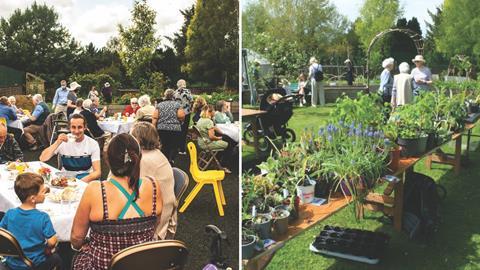
Although Chapel-en-le-Frith Methodist Church in Derbyshire has owned the land around their building since the 1960s, it was in 2018 that they started to create a community garden.
“Ours is a practical faith,” says church spokesperson, Jules Murdy. “We want to serve the community. We want to meet people where they are.”
Eight years on, the garden includes a greenhouse, vegetable plots, scented plants, a pond and a quiet area for reflection. It is entirely self-sustaining in both water and compost, winning it a Church Times Green Church Award.
It has also become a social hub for the local community. Parents collect their children from the primary school next door and spend time in the garden. There are four gardening sessions each week which actively include the isolated and lonely. Many people are referred through social prescribing.
“It’s a good place for people’s mental health and wellbeing,” says Murdy. “A whole lot of friendships have developed, and people aren’t so lonely now. It’s lovely to see.”
The garden team also donate any surplus food that is grown to the local food bank. Last year, the nearby Anglican church used the garden to mark its 800th anniversary. More than 75 people attended.
Now, hundreds of people visit every week. “The garden has made us more visible. People can see that something is going on here. It’s making connections beyond the church.
“Church isn’t about bums on seats. It’s about how we can share the love of God and what He has given us.”
2. The cathedral garden
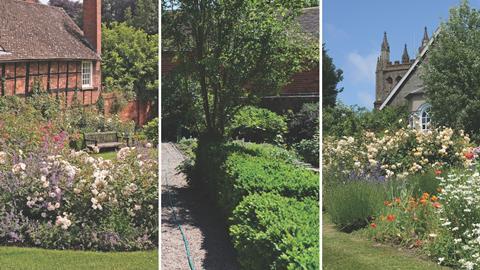
Hereford Cathedral is thought to have been founded in AD696, so perhaps it’s no surprise that with this long history, the cathedral is part of everyday life in the city. Office workers bring packed lunches into the gardens and children play in the Close after school.
In 2021, the cathedral was awarded a Silver Eco Church Award from A Rocha – and its gardens are at the heart of that environmental endeavour.
Though there are some gardens within the cathedral’s grounds that are only open to the public on special occasions, the Chapter House Garden and the Lady Arbour Garden are open every day.
The Lady Arbour Garden is a place of reflection, with formal planting including hydrangeas, box, ferns and periwinkle. The formal planting creates a sense of order, which makes it an easy place to relax. The Chapter House Garden features a Glastonbury thorn, whose DNA is said to be Palestinian, and this is a big draw for the public.
According to legend, the Glastonbury thorn sprang from the staff of Joseph of Arimathea, and so remains a symbolic connection to the birth of Christianity in Britain.
Cathedral spokesperson Abby Jones says that the gardens provide an accessible entry point for people “who might feel intimidated by coming into a religious building”.
Over the years, the team have seen many people who start by sitting in the gardens, and eventually enter the cathedral, finding tranquillity inside as well as out. During the Covid-19 pandemic, the cathedral grounds were visited by many people. Afterwards, some of those who enjoyed the outdoor space came inside to explore, finding tranquillity there as well. “The gardens are a constant reminder of our beautiful creation, and a real gift,” she says. “They are also a way into the cathedral.”
Head gardener, Lucy Parkes, says the mental health benefits of being outdoors are well known. “But gardens are also good for your spiritual health. Regardless of where you are on a spiritual journey, a garden will nurture that. It’s good for the soul. There’s always something to move you out of yourself. The garden makes people feel positive.”
3. The scripture garden
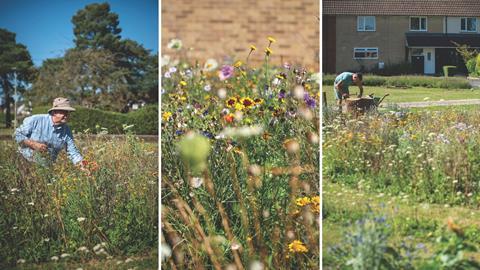
During the Covid-19 pandemic, three members of St Mary’s Church, Tadley, in Berkshire, decided to create a wildflower labyrinth based on Psalm 23. With a budget of just £200, their aim was to create a place where local people could come. Five years on, the garden has changed both the life of the church and its connection with the community.
“Life in and around the church has been totally transformed because of the garden,” says priest-in-charge, Rev Steve McKay. “We were a small, declining church and now we are on the up. The garden is drawing people into church.”
As a result of its success, a second garden area for children was established in the church grounds. A local pre-school visits three times a week and a primary school also uses the space regularly.
Tadley’s Men’s Shed – a national project that enables men to keep active and tackle social isolation – is now established on the church grounds, and the team helps with school visits.
Jodie Green, deputy manager of the pre-school, says that the visits help build the children’s self-esteem, but also “to understand what a church is and what it has to offer. Some children have never seen a church before”.
Since the gardens were opened, church attendance has risen, with more than 20 new members a year. The role it plays in people’s lives is hugely important. “It is my place of refuge,” says church member Chris Gillings. “It’s my worship space. I’m so glad it’s there.”
4. The show garden
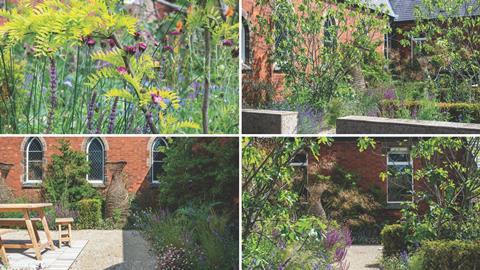
Mobberley Methodist Church lies just nine miles from Tatton Park in Cheshire, which until recently was a Royal Horticultural Society showground. In 2024, the church became the fortunate recipient of designer Ollie Pike’s garden, which had won ‘best in show’ at that year’s Tatton Park Flower Show.
What had been a former memorial garden and “a patch of grass” was transformed by the show-stopping design that includes fig trees and colourful, diverse planting such as achillea, salvia and erigeron.
At the heart of the space is a bespoke table and benches that invite people to sit together and gather as community. Cyclists, dog walkers and locals all use the garden, fulfilling its title: This Garden isn’t Finished Without You.
“It’s such a gift,” says Liz McGrath, the Methodist circuit’s pastoral worker. “People now come who might have driven past before.
“People have a coffee and a chat, read their paper in the garden, and then they ask to look round the church. It’s opened up the church to the community,” she adds.
For Rev Alan Bradley, the garden provides a peaceful space for pastoral conversations – but is also somewhere that points to the existence of a creator. “There’s a sense of entering the presence of God when you go into the garden,” he says. “I hadn’t expected that, but there’s a real spiritual connection. It’s a place where I love to sit and pray.”
The garden has proved to be a welcoming space for all, including those visiting the food bank, or struggling with loneliness or isolation. Some of those people are now finding their way to Sunday services. “The garden allows us freedom,” says McGrath. “People are more relaxed and open there. It’s easier to talk, and we have great conversations.”
In just 18 months, the garden has transformed the relationship between the community and the church, but Rev Bradley says it will shape their mission forever. “As the church looks to the future, we will have questions about how we can use the garden. It will live on and shape the church and its engagement in ways that we can’t imagine. The garden isn’t finished yet!”
5. The community orchard
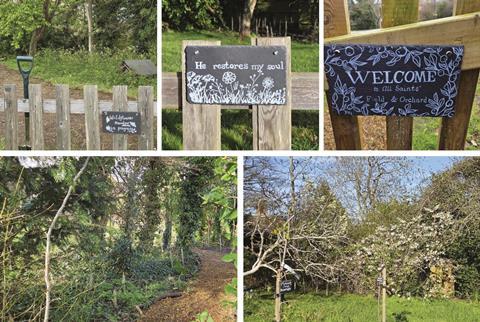
‘Treasuring creation’ was the idea at the heart of the community orchard project started by All Saints’ Church in Guildford.
“Young people really feel despair about the climate crisis,” says Rev Beverly Watson, “and treasuring creation helps with that. We needed to share that with the church and the wider community and open this space up to everyone.”
All Saints owned a glebe field overlooking Guildford Cathedral. It already had a cherry and walnut tree, so in 2021, the decision was made to create a community orchard. Ten more trees were added, including cherry, apple, plum and greengage.
Initially, the focus was on creating space for wildlife – the church holds an A Rocha Gold Eco Church Award – but it has increasingly become a place of sanctuary for people, too. Benches provide a place to sit and enjoy the newly planted woodland walk and wildflower meadow.
“It is somewhere people can feel a sense of awe from being in nature, whatever their faith,” says diocesan mission enabler, Alison Moulden. “With all the worries about the climate crisis, it really helps to see things growing – green shoots. That leads you to a creator, which is uplifting. It’s wonderful to allow that spirituality to happen for people who may not come into the church.”
A team of church members and committed locals meet monthly to care for the orchard, meadow and woodland walk. And through this involvement, some are starting to join the church community.
Plans are afoot to develop the church building over the next year, opening it out as a space of hospitality that leads down to the orchard. “Developing our hospitality will help with this whole thing of belonging, which is the way into the church,” says Rev Watson. “People like to contribute. Here, they feel that they have something to offer. So, there’s a sense of us serving the community, but also the community serving themselves.”
The orchard, meadow and woodland walk are now used for many outdoor events, particularly with local schools. More than 360 children have attended prayer events in the space over the last year. The fruit grown there is shared with the community. Anyone can pick it.
Sue Jones and her husband, Steve, lead the team who care for the orchard. “When we garden, we are there for the plants, but it’s also a time for people to be together.
“It’s given us a sense of being outward looking in what we do,” she adds. “It’s made us compassionate. You have different conversations with people outdoors than you do indoors.”
Valuing God’s creation and being active in the local community has “brought the walls down” between the sacred and secular, she says. “The church is more porous now.”
























No comments yet