






He’s one of the greatest apologists of our time – best known for taking on the New Atheist movement with grace and panache. Now, John Lennox has written his astonishing life story and it is packed full of never-before-told stories
John Lennox is at the start of a busy day when I arrive at his home, in a small village just outside Oxford. Later, the 82-year-old Christian apologist will give interviews to the BBC and The New Yorker.
“How are you?” I ask, as he kindly offers me a coffee. “Every day is a bonus at my age,” he replies.
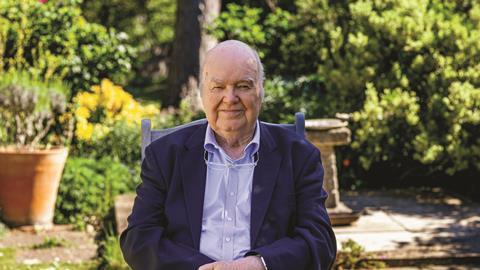
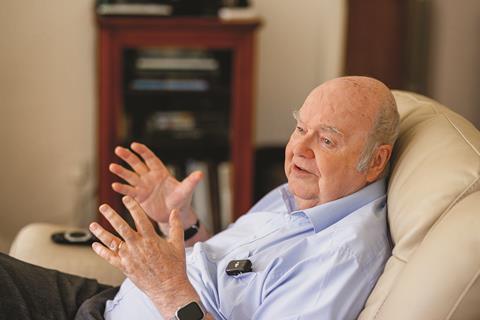
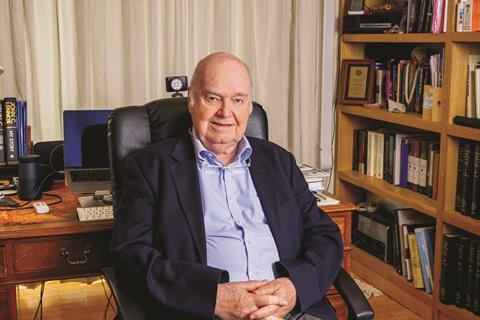
Lennox is generous with his time, posing for our photographer in his beautiful garden as well as his well-equipped home office, from which he now fulfils many of his speaking engagements remotely. I can’t help scanning the bookshelves: an Atlas of Bird Migration sits alongside John Grisham novels, and several weighty volumes on Darwinism.
Having spent the past few days reading the Northern Irishman’s sprawling 500-page autobiography, I’m eager to capture something of his life story in our interview – while privately suspecting that our allotted hour will barely scratch the surface. My Story (SPCK) is a remarkable read, not least because it recounts for the first time Lennox’s evangelistic missions behind the Iron Curtain during the 1980s.
Reading the book, I realised I had misunderstood Lennox. Yes, he is the Christian apologist best known for taking on New Atheists such as Richard Dawkins in debates which have been viewed millions of times on YouTube. But Lennox’s deepest passion is evangelism, which is very different from merely winning arguments.
This is a man who is as warm-hearted as he is sharp-minded, frequently deploying his trademark Irish wit. In the book he recalls a Communist guard who tried to stop him taking Bibles into China. Lennox quipped: “Really? Are you sure? I’ve been in many countries, but never in one where there were already so many Bibles that they didn’t want more!”
Tell me, what have you to offer me that’s better than what I have in Christ?
Denied a television as a child, the young Lennox spent much of his time reading books. Today he speaks four languages fluently – English, French, German and mathematics. At the age of 80, he started learning biblical Hebrew.
Over the course of his career, Lennox has written numerous influential books, including God’s Undertaker (Lion), Can Science Explain Everything? (The Good Book Company) and, more recently, God, AI and the End of History (SPCK), a commentary on Revelation. Yet he speaks about this body of work with characteristic modesty. “I’d love to have done a lot more,” he says, “but I’ve done at least some.” It’s rather like the head of NASA shrugging: “Well, we’ve travelled a little bit…”
Writing the autobiography itself took some persuading. “A large part of it is a story that has never been told before – by me or anyone else – and I’m the only one left to tell it,” he explains. “So many friends said: ‘You must write this down before it’s lost.’”
I for one, am glad he did.
Why were you reluctant to write your autobiography?
Talking about yourself is very risky – particularly for a Christian. The central focus should not be on us, but on Christ.
What persuaded me in the end was reading Acts, where Paul comes back to Antioch and shares with the church what “God had done through them” (14:27). It suddenly occurred to me that if my story is intimately bound up with what I believe God has done with me, surely I can share that in such a way as to be evangelistic.
In your teens and 20s you developed a passion for expository preaching and Bible study. Was that your first love before the science and faith conversation?
Oh, very much so. And it still is. I had a brilliant mentor who taught me how to think biblically and mentored me for nearly 50 years – Professor David Gooding. He opened scripture to me, and I loved it from the word go, because it appealed to my sense of order and logic. It really embedded in my mind the importance of getting to see precisely what scripture says, and its logical and literary structure, before you delve into what it means.
It’s led to a public ministry that has taken me all over the world.
In the 1980s you were teaching mathematics at the University of Wales in Cardiff, while secretly travelling on weekends throughout Hungary, Poland and the German Democratic Republic. You’ve never spoken about this publicly until now. Why is that?
Well, I was an academic speaking fluent German and travelling mostly on my own behind the Iron Curtain. So, it’s a bit suspicious and, from a practical point of view, my colleagues would never have understood it.
I often left Cardiff on a Friday night, did twelve hours Bible teaching, and was back by Monday morning, which is pretty intensive, but I just found that it was wiser to keep quiet about it.
At one point, you suspected the authorities of listening in on you while staying in a hotel room…
Oh, I was listened to. It was quite obvious. The particular event happened in what used to be called Karl-Marx-Stadt, now Chemnitz. I stayed in Hotel Moskau. It was a huge hotel but several times I was given exactly the same room. When you went in through the door, there was a kind of blinding flash in the lock, and a few moments later, the telephone began to hum. It was really hilarious.
One night, the telephone was annoying me. I was trying to sleep. So, I picked up the receiver and said in German: “Good evening, gentlemen. I don’t talk in my sleep, at least I don’t think I do. In any case, it won’t be interesting, and I’m sure you‘d like some sleep. I certainly would. So why don’t you just switch it off?” And they did.
Why were you being spied on?
The Communist authorities were very worried about Western political criticism. Some Christians visiting from the West were given an opportunity to speak to a Hungarian audience. They were very unwise and started criticising the government.
There was one incident in Hungary where the church leaders were told by the police that they must never allow a certain person to speak again, because they’d started upbraiding the Communist government. Then they said: “Why don’t you ask Dr Lennox again? We know him and he’s OK.”
I went many times. They wanted me to expound scripture, because they got so little of it. There was huge hunger.
I loved the story about the waiter who was desperate for a Bible.
Oh yes, that was very moving. That was in Kyiv, Ukraine. He was a humble-looking man in his 60s and he said: “Sir, is that a Bible you‘re reading?” I said: “Yes.” He said: “I’d love to have a Bible.” I got a New Testament for him in Ukrainian, and I could see two things, joy and disappointment. I said: “What’s the matter?” He said: “I‘m so pleased to have this, but I’d love to read the stories of Abraham and David.” My heart went out to him, so I went up to my room, got my Russian Bible and gave it to him. He stood there weeping.
A crucial turning point in your life came when you encountered a Nobel Prize winner as an undergraduate student. Tell us that story.
I always played Socrates, and still do, asking people questions. So I plunged in and asked this person about the research that he’d done to win the Nobel Prize. Then I said: “Did it ever occur to you when you discovered the intricacies of these processes that there was a mind behind the universe?” He stiffened and said: “No.” The conversation finished – he wasn’t going there. But at the end of the meal, he said: “Lennox, come to my room,” which was not an invitation, but a command.
To my surprise, he’d invited several other senior people. He sat me down and said: “If you want a career in science, you need to give up this naive faith in God, because it will cripple you intellectually. You’ll never make it. So, give it up now, in front of witnesses.” It was an enormous pressure.
I resolved to put arguments for God and Christ into the public space, give them the evidence and let people judge for themselves
I said: “Tell me, what have you to offer me that’s better than what I have in Christ?” He said: “There’s the philosophy of Henri Bergson.” It was a very bad choice, because Bergson actually thought of converting to Catholicism at one stage. I said: “If that’s all you’ve got, I’ll take the risk. I’ll stay with Christ.” I got up and walked out.
That moment changed many things for me. It taught me a lot about the unacceptable face of academia and the misuse of authority. I made up my mind that if ever I got to the kind of position I’m in today, as a professor at Oxford, I would never use my position to abuse anybody intellectually. And it did occur to me that if he’d been a Christian and I’d been an atheist, he’d probably have lost his job for doing what he did – such is the non-level playing field.
I resolved, as best as I could, to put arguments for God and Christ into the public space, give them the evidence and let people judge for themselves. And that’s what I’ve been doing for the rest of my life. I suppose it was a preparation for meeting lesser intellects, like that of Richard Dawkins.
You debated Dawkins in the early 2000s, at the height of the interest in his book The God Delusion (Bantam Press). Do you have the New Atheists to thank for inadvertently providing a platform for you to share the good news?
Oh, surely. In that sense, I owe Dawkins a lot. He gave me an international platform overnight.
Following your first debate with Dawkins, you were very unwell – and this seemed to become a pattern. What happened?
It is odd. Only a short time afterwards I nearly died. My right coronary artery was completely blocked, and [the doctors] just managed to save my life. It was quite staggering, even to the doctor who operated. He told me that I should be dead and, even if I survived, I should have had about a 5% quality of life. He said: “Look, your heart isn’t even damaged. I put a stent in; you can go home tomorrow.”
I don’t know if there’s any connection or not with the stress that came with preparing for that debate. It was a huge effort, because I take these things very seriously. In a sense, the gospel was on trial. I couldn’t avoid that. So much trepidation and a lot of hard work went into that, and possibly the stress contributed to it. I just don’t know.
How did that period of time shape you? Did it change anything?
I think if anything, it strengthened my faith. The Lord tests us to see if we’re real, I suppose, and if all that I held to during my life is true, it ought to be robust enough to sustain this. But I also felt that if we don’t challenge these people, they get away with it. Circumstances arose that put me in a position I never asked for. So, I felt: Well, Lord, You need to help me here. I got one opportunity after the other. And I still get letters from people who were converted after watching it on YouTube!
In your debates, you strike me as someone who wants to win the person as much as the argument.
It is enormously important. We need to show respect for one another. If you get angry or start ad hominem arguments [that attack an opponent’s character, motive, or personal traits instead of engaging with the issue being debated], you’ve lost the plot completely. I go out of my way to befriend others, to understand why they are so angry. Friendship and respect don’t mean you have to compromise with truth. Paul puts it brilliantly: “speaking the truth in love” (Ephesians 4:15). You can even show affection to people without compromising truth. And with God’s help, that’s what I’ve tried to do.
Do you think you made any progress with people like Dawkins or Hitchens on that relational level?
Oh, that’s very hard to evaluate. I’m encouraged by the fact that people sometimes move incrementally towards the Christian faith.
It would be wonderful if Dawkins ended up like Saul of Tarsus and was converted – I pray for him.
You quote 1 Peter 3:15: “Always be prepared to give an answer to everyone who asks you to give the reason for the hope that you have. But do this with gentleness and respect” frequently in the book. Has that been a life verse for you?
Well, it’s one of them, and it’s a very important one. But it was a long time before I noticed its implied context – people asking you for a reason. So, there’s a challenging question – how do I live and talk in such a way that people will realise I’ve got a hope and ask me about it? I often say to people: “When was the last time anybody asked you the reason concerning your hope?” and heads all look at the floor.
You’ve been compared to CS Lewis. Is that a fair comparison?
Lewis was a genius. I’m not a genius. I listened to Lewis in Cambridge, and I owe him a huge amount.
But you could argue that CS Lewis was the foremost apologist of his day and…
…Oh, evaluations like that don’t sit too well with me. They are for others to make. Sometimes I say that if I can see anything, it’s only because I stand on very tall shoulders. And Lewis supplied two of them.
You talk a lot in the book about how supportive your wife, Sally, has been in doing so much while you were away travelling and speaking.
Yes, that’s right.
And she never asked you not to go?
No, and that was a key thing before we got married. She committed herself to not standing in the way of anything the Lord called me to, and she kept to that magnificently, which is why the book is dedicated to her.
In a sense, the gospel was on trial. I couldn’t avoid that
It wasn’t easy, because some of my trips were a week or two at a time, which is a long time to be left with three children. She supported me way beyond what any person ought to be called to do.
So now that she’s not well, it’s my turn to look after her, which I do gladly because there’s a sense in which life has come full circle. She cared for me. I need to learn how to care for her.
How is your health?
I’m 82 and I’ve had a couple of bad years. I had a mild stroke, and I got shingles with a horrific consequence – Ramsay Hunt syndrome – which was extremely painful for a long time. I’m getting older and a bit wobbly, but it seems the Lord has left me with a pretty clear mind. So, I’m doing a lot of conferencing on Zoom. I’m not travelling. I’m staying here to look after Sally, but very grateful for each day as it comes, and grateful for the opportunity to talk to people like you.
How can we be praying for you?
Well, I think that the race is to be run. And I simply say: “Lord, enable me to complete what You have for me to do, and then please take me home quickly.”
To hear the full interview listen to Premier Christian Radio at 8pm on 13 June or download The Profile podcast
My Story by John Lennox (SPCK) is available now



















No comments yet