








The Pope’s letter Magnifica Humanitas raises vital questions about what it means to be human in an age of AI. Warning against the abuse of power, the encyclical asks: Is the advancement of artificial intelligence taking place at the cost of human dignity? Tony Wilson takes a closer look at the document
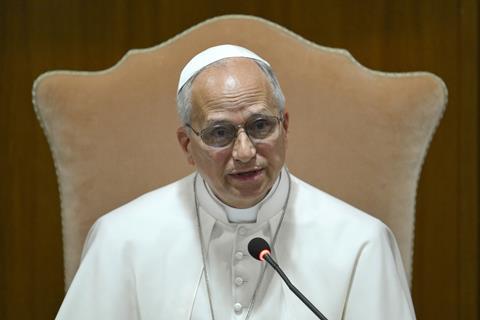
When Cardinal Robert Prevost first addressed the assembled crowds as the newly elected pope, he chose the name Leo with a clear nod to his predecessor of the late 19th century, Leo XIII. I imagine the inspiration for his first encyclical, Magnifica Humanitas (Magnificent Humanity) was already in his mind.
His predecessor’s Rerum Novarum (Of New Things) was published 135 years ago, at the height of the Industrial Revolution. It set out guardrails to defend the dignity of humanity from the excesses of capitalism on one side, and socialism on the other.
Magnifica Humanitas seeks to do the same in our time. While industrialisation threatened to dehumanise workers, this discussion paper asks what it means to be human in an age of technological revolution.
It’s worth stating that, as an encyclical, the Pope’s open letter is not issued with papal infallibility. It is addressed to the Christian faithful and to all people of goodwill – including people of other faiths and none. The inclusion of the Christopher Olay (co-founder of Anthropic, and an atheist) at the presentation of the encyclical underlines that this letter is intentionally broad in scope.
It is also not anti-technology. The pope makes it clear that he welcomes many of the educational, medical, social and business benefits that this new technology brings. And this is not overreach by the Church. As a mathematician, our new pope has all the qualities of mind to understand algorithms and the proper limits on computing technology. He clearly respects the proper domain of secular authorities to legislate but asserts the right for the Church to offer due diligence when human dignity is at stake. And he is well qualified to do so.
Pride and humility
Pope Leo grounds his thesis in two biblical construction projects; the tower of Babel (Genesis 11) and the re-building of the walls of Jerusalem by the returning exiles (Nehemiah).
The former is a work of human pride in which we set out to reach the heavens by dint of human effort. This is the project which sees humanity as having all that is needed to achieve perfection through incremental development. Liberal progressivism if you will.
The latter is one that starts with prayer and fasting before engaging the secular authorities for support. It then proceeds with a community project in which the walls are constructed for the common good, with each family assigned a part of the wall to build.
We have dignity that is worth defending simply because we are made in God’s image
A repeated theme throughout Pope Leo’s encyclical is the concentration of AI development in the hands of a few individuals who have sufficient wealth and power to be above government oversight. The development of AI builds walls for the protection and aggrandisement of a few, while the rest of us are vulnerable to exploitation.
Having swathes of personal data harvested, stored and potentially used against our best interests is not a vision of human flourishing. Similarly, the monetisation of our attention by feeding us AI slop and clickbait diminishes our rational and creative capacities.
Spreading misinformation under the guise of truth is the low water mark of utilitarianism, and inexorably leads to the subjugation of the people. The importance of good journalism as a bulwark against fake news is stressed in this encyclical.
Being human
Pope Leo contrasts a Christian worldview with the materialist dystopian vision of what it means to be human.
On the one side, we have a view that humanity is effectively a failed concept which needs to be corrected and optimised by technology. Those few with power and wealth control our access to data and services, justified on the grounds of looking after us.
As a further development, trans-humanism is the idea that technology will augment our capabilities - arguably this stage is already well-established. The logical conclusion of this is post-humanism, which thinks little of replacing the messy carbon-based intelligence with superior silicon-based AI.
If you start from materialist atheism, there are few logical objections to a programme of this kind.
The pope’s vision is what we might call Christian humanism (the first humanists were Christians after all, so let’s reclaim this title) – an anthropology based around who are in Christ.
Firstly, the incarnation of Christ grounds the central importance of embodied humans.
Secondly, humanity is evidently flawed, but we are not a failed project. AI developers might see our glitches as a bug that needs a software patch or upgrade (trans-humanism). Extreme technologists might see it as evidence we need to be eliminated (post-humanism).
We don’t need to need new coding, we need forgiveness, healing and salvation
The Christian worldview sees things differently. Our post-fall flaws mean it is inevitable that we all mess up. Our physical weaknesses leave us vulnerable to bodily breaks and bruises.
With a materialistic worldview, it is easy to see how a Babel-like project to perfect the human condition would involve our eventual replacement. But, for the Christian, the mess is the context in which we grow into the likeness of Christ. Looked at this way, the flaws are not bugs but features of a real human.
AI might be able to fool us that it feels empathy or emotions such as love, but these experiences are only available to body-soul composites. As personal, subjective entities we know what sorrow, pain and love feel like. We develop as people through exposure and our response to humanity in all its magnificence and frailty.
Ultimately, we will be fully forgiven, healed and restored through our status as brothers and sisters of Christ, being incorporated fully into his resurrected and ascended life. We will be partakers of the divine and trinitarian nature of Jesus, our saviour (2 Peter 1:4).
Prophetic wisdom
Pope Leo ends with a wake-up call, reflecting on the prayerful song of Mary when she meets Elizabeth as told in Luke 1:39-56. Mary sings with prophetic wisdom about the future reign of her son. He will scatter those who are proud in the thoughts of their hearts; he will cast the mighty from their thrones; and he will lift up the lowly, send the rich away empty and fill the hungry with good things.
In closing his encyclical with this prayer, Pope Leo puts the Church en garde. We must remember our preference for the poor and needy to ensure that lack of access to technology and data does not exclude and enslave.
We must, with a prophet’s vision, discern who are the rich, powerful and proud movers in the world of AI. We must work with all people of goodwill to put safeguards in place to preserve a grander vision of humanity than anything technology can deliver.






















No comments yet