










The courts have recently intervened in two high-profile cases involving family disputes over whether loved ones should be cremated or buried, with some citing Christian beliefs as the reason for preferring burial. Tony Wilson explains why some Christians hold to this belief
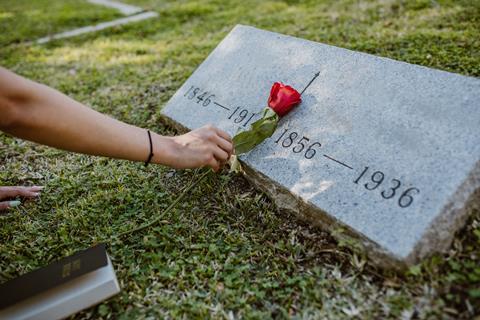
A dispute between the fiancée of a man who had died from cancer, aged 36, and his mother has reached the High Court.
Transport for London worker Simon Comerford took his own life in February a year after he was diagnosed with testicular cancer. His partner Toni Cameron has since become embroiled in a bitter dispute with Christian mother, Maria Comerford, who insisted her son should be buried and not cremated.
The High Court judge has now accepted that the mother followed the “strong preference” of the Roman Catholic Church for burial rather than cremation, but said her wishes were not determinative on account of her son’s secular beliefs and the preferences of his fiancée. This will allow Toni Cameron to go forward with the planned cremation.
The High Court reached a similar decision in the case of a 95-year-old British man who had lived in France for over 30 years and wanted to be buried near Paris. Referring to his “homemade written will”, the judge decided instead that he should be returned to England for cremation, at the behest of one of his warring sons.
These cases give us pause for thought about the reasons we, as Christians, say farewell to our loved ones in particular ways. The strong preference for burial over cremation – found in both the Eastern Orthodox and Roman Catholic churches - is based on principles that are worth examining.
Mind, body and soul
As a starting point, we need to recognise that Christian theology says we are body-soul composites and that both parts must be unified to make a human person. Our fears about dead bodies and disembodied spirits reveal a deeply held intuition that, on their own, both entities are incomplete and unnatural. Something essential is missing when these two core aspects of humanity become separated.
In choosing to resurrect Christ into new body, God reveals our ultimate destiny is to have a post-death reunification. We must surrender our Platonic or gnostic ideas that we will one day float about in an ethereal heaven in some disembodied state. God is going to re-create us to live in a renewed physical world.
The preference for burial is not from a misguided worry that God may not be able to assemble us should our atoms become too dispersed. No, the Christian hope is for all, even those who die in warfare or tragic accidents where nothing remains to be buried.
We are right to guard ourselves against superstitious practices based on bodily remains
For a better understanding, we must start with the Bible. Stephen was one of the first deacons of the Church and the first Christian to be martyred according to the book of Acts. We read, in Acts 8:2, that “devout men buried Stephen and made loud lamentation over him.”
Since then, the Church has taken it to be an act of charity and mercy to respectfully bury the body after death.
We also have early accounts of Christians like Ignatius, the Bishop of Antioch, who discipled under John. He was martyred by wild beasts in Rome around 108AD. Approximately 50 years later, Polycarp was martyred in a similar way. Records show that members of their churches, at some risk to their own lives, gathered their mortal remains from the arena and interred them with great respect.
In chapter 18 of The Martyrdom of Polycarp, we read about the centurion’s decision to gather up Polycarp’s bones, which are “more valuable than precious stones and finer than refined gold” and lay them “in a suitable place where the Lord will permit us to gather ourselves together, as we are able, in gladness and joy, and to celebrate the birth-day of his martyrdom for the commemoration of those that have already fought in the contest, and for the training and preparation of those that shall do so hereafter.”
Similarly, the collection of the bodies of Christian brothers and sisters in the catacombs of Rome was motivated by respect and for liturgical reasons (not to hide from Roman authorities as some erroneously claim). Evidence shows that the early Christian communities gathered to celebrate the Eucharist in the catacombs from earliest times.
Remembrance and more
But why should Christians treat the bodies of the dead in this way? And should we persist in a strong preference for burial over cremation?
Jesus uses touch and physical substances like mud in many of His healings. Our physical nature means that our bodies - and the material things around us - can be an effective means of communicating God’s grace. The healing ministry in churches today makes space for the laying on of hands and anointing oil for this reason.
In Mark 5:25-34 we read of the woman healed by touching the hem of Jesus’s garment. She received her healing even before Jesus was consciously aware of what happened. Only subsequently did He turn to ask who had touched His clothes.
Perhaps to the surprise of the first Christians, God used items as mundane as handkerchiefs and work aprons that had been in contact with Paul as means of effecting healing and exorcism.
We are right to guard ourselves against superstitious practices based on bodily remains or the personal objects touched by saints during their lives. The relics themselves are simply witnesses to the life of a Christian, saved by God, and that are still used by Him to communicate grace or perform a miracle. The source is always God working in and through His people.
The Christian hope is for all, even those who die in warfare or tragic accidents where nothing remains to be buried
In reflecting on these healings associated with physical objects, it is reasonable to see why early Christians would collect and revere the bodies of their departed loved ones. Even now, every Roman Catholic and Eastern Orthodox altar has a relic of a saint buried underneath it.
In a nod to Revelation 6:9, we consider it an important reminder that our worship is shared within a broader communion of the Church Triumphant, including those who are held in the love of God after death.
Cremation, at least in the UK, has become the preferred way of committing ourselves to the earth. The older established churches retain their preference for burial for one more important reason. Having a marked grave within a place reserved for burial is itself a witness to the hope we have in Christ.
To be scattered in some remote beauty spot or on the pitch of a football team might strike us as “what they would have wanted”, but does it also give way to nihilistic thinking? Perhaps we need to rid ourselves of the spooky connotations of graveyards and see them for what they really are; a testimony to the God who will raise us up.
In the words of Job 19:25-27: “For I know that my Redeemer lives, and at last he will stand upon the earth; and after my skin has been thus destroyed, then in my flesh I shall see God, whom I shall see on my side, and my eyes shall behold, and not another. My heart faints within me!”






















2 Readers' comments