











The martyrdoms of St Peter and St Paul have long been cited as evidence for the truth of Christianity. But how strong is the historical case - and what does their extraordinary witness teach believers today?
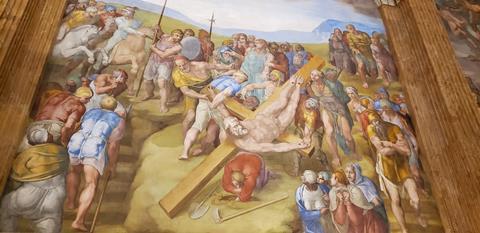
Michelangelo, the great renaissance artist, is universally acclaimed for his Creation of Adam, a magnificent fresco stretching across the ceiling of the Sistine Chapel. The work provides a powerful representation of the intimacy between God and man in the moment of creation. Only a stone’s throw away, however, in the nearby Pauline Chapel, a lesser-known masterpiece takes a very different theme.
Michelangelo spent his final years painting his Crucifixion of Peter (pictured, above), depicting the martyrdom of this great apostle.
In a much-celebrated act, Peter supposedly requested to be crucified upside-down, rejecting any parallel between his and his saviour’s deaths. Michelangelo portrays the upended apostle bound to the cross, in the act of being raised, his torturous death just moments away.
While Michelangelo could look to scripture to inspire his Creation of Adam, the tradition behind Peter’s martyrdom comes from extra-biblical writings. His death was often considered alongside Paul’s, who was beheaded under the Emperor Nero. A range of early sources comment on the deaths of both apostles, but aside from the martyrdom of James recorded in Acts 12, the Bible says nothing about the ends of the apostles. A single complete record is only finally supplied by the church historian Eusebius, who wrote his Ecclesiastical History in the mid-fourth century AD.
These events were not, however, Eusebian creations. Eusebius draws on several sources to support his claims, and it is evident that Christian communities across the ancient world were both aware of and fascinated by these apostolic martyrdoms. The subject clearly captivated Michelangelo too (he spent four years on his Crucifixion of Peter), and these events remain a powerful apologetic challenge. If the apostles were willing to die for the Gospel they proclaimed, they must have been utterly convinced of its veracity. You wouldn’t die for something you knew to be false, would you? Similar questions are regularly posed in apologetic talks or texts today, and we can understand why. If these men really did suffer and die for their faith, they provide compelling evidence for its historical foundation.
But how confident can we be in the truth of these apostolic martyrdoms?
The evidence
Let us consider just these two examples of Peter and Paul, for the historical record suggests both men really were martyred for their Christian faith, bringing a deeper sense of meaning to Paul’s bold declaration in Philippians 1:21 that, “for me, to live is Christ, to die is gain.”
Eusebius twice describes these martyrdoms. One brief passage in the second book of his Ecclesiastical History (2.25.5) confirms that Paul was beheaded in Rome, and Peter crucified, before a lengthier description of the suffering and martyrdom of both men in Book Three (3.1.2-3) adds the striking detail about Peter’s upside-down crucifixion. While this latter detail is only loosely supported by earlier sources – the second-century apocryphal Acts of Peter is the sole early source for this element of the tradition – the martyrdoms of Peter and of Paul are widely acknowledged across the literary record of the earliest Christian communities.
As well as referencing archaeological evidence, Eusebius either quotes from or cites works by Caius of Rome (c.200 AD), Dionysius of Corinth (c.175 AD), Tertullian of Carthage (c.200 AD) and Origen of Alexandria (c.230 AD) to support his claims, demonstrating the breadth (and geographical spread) of the historical record for these martyrdoms. The earliest Christian communities quickly spread the stories of their deaths.
These martyrdoms are attested well beyond the sources Eusebius includes. Various second century Apocryphal Acts (such as the Acts of Peter) provide further evidence, as does Irenaeus of Lyons (c.180 AD) in his Against Heresies (3.1.1). An early canon list, the Muratorian Canon (c.170 AD) also mentions Peter’s martyrdom (l.37). The list only grows if we look later in antiquity. Peter of Alexandria (c.306 AD), Lactantius (c.315 AD), John Chrysostom and Jerome (both late fourth century AD) provide just a few examples of further voices.
More than apologetics
These accounts were widely accepted throughout the first Christian centuries, but the way they were discussed presents us with a fresh challenge in the 21st century. While we are often tempted to reserve such examples of spiritual resolution for apologetic ends, our earliest sources dwelt on the potency of these martyrdoms for Christian believers. Our two earliest references to these deaths reflect on the power of these apostolic examples.
Ignatius of Antioch (c.110-115 AD) was a notable early church leader and seven of his epistles survive. He alludes to Paul’s death in his Epistle to the Ephesians (12.1-2), but in a rather moving letter to the Roman church he reflects on both martyrdoms ahead of the looming reality of his own: “Pray to the Lord on my behalf, that through these instruments [of execution] I may prove to be a sacrifice to God. I do not give you a command as a Peter or as a Paul. They were apostles, I am but a condemned criminal. They were free, thus far I am but a slave. But if I suffer, I will be the freedman of Jesus Christ, and will rise up free in him.”
Paul and Peter both considered the blood of Christ more precious than even their own lives
Ignatius writes with evident emotion. He went on to meet his earthly end in the brutality of the Roman arena, his body torn apart by wild beasts. As he faces this savage death, Ignatius considers the models of Peter and Paul. These apostles exemplify his impending movement from human condemnation to eternal freedom. By referencing them in this context Ignatius encourages his readers to pray with confidence about his coming martyrdom. As for Paul, so for Ignatius, to die truly was to gain.
Clement of Rome (c.95 AD) was the author of an epistle to the Corinthian church (planted, of course, by Paul himself only four decades earlier) now known as 1 Clement, Clement was a Roman church leader, and his own reference to the martyrdoms of Peter and Paul is similarly freighted with emotional resonance: “Let us consider the noble exemplars of our own generation. Because of jealousy and envy the greatest and most righteous pillars [of the church] were persecuted and fought on to the death. Let us set the good apostles before our eyes. Peter, through unrighteous jealousy, endured not one or two but many trials, and thus, having made his testimony [his martyrdom] went to the appointed place of his glory. Due to jealousy and strife Paul showed the way to the prize for patient endurance. After he had been in chains seven times, had been sent into exile, had been stoned, and had preached in the East and in the West, he won true glory for his faith … and when he had given his testimony [his martyrdom] before the rulers, he thus departed from this world.” (1 Clement 5.1-7)
Clement highlights the example of these apostolic martyrs. This passage comes from a part of the letter where Clement urges his readers to flee the devastating seduction of envy and jealousy to embrace afresh the self-sacrificial nature of faith itself. As Clement continues: ”Let us attend to what is good and pleasing and acceptable in the sight of one who made us. Let us look steadfastly to the blood of Christ, and see how precious that blood is to his Father; for when it was shed for our salvation it brought the gracious gift of repentance to the whole world. Let us turn to every age that has gone before, and learn that, from generation to generation, the Lord has granted a place of repentance to all those wanting to return to him.” (1 Clement 7.3-5)
Testimonies to the truth
Paul and Peter, in dying for their faith, exemplified the Gospel they both preached. When the blood of Christ is considered more precious than the riches of this world, even death itself becomes no great price to pay.
These apostolic martyrdoms, widely acknowledged and supported by the historical record of the Christian faith in the first centuries AD, certainly stand as powerful testimonies to the truth of the Gospel message. Surely, these men would not die such gruesome deaths for a message they did not wholeheartedly believe to be true? But many of these ancient sources don’t prioritise their apologetic force. They instead serve as models for those who already believe the Gospel these apostles died for.
Michelangelo painted his Crucifixion of Peter in the newly constructed Pauline Chapel in the mid 16th century. The Chapel stands as a monument to the wealth and power of the renaissance Catholic Church. Perhaps Michelangelo too recognised that the powerful witness of these apostolic martyrdoms was not simply an apologetic tool designed to challenge the unbeliever with the confidence of these first Christian witnesses? Perhaps he too recognised that, like Ignatius and Clement in those first decades after these brutal events, their powerful witness poses a challenge to the believer too.
Paul and Peter both considered the blood of Christ more precious than even their own lives. We would do well to reflect on our own hearts; can we truly say the same for ourselves?



















No comments yet