




It’s 500 years since William Tyndale first translated the New Testament into English. This monumental piece of work came at great personal cost, as Jenny Sanders explains
Accessing a Bible in multiple versions is now easy for all of us. But this wasn’t always the case.
Five hundred years ago, church services were held in Latin, people were often poorly educated and many relied on clergy, church art, stained-glass windows and mystery plays to learn biblical stories. The Bible itself was largely inaccessible to ordinary people.
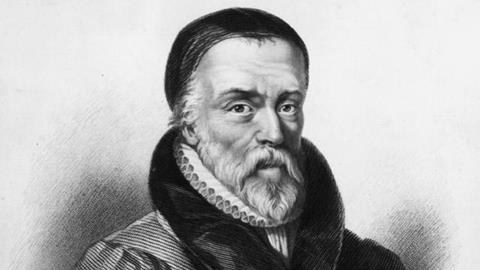
William Tyndale would change this dramatically. Known as “the Father of the English Bible”, he laboured to see God’s word made available from the pavement to the palace, challenging the power and wealth of the Roman Catholic Church and the stifling grip of penance and indulgences that impoverished parishioners throughout the country.
Tyndale began life in a prosperous Gloucestershire farming family, with links to the wool trade. He received a good education at Magdalen College School in Oxford studying Greek and Latin, before progressing to Oxford University and then visiting Cambridge. There, ‘modern’ scholars encouraged discussion, debates honed theological clarity and increasingly, exposed Tyndale to the disconnect between priests and people.
By 1517, the Reformation was sweeping Europe. Martin Luther nailed his 95 theses to the door of Wittenberg Castle Church and, four years later, the Chancellor of Cambridge ordered Luther’s books to be burned.
Around this time, Tyndale returned to Gloucestershire and spent two years tutoring the children of Sir John Walsh at Little Sodbury. He also preached locally and began to hone his idea of translating the Bible into English.
Before the advent of the printing press, handwritten copies of John Wycliffe’s Bible (written in 1380) were translated from the Latin Vulgate and laboriously copied and shared. Inevitably, mistakes crept in, until many considered it compromised and corrupted. Tyndale was intent on returning to the original sources of Greek and Hebrew to produce a fresh, new translation.
In 1523, Tyndale travelled to London to seek permission from Bishop Cuthbert Tunstall for his work. He refused, and Tyndale was forced to go abroad to pursue God’s call.
Much of his work was done in secret, first in Hamburg. Wittenberg, and, then Cologne. At these places he had access to all the books he needed, including Luther’s German translations, and could work in an environment where Protestant ideas were flourishing.
Printing was prospering here too, and Peter Quentel was the sympathetic printer commissioned to print 3,000 copies of the first completed New Testament. Unfortunately, the plan was discovered, the authorities alerted and shop raised. Tyndale and his assistant, William Roye, escaped under cover of darkness, taking the first 22 chapters of Mathew but leaving behind printed sheets, notes and typefaces
Tears, joy and awe accompanied the discovery that God was now speaking to people in their own language
Arriving in Worms, in southwest Germany, they found another printer, Peter Schoeffer, who finished the task. These contraband copies were smuggled into England in bales of cloth, wine barrels and bread deliveries before being disseminated around the country.
In February 1526, Tyndale’s New Testament translation was complete. Dispensing with archaic expressions, he returned to the original sources of the scriptures, keeping the language simple and the concepts clear, while his rigorous scholarship ensured it was an accurate rather than derivative translation. Using new movable-type printing presses, multiple copies could be mass-produced more cheaply than ever before.
Those who received the pocket-sized, smuggled treasure knew that it was an imprisonable offence, but it was also revolutionary. Tears, joy and awe accompanied the discovery that God was now speaking to people in their own language.
Copies had to be hidden beneath floorboards, behind walls or in the thatch, but Tyndale’s work meant the saints were finally being equipped. Those who could read shared the scriptures with those who could not, and many memorised as much as they could. Consequently, the thirst for education began to grow, but the clergy were not rejoicing.
Bishop Tunstall called it a “pestilent and pernicious poison” that would “infect and contaminate the flock”. Copies were confiscated and Tunstall commissioned merchants to buy up the stock and burn it publicly to intimidate and discourage potential readers.
But ironically, the money spent on purchasing copies allowed Tyndale to continue working on the Old Testament. The Pentateuch and Jonah were completed in 1530; work then began on Joshua through to 2 Chronicles.
A few years later, Tyndale was betrayed by a false friend, Henry Phillips, a man desperate for money. Imprisoned for more than 18 months, William Tyndale refused to recant and despite pleas for his release, died a martyr’s death, burnt at the stake in Vilvoorde near Antwerp (modern-day Belgium) in 1536. Throughout all that he endured, he remained resolute, faithful and courageous. Some believe that his jailer and members of that household were saved as a result of Tyndale’s testimony.
His execution was marked by the famous last words: “Lord! Open the King of England’s eyes.” And by 1539, there was an English language Bible in almost every church in the country, large portions of which were drawn directly from Tyndale’s pioneering work.














No comments yet