









The UK’s Jewish community needs to know that the Archbishop of Canterbury’s views on the Israeli-Palestinian conflict do not speak for all British Christians. That’s according to Dr James Patrick of the Love Never Fails alliance, who says both yesterday’s General Synod vote endorsing Kairos Palestine II and Sarah Mullally’s pastoral letter following her visit to the Holy Land, risk deepening divisions and presenting a one-sided account of the conflict
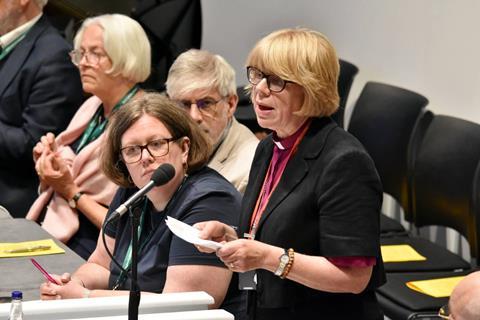
Dear Archbishop Sarah,
In light of the controversial motion passed at General Synod yesterday, your five-day pilgrimage in the Holy Land just three weeks ago could appear to be a well-timed advertisement in its support. Even so, your concluding pastoral letter wisely steered clear of the worst excesses of the Kairos Palestine II document commended in the motion. KPII accuses Israel 30 times of “genocide”, and claims that the State of Israel is “racist” and colonialist from its origins (1.3; 2.1; 3.3; 4.2), a listed example of antisemitism in the International Holocaust Remembrance Alliance’s definition adopted by the Church of England in 2018. It is no wonder that British Jewish and Christian leaders alike have expressed their deep concerns about this motion, which promotes incendiary accusations rejected by our own government.
Like you, we want to hear the suffering community that wrote KPII, and have no desire to silence them, even though they demand to boycott dialogue with any of us who respectfully question their claims (3.4, 12). We do not recognise their caricature of Zionism (1.3) as a desire to empty Palestine of non-Jews, using apartheid as a tool of ethnic cleansing and genocide. These horrific libels are disproven by the terms of the Balfour Declaration (1917), Israel’s Declaration of Independence (1948), and the clear evidence of 2 million Arabs having full equality under the law within Israel. The Jewish scriptures insist on equality and love for both Jews and non-Jews in the land (Leviticus 19:33-34), and Israel’s democracy is extremely diverse and multi-ethnic, with Arabs participating in every level and sector of society.
We naturally feel a deep solidarity with both indigenous groups in the land: the Jews who have shared their scriptures and rabbi Jesus and apostles with us, and the Christians who remained after Rome exiled many Jews. So, as fellow British Christians, we followed your recent visit with interest, hoping it would continue the noble Anglican legacy since the 1820s of care for both Jews and Arabs in the land. Here in Britain, our Jewish neighbours are eight times more attacked than any other minority, and official reports about the Jewish state have a direct impact on their well-being, whatever their own opinion about Israel’s policies.
Your pastoral visit was at the invitation of Archbishop Hosam Naoum, so it was only to be expected that its primary if not sole focus was on Palestinian Christians in the land. Their hardships and ministries certainly deserve attention and support. But following the example of the father in our Lord’s parable of the prodigal son, surely both the younger and older sons should hold a place in your affection? Sadly it seems even Christ Church Jerusalem was ignored, an Anglican congregation faithfully modelling reconciliation of Arabs and Jews.
Even among your chosen people group, your advisors failed to give you a balanced picture, suggesting that the greatest threat to Palestinian Christians is Israel and its “settler violence” (rightly condemned by most Israelis), rather than the Muslim Palestinian majority and attacks by local Muslim neighbours (with popular approval). Even Daoud Nassar whom you visited has suffered at their hands. It bears emphasising that throughout the whole Middle East, only in Israel is the Christian population growing. Your pastoral letter went further, blaming Israel’s fear of “potential danger” for the suppression of the Palestinian population, as if anti-Jewish terrorism is only imagined. You made no call upon wider Palestinian society to reject violence; on the contrary, you tacitly defended it. Others have already drawn attention to the serious lack of wisdom by your advisors, arranging visits with two young women who are both reported to have personal associations with terrorist groups.
The reality of antisemitic terror by Israel’s neighbours is undeniable in the “atrocities of 7 October”, which you witnessed at the Nova Exhibition in London shortly before your trip to the Holy Land. But if you take an extreme pacifist position, “We hold that war is never the answer”, this raises the question of how Israel might be expected to react to Hamas and other groups. Hamas always refused the “patient diplomacy” and “negotiation” you propose, so in such cases using “military force to resolve disputes” for self-defence (UN Charter, Article 51) is not “abandonment of international law”. On the contrary, Israel is now conducting “a vigorous defence of the rules-based international system” against Islamist regimes and their proxies “across the Middle East”, who are hell-bent on destroying both Israel and that system.
Your compassion for those suffering in Gaza is shared by all, and you rightly urge the international community to “relieve this agony”. Yet despite the UN Security Council Resolution 2803 agreeing a path for this, no country is willing to disarm Hamas except Israel, for the sake of Gaza’s civilians as much as for Israel’s. As long as the proscribed terrorist organisation Hamas rules Gaza, a “two-state solution” will not be possible.
Coming to the heart of the political and spiritual dispute, your pastoral letter implies that only when Jerusalem becomes a “shared capital” will “the religious rights of all faiths” be “fully respected”, citing the “Hashemite custodianship of the holy sites in Jerusalem”. Religious freedom should certainly be a high priority for Christians. But this statement confuses heroes and villains. It should be recalled that the Hashemite Jordanians destroyed nearly every synagogue in the Old City of Jerusalem, expelling all Jews and denying them access to the Western Wall, their holiest site, for 19 years from 1948 to 1967. Only restored Israeli authority in 1967 granted complete freedom of worship to all religions in the reunited holy city, which remains the case up to the present day.
Your pastoral letter began and ended with an invocation of God’s grace and peace. The church does indeed have a responsibility to act as a peace-maker. But this will be impossible if it presumes to pass motions and make political pronouncements on the complex and religiously sensitive dispute in the Holy Land, without actively committing itself to listen to the perspectives and feel the pain of those on the other side too. Jesus, our Jewish Messiah, showed love and respect for Samaritan, Jew, and Roman alike, and refused to allow His message to be co-opted by any side, including His own. His representatives today bear a sacred duty to follow in His footsteps. May God grant the Church of England wisdom from above as you seek His path.























5 Readers' comments