









Why do some books become instant classics while others fade into obscurity? Beatrice Scudeler says many of our most beloved stories have distinctly Christian themes, even if their authors don’t believe
The Christian story used to be at the centre of our culture.
The vast majority of visual art throughout the Middle Ages and Renaissance – from sculpture to painting to book illustrations – depicted either scenes from the Old Testament, or moments from Jesus’ own life. Literature, too, especially in the form of poetry, often centred around our desire to praise and grow closer to God.
As you may have noticed, Jesus’ story is no longer front and centre of our culture. And yet, as historian Tom Holland has been arguing for the past few years (see his popular book Dominion, Little, Brown), Western countries are still deeply steeped in Christianity. We may have forgotten who Jesus is; we may have turned Easter and Christmas into commercialised holidays. But our moral intuitions, whether we’re aware of it or not, are still fundamentally Christian.
As a literary critic by training, it fascinates me that the stories which most resonate with people reveal that we are still immersed in a Christian worldview. The more I’ve mulled over why certain novels become classics while others enjoy only brief popularity, the more I’ve realised how many of the most beloved contemporary books, even if they don’t explicitly deal with religious issues (and even if the author is not religious), have distinctly Christian themes and values.
A sense of the sacred
Take, for example, Donna Tartt’s The Secret History (Penguin), still a cultural phenomenon more than 30 years after its publication in 1992. Tartt has since converted to Catholicism, but she had no firm religious affiliation when she wrote her debut novel. And yet, a longing for God haunts the story.

In the absence of a life marked by sacraments, people will look for ways to grow closer to the divine elsewhere
Told from the point of view of Richard, a new student at a fictional college, the story is, in many ways, about what happens when a non-Christian worldview is taken to its logical conclusion. Professor Julian Morrow encourages his students to recreate a bacchanal, an ancient Greek ritual that was later adopted by the Romans, which consisted of using alcohol and dancing to achieve a state of ecstasy and communion with the pagan god Dionysus. Richard later finds out that four of the students, Henry, Francis, Charles and Camilla, have in fact succeeded, but that in their frenzied state they murdered a man who happened to be passing by. When another student discovers this, he is pushed off a cliff while the others watch. After months of covering up the two crimes, one of the four takes his own life, preferring death to prison.
Some of the students appear non-religious while others are said to have a Catholic background. However, none seem to believe that moral boundaries apply to them. In choosing pagan rituals to achieve transcendence and reach something divine, they find only suffering and death. Even their professor, a sophisticated intellectual who appears careless about the moral rules of Christian culture, is horrified to find out about the murders, and leaves the college.
There is a lot that is deeply tragic in The Secret History, but it is not an inherently hopeless novel. Instead, one of the very last moments of the story shows four students attending an Ash Wednesday service at a Catholic church. When one goes up to receive communion, unaware of its significance, the others stop him, implying that they are not allowed to partake in the sacrament as they are still in a state of mortal sin.
While they have spent the entire novel trying to see themselves as autonomous individuals who can do anything they want, these characters are still haunted by a sense of the sacred. They don’t respect Christian moral teaching, and yet they don’t dare receive the Eucharist because, on some level, they still believe in God and His righteous judgement. While the fate of their souls is ultimately left ambiguous by Tartt, the door is left open for redemption. If there is faith, be it “as small as a mustard seed” (Matthew 17:20), there is hope.
Life in all its fullness
While Tartt did eventually convert to Christianity – perhaps unsurprisingly, given how evident her interest in Catholicism is in The Secret History – other novelists whose stories have deeply shaped our culture are completely areligious. Kazuo Ishiguro is the author of books including The Remains of the Day, The Buried Giant and, my personal favourite, Never Let Me Go (Faber & Faber). If Tartt teaches us that even people who are utterly lost can retain a sense of the sacred, Ishiguro reminds us of the sanctity of life itself.

Set in a dystopian society where human clones are raised to have their organs harvested in an effort to extend the lives of non-cloned humans, Never Let Me Go centres around the lives of three clone students, Kathy, Tommy and Ruth. Hailsham, the school that they attend, is an experiment: while other clones are brought up in much harsher conditions, the teachers at Hailsham are part of a smaller group who think they should be treated humanely up until the point, sometime in early adulthood, when they are ready to donate their organs.
Never Let Me Go is another tragic story that nethertheless holds on to a sense of hope. Kathy and Tommy try to postpone their donations on the grounds that they are in love, but this is to no avail. Eventually Tommy and Ruth donate their organs and die, leaving Kathy alone to contemplate how brief their time on earth was. Despite her suffering, and knowing that she, too, will die soon, she holds on to her memories of happy childhood days: “I lost Ruth, then I lost Tommy, but I won’t lose my memories of them.”
Widely celebrated at the time of its publication, Never Let Me Go was made into a film with Keira Knightley, Andrew Garfield and Carey Mulligan in 2010. Now, 20 years after the book’s release, it has gained new significance amid debates around assisted dying. Ishiguro’s story doesn’t perfectly map on to our current situation, but it does draw attention to the one basic fact which Christians believe: that to exist, even if it is painful, is fundamentally a good thing.
Ishiguro has publicly stated that while he would not call himself an atheist, he is wary of organised religion. He isn’t someone that we could confidently point to as a ‘Christian’ novelist. But his interest in complex bioethical issues and his final insistence, both in Never Let Me Go and more recently in Klara and the Sun (Faber & Faber), that life is precious, is a sign that Christian moral teaching is still alive in our collective consciousness.
More than words
But Christianity, of course, is not just some abstract list of beliefs. Being a Christian means putting your faith into action through the way you live your life; reading your Bible, praying, showing up to church on Sunday, baptising your children and taking communion, among other practises.
Secular society is becoming increasingly distanced from such rituals. Humans, however, still need them. Tartt shows us exactly what happens in the absence of a life marked by sacraments: people will look for ways to grow closer to the divine elsewhere, often in much more harmful and self-destructive ways.
The choice to leave the door open to God’s existence saves the novel’s protagonists from complete tragedy
Rituals fulfil two basic human needs – communion with God, and communion with each other. Take baptism, for example. This is about entering into a life of faith in Jesus Christ and the Trinity, but it’s also about joining a community of believers. We are dependent on each other to foster our faith. As Jesus said: “For where two or three gather in my name, there am I with them” (Matthew 18:20).
Hamnet
Historical fiction is currently one of the most popular genres in the publishing industry. One reason that stories set in the past are so appealing to us now is precisely the prominence of rituals, the shaping of life through a commonly recognised liturgical year, where Easter and Christmas are about more than just presents and food.
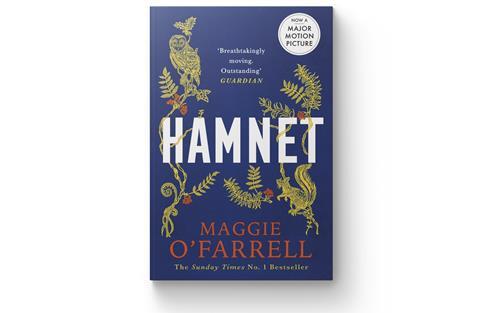
Take, for example, the enormous success of Maggie O’Farrell’s Hamnet (Tinder Press), recently adapted into an award-winning film. O’Farrell was born into an Irish Quaker family but appears to now identify largely as an atheist. Her novel’s protagonist, Agnes (an imaginative version of Shakespeare’s wife, Anne Hathaway), is portrayed as a nature lover, unorthodox in her beliefs. It’s a contemporary projection on to a real historical figure that reflects the current trend of identifying as spiritual rather than religious.
Upon first glance, there is nothing obviously Christian about Hamnet. Yet when the worst happens, it is once again the choice to leave the door open to God’s existence which saves the novel’s protagonists from complete tragedy. Hamnet focuses, as the title suggests, on the death of Shakespeare’s son of the same name. The scene of his passing is deeply painful to read – or watch. Agnes is heartbroken beyond description. Hamnet’s twin, Judith, is spared the sight of her brother’s death but eventually wants to see his body. When she asks her mother where Hamnet has gone, Agnes hesitates, breathing in to steady herself before responding: “To Heaven. And his body is left behind. We have to take care of it the best we can.”
Christianity still gives us a consistent framework through which to interpret the world and our place in it
Whether Agnes truly believes this is unclear. But it’s clear that she cannot bear to leave her daughter with a sense of despair. The only possible way to turn this tragedy into hope is to go through the ritual of burial, which Agnes and her husband complete despite their enormous suffering. The implied message is that one day, his body will be reunited with his soul in heaven. Whether she feels that this is true or not, Agnes and her family need this shared belief to survive.
These shared beliefs and practices can no longer be taken for granted in our society, and yet our desire for them still remains in our hearts. People still hold funerals and memorial services, though they may no longer believe in heaven. Some still choose to baptise their children and get married in a church because, although they wouldn’t describe themselves as Christians, they still search for a sense of the sacred.
The stories we tell
Christianity still gives us a consistent framework through which to interpret the world and our place in it. As CS Lewis once said: “I believe in Christianity as I believe that the sun has risen: not only because I see it, but because by it I see everything else.” When tragedy strikes, we still cling to a Christian sense of hope, whether that be in the form of believing in the intrinsic value of human life, as in Never Let Me Go, or acknowledging that some things are truly sacred, as in The Secret History, or clinging to shared Christian practices as in Hamnet.
The stories we continue to tell show that our society is not ready to give up on Christianity. It’s our job, as Christians, to point out that literature, in its truest and most beautiful form, sheds light precisely on our desire to grow closer to God.






















No comments yet