





How can your church ensure people living with dementia remain welcomed, valued and spiritually nourished? Rev Mark Wormell shares a wealth of practical tips
As a pastor in Sydney, Australia, I lead a short chapel service in a dementia ward. One week at the end of the meeting, the people – mostly in wheelchairs or using walkers – were waiting to be taken back to their rooms. Standing in the hospital corridor, and despite their dementia, they spontaneously started singing the closing hymn again from memory. God was with them; He gave them what they needed and they sang for joy.
It doesn’t always happen like that, but this remarkable occasion reminded me of God’s power to touch those living with dementia. Each person matters to God. The question for the Church is: Do they matter enough to us?
A dementia-inclusive church understands and supports the needs of people living with dementia, and those caring for them. The goal is not only to accommodate people with dementia, but to help them remain active and valued members of the congregation. This will involve not just the leaders, staff and volunteers, but the whole congregation.
Why should we do this? When Jesus calls us to “love…God with all your heart, soul, and mind” (CEV) and to “love your neighbour as yourself” (Matthew 22:37-40), it is a call to action. As scripture says: “Let us not love in word or in tongue; but in deed” (1 John 3:18, NKJV, my italics).
Love requires action – and becoming a dementia-inclusive church may involve a number of actions that bring about change.
Understanding the basics
Firstly, some learning may be required. I have found that running a seminar for the church is a good start – both because it helps church members care for those in their midst, and functions as an important step towards the church becoming a welcoming place for the whole community. You may find it helpful to invite an outside speaker who can explain what dementia is from a medical perspective, how it can affect individuals and what kinds of support may be needed. A speaker from a Christian organisation (see box) will also be able to offer guidance on the spiritual aspects of dementia care.
Around 1 million people are estimated to be living with dementia in the UK, a figure expected to rise as the population ages. It is the third major cause of death and affects one in 14 people over the age of 65 – rising to one in six people over 80. While it is primarily a disease that affects older people, younger-onset dementia can affect people from their 30s onwards.
Dementia does not diminish God’s love for us, take away our faith or prevent us from coming to Him for the first time
Most people associate dementia with memory loss but it is actually a term given to more than 100 conditions that can affect memory, thinking, bodily functions and behaviour. Often, it can be accompanied by depression. Psychiatrists are very clear that a little forgetfulness, particularly as we get older, is not dementia. Forgetting where we put the keys is completely normal. Forgetting what keys are for is not.
The most common form is Alzheimer’s disease, which usually affects memory. But there’s also cognitive dementia, vascular dementia, frontotemporal dementia, alcohol-related dementia, dementia related to Parkinson’s disease – and many more.
Each form has different symptoms and progressions and therefore requires different care. There are currently no known cures for the major progressive types, although progress is being made in detecting, managing and avoiding some of them.
Made in God’s image
After seeking to understand the basics, the next step is to remember that a person’s value is not diminished by any illness or disability, including dementia.
God made us in His image and He values each one of us. He gave His Son to die for you and I and has adopted us into His family forever. This is an irrevocable status, and means we are not defined by our access to our memories, our abilities, our capacity for relationships or any other scheme humans can devise.
Given that even death cannot “separate us from the love of God that is in Christ Jesus” (Romans 8:38-39), dementia certainly cannot. We do not cease to be loved by God if we get dementia. Nor do we cease to be a ‘neighbour’ because we live in a care facility and can’t get to church.
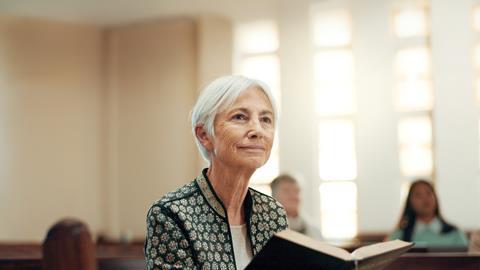
In one dementia-inclusive service, a woman in a wheelchair held her arms as if she was protecting herself. She had dementia and appeared to not take in the welcome, the Bible reading, the short sermon or the prayers. But when someone stepped up to piano and started playing, ‘At the name of Jesus’, she unfurled like a flower. A smile came to her face, and she sang every word from memory. God had sustained her faith, and her joy in Jesus brought joy to me.
Watching our words
The way we speak about dementia shapes how we think about and deal with dementia. Therefore, we need to be careful with our language. It is better to talk about “people living with dementia” rather than “suffering with dementia” or “being demented”. We are not defined by our illnesses.
It is best not use terms like “the lights are on but no one is home”, or “they have gone” when the person is still alive. We should never speak as if someone won’t hear or remember, as we just never know. People who have been uncommunicative for some time can have moments of startling lucidity. People living with dementia should be treated with the same respect as anyone else.
As Christians, we are used to dealing with fear, and Jesus addressed this on a number of occasions. However, for many in the West, dementia offers more immediate cause for fear than where our next meal will come from. Many people fear losing their minds and relationships. They fear losing control. And they fear being utterly dependent on others. Some fear losing their faith.
We need to recognise these fears and remember that God will help us with them. We must also be there for those who are fearful and love them as God loves us. Drawing on the words of Jesus, we can be confident to say that Jesus will never let us go (see John 10:28-29). He will always be there for us. And He will always be able to get through to us, even if our senses decline.
My sister worked as a nurse in a dementia ward. One of the people in her care had been abandoned by her family because she had become so difficult. Although not a Christian when she entered the facility, after a while she started going to the chapel services. When my sister asked why, she replied: “I have dementia. No mortal can help me, but maybe God can.” She added: “God will be there. He won’t walk away.”
Dementia does not diminish God’s love for us, take away our faith or prevent us from coming to Him for the first time. He can always see into our hearts.
A dementia-inclusive church can remind its members that God has made us to care for each other. This includes being prepared to receive care as well as giving it. A few years of dependent living is nothing compared to the joys God has for us in the age to come. And we need not fear what we will be like in that age. Our memories are not lost in dementia or death. As professor John Swinton says in his book Dementia (SCM Press), our memories are held in the hands of God.
Becoming a dementia- inclusive church
Whether you are organising a specific service aimed at people living with dementia, or want to make general changes to ensure your church activities are inclusive, the following pointers may help:
- Consider running a shorter service or services specifically designed to be dementia-inclusive
- Use simple, clear language in sermons and announcements
- Maintain familiar liturgies, hymns, prayers and routines, as long-term memories are often retained longer and even simple changes can be disorientating
- Help people who struggle with mobility get to church. A diagnosis of dementia is not a signal that we should give up on meeting together (see Hebrews 10:25)
- Communion and familiar church music are often the most significant part of the service for people living with dementia
- Review the physical environment for accessibility and safety. As well as ramps and rails etc, be aware of contrasts in flooring, as these can be disturbing to those whose visual perception may be affected by dementia
- Provide printed materials with large fonts and clear formatting
- Use clear, large-print signs for toilets, exits and key rooms
- Minimise unnecessary background noise where possible
- Keep room layouts consistent and avoid frequently rearranging furniture
- Provide seating areas for rest and quiet reflection
- Use the Bible carefully and sparingly. It still lies at the heart of how God speaks, but it may need supplementing with dramatisation, pictures and music
- Online services work for some people, but nothing replaces a smile, a warm hand or a chat with a friend.
A caring church
Many churches have pastoral care programmes for members seeking to grow in this area of ministry. These can be easily adapted to care for the specific needs of people with dementia and help others feel comfortable about interacting with them.
Basic communication techniques include speaking clearly and calmly, allowing extra time for responses, avoiding correction when someone is confused, and focusing on connection rather than factual accuracy. While patience is needed in most pastoral work, it is absolutely essential for people with dementia.
Dementia training should also cover recognising signs of distress and knowing how to respond compassionately. Those living with dementia may well have shorter attention spans, repeat themselves during conversation, be agitated during services and have difficulty following sermons. As a caring church, we should embody grace, inclusion and dignity over performance or memory.
Our value is not diminished by illness or disability, including dementia
When recruiting staff and volunteers, we should ensure that they really care about older people, including those with dementia. Some churches make a point of knowing what services are available from government bodies and charities, so that they can help people access these.
Your church may also want to develop a care programme that includes regular visits to people with dementia. Many people in care homes receive no visitors, and finding out whether local homes need help with chapel services or spiritual care can be an excellent way for a church to get involved in loving their neighbours in practical ways.
Some church members may find this daunting at first, even if they have known the individuals now living in care for years. But we can provide training and support, reminding them that God has made us for relationship. We visit not for what we get out of it but for the good of the person we visit, even if they do not show it.
I used to take communion to a woman with dementia who was 100 years old. She used a walker and was nearly blind, but she had followed the liturgy for decades and did not need a service sheet. She recognised my voice from our Sunday morning livestream, which she listened to with her 98-year-old husband each week. It was clear that, despite her dementia, the act of reaching out to take the bread and wine reminded them of who they were and who God is.
It is also important to remember that dementia affects the whole family. Caregivers often experience grief, even before death (known as ‘anticipatory grief’), exhaustion, burnout, guilt and isolation. They feel they are always on call. Therefore, churches need to be especially alert to the needs of carers. This might look like a support group, helping with transport or regularly checking in with families affected by dementia.
Some carers may choose to suffer in silence. Consistent emotional and spiritual support must be provided over the long-term, not just during crisis moments – and encourage carers in your congregation to access respite care.
A dementia-inclusive church ultimately communicates: “You belong here, you are valued and your spiritual life remains important regardless of changes in memory or cognition. “And for those who draw alongside people living with dementia, the rewards are rich, as you see God work powerfully in the lives of those coming to Him in utter dependence.
Where to find more information
Alzheimer’s UK offer a variety of courses for organisations who have contact with people living with dementia. alzheimers.org.uk
Anna Chaplaincy offer a spiritual care series for anyone seeking to support older people, which includes a session on dementia. annachaplaincy.org.uk
Pilgrims’ Friend Society offer one-off seminars that focus on caring for those living with dementia in a Christian context. pilgrimsfriend.org.uk/book-a-talk-with-us
The Church of England has online resources about dementia, and some dioceses offer specific dementia training. churchofengland.org
The Methodist Church has an online dementia-friendly churches hub. methodist.org.uk
Some denominations and charities offer the option to work towards a ‘Dementia-Friendly Church’ certificate. Check locally for details.






















No comments yet