



By choosing to be pictured with Palestinians who are allegedly linked to terrorist organisations, the Archbishop of Canterbury is hindering the peace process, argues Rev Dr Ian Paul
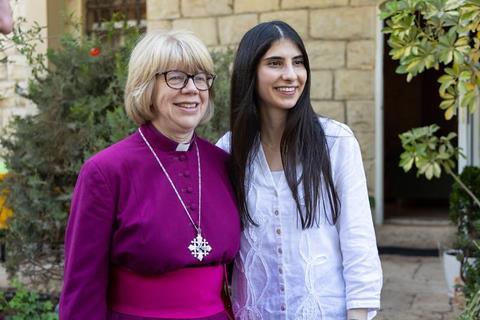
Michael Coren offered a robust defence of Sarah Mullally’s recent visit to meet Palestinian Christians from his own perspective as someone with Jewish heritage.
I agree with Michael that Archbishop Sarah has indeed made welcome statements against antisemitism in all its forms. And she went to the Nova exhibition in London, and met families of those slaughtered in the 7 October atrocities.
And yet both these, and her recent visit to the area, leave some serious questions to ask.
I was made aware of the visit because I suddenly noticed a rush of posts about it on Facebook. This wasn’t just the algorithm; I look at her feed and realised that her team were posting twice or three times a day.
I was only aware that she had visited the Nova exhibition because someone mentioned to me that there was one post on Twitter/X. I wonder why this was so much less visible on social media?
As part of her visit to the West Bank, she met Layan Nasir and her family; the three bishops (Gloucester, Norwich, and Chelmsford) has met the family earlier in the year. Was that a coincidence? No. Layan has because a cause celebre for Palestinian Christians, as she embodies the sense of injustice they feel, having been detained without trial by the Israeli security forces - ironically, under legislation left over from the British mandate, put in place to deal with terrorism.
But what was strange about this was the lack of curiosity about why she had been detained. What was she accused of? There was no formal charge from the Israeli security forces, but it only took me a few minutes to find out that she had been active in an organisation called Democratic Progressive Student Pole (DPSP). She had been involved in the organisation, welcoming new students to Birzeit University - but this is in fact the student branch of the notorious terrorist organisation, the Popular Front for the Liberation of Palestine (PFLP).
This organisation was founded by radical Marxist and Palestinian Christian George Habash. And it took part in the atrocities of 7 October, whose consequences Sarah Mullally had been learning just a week or so before.
It might be thought that Layan’s involvement was innocent, except I also found a post on her Facebook feed, with a photo, exclaiming in Arabic her support both for DPSP and PFLP. (She has since hidden it.)
Archbishop Sarah’s social media team posted on Facebook pictures of her praying with the family, standing in front of a portrait of her great uncle, Kamal Nasser, with Mary holding the baby Jesus in the background. Nasser is revered as another symbol of Palestinian struggle, as he was killed by Mossad in 1973. Why? Because he had been in the senior leadership of the PLO, and was believed to be responsible for organising the 1972 Munich massacre of Israel Olympic athletes - an event I am old enough to remember, which forever changed the world by putting Palestinian terrorism on our front pages.
Next in her visit, she is pictured meeting Archbishop Benedictus, and receiving a gift from him, standing directly in front of a portrait of Yasser Arafat, the person who more than anyone else led the PLO into being an international terror organisation, and in response to the Oslo Accords, initiated the Second Intifada, in which 1,010 Israelis were killed by suicide bombers, and 8,134 were maimed.
Archbishop Sarah then goes on to meet a young woman, with photos and videos posted on Twitter X; the woman is Zeina Barbar. Her father planted a car bomb in the Mea Shearim district of Jerusalem; she has been arrested on terrorism charges; and she has posted online her support for Samer Arbid, who commanded a PFLP terror cell that carried out a bombing against Israeli civilians, murdering 17-year-old Rina Shnerb, and injuring her father and brother.
Why does all this matter? Isn’t this an inevitable part of such a trip? No, for two reasons.
First, I don’t think there is any doubt that the Palestinian Christians that she visited were keen to ensure that she was pictured in these contexts. But a friend of mine, who had been interfaith adviser to a previous archbishop, was appalled. ”This should never been allowed to happen.” It is very striking that when Archbishop Sarah’s predecessor, Justin Welby, visited the region, he made sure that he met with - and was seen meeting with - people from both sides.
Secondly, visiting such a complex and contested area, and listening to only one voice while there, does not help the peace process - it actually makes it harder. When I last visited in 2018, in a trip organised by the Anglo-Israel Association, we met with people from every perspective - PLO, settlers, PLA politicians, those at the Keren Shalom crossing, and even the British ambassador. Unless you do this, it is impossible to understand the sensibilities and complexities - and it is just unwise.
One British Jew expressed his reaction to the visit like this: “Archbishop, compassion that travels only one road is not Christian witness; it is political theatre dressed in pastoral language…When a pilgrimage offers the world one people’s tears and not the other’s, it does not heal. It teaches the watching world that Jewish suffering is secondary — politically inconvenient, morally less urgent.”
The archbishop’s stated commitment to combat anti-semitism needs to be matched by her actions.
This weekend the General Synod is planning to ‘receive’ the Kairos II Palestine document, which falsely and offensively describes Israel as a “genocidal, apartheid, colonial” state. Jewish leaders have stated in the clearest terms that, if the debate goes ahead, it will do irreparable damage to Jewish-Christian relations.
In a Britain where Jewish children can no longer safely walk to school without taunts of “You don’t belong here!” and where every synagogue now must have armed guards - can we not do better?

















4 Readers' comments