








Archbishop Sarah Mullally has faced fierce criticism following her pilgrimage to the holy land, with some accusing her of taking sides. But Michael Coren argues that her willingness to acknowledge both Israeli trauma and Palestinian suffering reflects the difficult way of Christ
I’m 67, grew up in Britain, and have lived in Canada since 1987. Three of my grandparents were Jewish; my maternal grandma, Bertha Jones, was a blue-eyed, blonde-haired cockney. Am I Jewish?
It is, as they say, complicated. Probably not, according to Jewish religious law, but Jewish enough for antisemites. The champions of that obscenity, the Nazis, only required one Jewish grandparent for eligibility. I more than qualify.
I wasn’t raised with any particular religion but there was certainly a working-class Essex Jewish culture in the mix. I embraced Christianity in the mid-1980s, and was ordained an Anglican priest six years ago. I’ve always been aware of what antisemitism was but only occasionally experienced it and usually from people who hated almost everybody. It’s been that way for most of my life. Until now.
A visit under scrutiny
Since 7 October 2023, the sewers have breathed, hatred of Jews rejuvenated, and what was in the margins moved increasingly into the mainstream. If you doubt it, I’m sure you’re not Jewish. I don’t mean an informed criticism of Israel or even anti-Zionism, and I readily admit that accusations of antisemitism have been used irresponsibly to silence questions about Israel. No, this is different, this is real, this is sickening.
Which is why Jewish people have a perfect right to look to the Christian world for solidarity and support. If Christians, followers of the Jewish Jesus, had treated Jewish minorities properly over the centuries, it’s unlikely Israel would have become so vital. It’s also why there are some extremely strong opinions being offered about the Archbishop of Canterbury’s visit to her fellow Christians in Israel and Palestine.
Some of those opinions about Dame Sarah Mullally have been incredibly harsh and condemning. Some have accused her of taking one side in the conflict, others have alleged that she has ignored the dangers of Islamic extremism and persecution of Christians.
First, she’s repeatedly condemned antisemitism and stressed that tackling this evil is “not a problem for the Jewish community to solve,” but rather the responsibility of all of society. Shortly before the trip to the Holy Land she visited the Nova Music Festival exhibition in London, “It was deeply shocking and moving…and a privilege to meet with relatives of those who were murdered in the 7 October attacks,” she wrote reflecting on the experience.
Second, while the geopolitics of the Middle East aren’t always separate from antisemitism, they’re not irretrievably linked. Third, support for justice in Palestine, and horror at the persecution of Christians in parts of the Muslim world, aren’t mutually exclusive.
The gospel’s way
She’d been invited by the Anglican Archbishop in Jerusalem, Hosam Naoum, a man who has demonstrated a deeply impressive empathy and balance in his various statements.
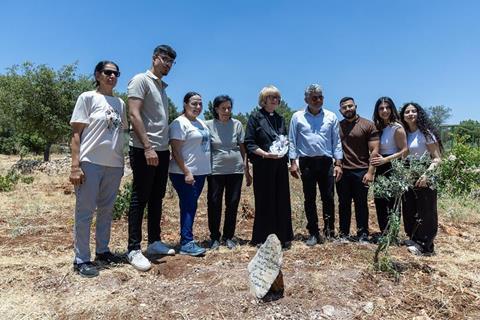
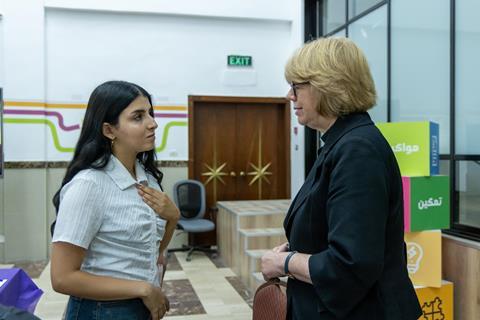
Indeed, in their joint pastoral letter after trips to Jerusalem, Nazareth, Bethlehem, Birzeit, and Ramallah, they wrote that, “Across Palestine and Israel, we met families that feel unmoored and traumatised by endless conflict. In Israel, the simultaneous fighting of many conflicts at one time, and the deep-seated aftermath of the horrifying atrocities of 7 October, have created a state of intense sensitivity to potential danger that has transformed society and politics. In the West Bank, unchecked settler violence, forced displacement, systemic discrimination, and expanding checkpoints have left the Palestinian population impoverished, desperate and powerless to enact change.”
As someone who has some familiarity with the politics of Israel and Palestine, and with the views of both the Jewish diaspora and international pro-Palestine activists, I assure you that this will be seen as either much too much or far too little. But then I’m also sure that she’d been told before the trip that the criticisms wouldn’t be confined to one source.
Surely, however, that’s the Christian way, the Gospel way, the different way. Palestinian Christians deserve a voice, the region is not at peace and two clashing realities show no sign of resolution, and extremism on both sides has only been empowered by recent events. Put simply, what else could and should the Archbishop of Canterbury have done?
Her pastoral letter spoke of seeing a church that “remains a place of encounter, hospitality, and witness. Through its schools, hospitals, and ministries, the Church defends human dignity and works for life lived in all its fullness. Amidst many hardships, we have witnessed a resilient Christian steadfastness that chooses love over hate and refuses to let despair have the final word.”
She has, to quote the 1940s jazz standard, taken “a chance on love” and that’s the godly thing to do. It may well be that not everybody she met on the trip shares her opinions and hopes but then surely Christ tells us that this is inevitable. As an Anglican I’m proud of her; as someone of Jewish lineage — equally so.
























1 Reader's comment