










When a social media influencer decided to ‘pretend’ God was real for 30 days, it was an experiment designed to gain followers. But after 20 days of reading the Bible, praying and practising gratitude, he experienced an epiphany. Does this mean you can you ‘fake it ’til you make it’ as a Christian? Andy Kind gives his view
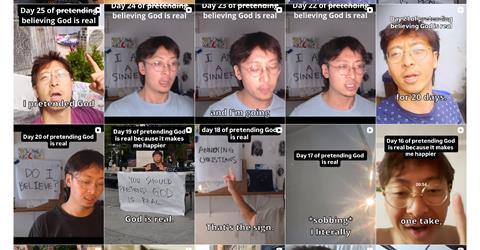
Brian Guan, one of the now countless Instagram influencers, set himself the challenge of spending 30 days pretending that God was real. As a way of attracting new followers and comments, that sounds like a pretty decent marketing ploy - Guan has worked in cryptocurrency, and so you might be forgiven for accusing him of mercenary opportunism.
The problem came when, after a mere 20 days, he decided that God was indeed real – and he has now become a Christian. More wood to fuel the fire for those who like to quip that God has a sense of humour.
It’s an interesting experiment, and observing him move through the stages of scepticism, playfulness, curiosity and hope is certainly engaging. The tearful confession which comes on Day 20 that, ”I can’t pretend anymore - this **** is real, dude” brought a tear to even this bruised evangelical’s eye.
Being a Christian is a last supper, not a teddy bears picnic
Having only come to this after the fact, flicking through the back catalogue of his experiences is akin to having God’s own view. After all, He alone knows the end from the beginning. How many people who currently seem so far from God is the Lord simply smiling down on, patiently waiting for them to reach their own Day 20?
One question that suggests itself here amid all the hallelujahs and I-told-you-sos from the #ChristiansofInstagram might be: Is this a legitimate way to invite people into a life of faith? My tl;dr answer is simply: “Yes, of course, why not?” Fake it till you make it, as I have never said before.
Blind faith
But hang on. Should we suggest to those close to us that they simply pretend God is real and hope for the best? Isn’t that what Christians are accused of anyway from some quarters: blind faith in a sky daddy they know, deep down, isn’t real?
For context, ‘pretending’ in Guan’s case is maybe a bit of a misnomer. It was more that he acted as though God was real. That involved reading scripture, praying and practising gratitude daily. If the Bible is indeed the word of God, and engagement with it (unlike my experience with cryptocurrency) doesn’t return void (see Isaiah 55:11) then it’s more the case that he lowered his barricades and the rescuer got it.
He stopped simply wondering if anyone was out there and, like the stranded hiker on the blizzard-beaten mountainside, decided to ask.
If I was a more cynical person (or more rooted in Reformed theology) I would say that most human beings spend their lives only pretending there isn’t a God, following the argument from Romans 1 that God’s “eternal power and divine nature” have been clearly perceived through what has been made, so that humans are “without excuse”.
That, however, is not quite where I land.
Trusting in something
The reality is that all of us put our faith or trust in something – or, indeed, in lots of things. Whether it’s the garden chair you’re about to rest your weight on, or the idea that your spouse will come home from work this evening, we cannot live a life of permanent uncertainty. We are simply not wired that way. And the universe itself is stitched together in such a fashion that putting your faith in something tends to yield a dividend.
You see it in the lives of those people who engage with cosmic ordering and ‘manifesting’. Some might dismiss that as errant nonsense, but it clearly isn’t just that. Why? Because the spiritual disposition of the cosmos allows for it. Simply put: faith works.
To my mind however, the problem with manifesting and the like is that it places the power to change and guide into the wrong hands – our own, or something more deceitful. It’s like the clay telling the potter what he should make. It’s a counterfeit. Faith works, but you have to put your faith in the right place.
All of us put our faith or trust in something – or, indeed, in lots of things
Overall, my feelings here are those of the apostle Paul in Philippians 1.18: ”But what does it matter? The important thing is that in every way, whether from false motives or true, Christ is preached. And because of this I rejoice.”
Initially, Guan’s spiel was “pretending to believe in God to see if it makes me happier.” I can guarantee that the rest of his life is not going to be an unbroken chain of fortunate events. Being a Christian is a last supper, not a teddy bears picnic. But to see someone open to God revealing himself, and to witness the obvious change of heart and mind taking place in real time, is a wonderful thing.
He may have started out pretending that God was real. God, to his credit, has never merely pretended. And because of this I also rejoice.






















No comments yet