












Chris Follett examines how the conflict in the Middle East is being read through an end-times prophetic lens and questions whether that perspective clarifies the Israeli-American military operations in Iran, or risks justifying them
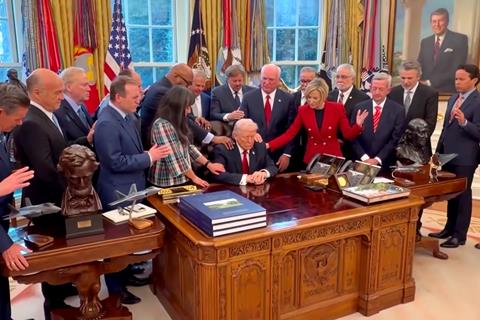
You may have seen the picture widely circulated in the media, just one week into Donald Trump’s war against Iran, showing him seated in the Oval Office surrounded by a group of 20 or so US evangelical pastors, laying hands and praying over him for his presidency and for the ensuing conflict with Iran.
Whatever one might choose to read into this event – be it the view that it is merely a PR opportunity designed to stroke Trump’s evangelical Christian base; or that Trump genuinely perceives the occasion to reinforce his personal belief that God has chosen him to fulfil some greater purpose for the US and the world – it is clear that for the pastors involved and the congregations they represent, Trump is still very much regarded as God’s man in the White House.
Faith takes the front row: Pastors lay hands on President Trump in the Oval Office!”
— Pvnch (@PvnchHQ) March 6, 2026
pic.twitter.com/faOTeHlnd1
For many evangelical Christians in the US, there can be no greater imperative for a US administration than to provide unstinting support to the state of Israel. Undoubtedly, President Trump has delivered on this commitment more than any other US president that has preceded him.
Notably, in his first presidency his administration recognised Jerusalem as the de-facto capital of Israel, when he took the controversial decision to relocate the US embassy there, and more recently by providing unqualified support to Israel, both politically and materially, in the war it has waged in Gaza.
The commitment to Israel amongst many evangelical Christians in the US arises from their belief that this nation is central to God’s purposes as the world approaches the biblical end times. They believe that the reemergence of Israel as a state in 1948 was no less than a fulfilment of the Old Testament prophecies that speak of God restoring the Jews to their former lands, which is regarded as a necessary precursor to Christ’s second coming.
Furthermore, many of these Christians also believe that the promise of either blessing or curse recorded in Genesis 12:3, can be extrapolated from Abraham and his immediate descendants to apply to the nation state of Israel today. They reason that by supporting Israel the US will remain under God’s favour, while those nations that choose to oppose or attack Israel will inevitably come under His judgement.
The war according to Ezekiel
The fact that the current war involves Iran – which corresponds roughly to the kingdom of Persia in biblical times – adds to the sense of this being a pre-apocalyptic event for some commentators. These believers would point in particular to prophecies in Ezekiel 38 and 39, which refer to an assault against Israel from the land of Magog (by Gog prince of Rosh, Meshech and Tubal). Persia is listed among Gog’s unholy alliance of nations that conspire to attack Israel and as Ezekiel’s prophecy unfolds the invaders are resoundingly crushed by the Lord.
The difficulty with trying to map any of the Old Testament prophecies (and indeed those in the New Testament) referencing the nation of Israel to modern events, is that you are necessarily in the realm of speculation. While there are some parallels that might be drawn between Ezekiel’s prophecy and the current conflict there are also some striking discrepancies. Not least among these is the fact that Israel is attacking Iran (albeit under some provocation), together with the involvement of the US as a third party, which is not mentioned in Ezekiel’s prophecy.
Clearly, any attempt to frame the conflict as some kind of divine mission runs the risk of seriously distorting the rationale for getting into the war
In this latter respect, some have sought to present this as a divinely ordained war, identifying the US forces involved as God’s chosen instrument of judgement against a nation that is emphatic in its opposition to Israel. It was reported in The Guardian newspaper, that complaints have been registered by some US military personnel, as their commanders have been talking about the current conflict in such terms.
From a political perspective, Israel’s motive for launching this war is reasonably clear – hit your enemy while they are at their weakest. For the US, it is telling that President Trump’s administration is struggling to articulate clear war aims, beyond the degradation of Iran’s military capabilities. Clearly, any attempt to frame the conflict as some kind of divine mission runs the risk of seriously distorting the rationale for getting into the war, given the huge ramifications it is already having for people both in the region and right across the world.
What does Paul say about Israel?
When considering the future of the Jews and the nation of Israel from a Christian perspective, the clearest teaching in the Bible on this question is provided by Paul in the book of Romans.
In chapter 11, Paul uses the analogy of an olive tree to explain God’s purposes for both the Gentiles and the Jews. Paul refers to the Gentile Christians as a wild olive branch that has been grafted into the olive tree – this is the incorporation of non-Jewish believers into the Kingdom of God through Christ – while the natural olive branch (the Jewish people) is set aside.
Paul refers to some future time, which he refers to as the “fullness of the gentiles” (verse 25); after which the natural olive branch will be grafted back into the olive tree. This may be interpreted as the time when the Jews as a people will recognise Jesus as the true Messiah, and so are unified with the Church as one under Christ’s banner.
Arguably, until this Pauline condition is met, we are unwise to view the nation state of Israel in the manner that some dispensationalists might want us to. That is, to simply overlook this yet-to-be-fulfilled Pauline condition and act and respond to all of Israel’s actions as though it has been fulfilled (Paul makes the point that Israel in its unbelieving state is in a place of disobedience in verses 30-31).
With respect to Israel’s most recent actions, the disproportionate level of death and destruction wrought upon Gaza in response to the 7 October massacres, along with the ongoing persecution of Palestinians living in the West Bank at the hands of Jewish settlers, are not in any way the actions of people who are seeking to advance God’s Kingdom as it is understood by Christians today.
Many dispensationalists seem content to turn a blind eye to this uncomfortable reality, as though Christ has somehow become divided, with our Lord apparently measuring the actions of the nation of Israel against a very different moral standard to that which Christians would recognise.
The fulfilment of the Pauline condition with respect to the Jewish people and the nation of Israel seems hard to imagine at this time, yet when the Lord wills it so it will likely happen in the blink of an eye, in much the same way that, almost overnight the Berlin Wall came down.
That day will be a truly remarkable and indeed wonderful moment for all believers, who will know that the time of the Lord’s coming is fast approaching. Doubtless it will stir hostility and opposition even more vehement than Israel faces today, but they and the rest of the Church will meet the challenge of those days in the knowledge and assurance of Christ’s eternal victory over the dominion of darkness and evil.
























1 Reader's comment