












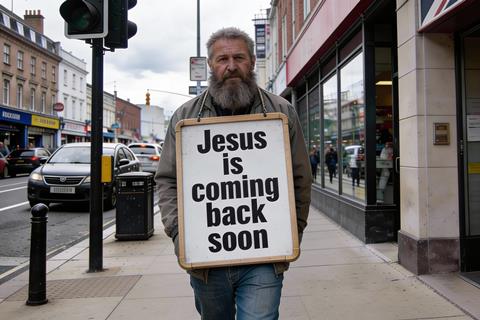
People have been predicting the date of Jesus’ return for centuries – and they have always been wrong. Reports are now emerging of some placing financial bets on Christ coming back in 2026. With war, climate crisis and persecution dominating the headlines, how should Christians think about the end times, and what does the Bible actually say about knowing the date?
Does the date 21 May 2011 mean anything to you? Can you recall what you were doing on that day?
My guess is that unless it happens to be your birthday (or some other significant anniversary), probably not. The date’s significance is that it is one of the more recent predictions regarding the occurrence of the second coming of Christ.
Made by Harold Camping, an American Christian radio broadcaster, he was convinced that the rapture would occur on this date, based upon his detailed analysis of the scriptures. His organisation, Family Radio, spent millions of dollars in advertising at the time to get the message out, and you don’t need me to tell you how it ended.
History is littered with failed predictions regarding the date of Christ’s return, made variously by mystics, theologians, religious movements, occultists and quacks. Notwithstanding, according to a recent Bloomberg article, people are placing bets on Christ’s return in 2026. Admittedly, most are betting against its occurrence, but it does beg the question how close are we to the end times and might Christ actually return in 2026?
Christ’s return to earth is a central tenet of Christian eschatology (the study of last things or the end times). We do not have to look too far into the scriptures to find direct reference to this event.
In Acts 1, recounting the occasion of Jesus’ ascension into heaven, Luke writes, “He was lifted up while they were looking on, and a cloud received him out of their sight”. Luke goes on, noting that two angelic figures then appeared to the disciples telling them, “This Jesus, who has been taken up from you into heaven, will come in just the same way as you have watched Him go into heaven” (Acts 1:9-11).
In Matthew 24 and 25 Jesus speaks at length about the events surrounding the end times and the final judgement, referring specifically to one whom he refers to as the Son of Man, “coming on the clouds of the sky with power and great glory”. Thus, in contrast his first coming to earth, as a vulnerable infant born into the humblest of circumstances, when Jesus returns again everyone will know about it!
So, what of 2026? How likely is it that Christ will return during this year? Actually, we might well reason that it is as likely to happen this year as in any other. I say this for two reasons. First, Jesus stated that no-one apart from the father can know the timing of his return (Matthew 24:36), hence the futility of all of those efforts to call the date, as one date is, surely, no more significant than any other. Secondly, Jesus also made clear that this event when it happens, would be largely unexpected. In his own words, he will come, “as a thief in the night” (Matthew 24:42-44, see also 2 Peter 3:10).
Hand on heart, I am not anticipating Christ’s imminent return, and I don’t imagine many other believers are (let alone all those placing the bets against it happening); yet, paradoxically, this is precisely the condition Jesus stipulates for his return!
While no-one can call the actual date of Christ’s return, many believers do point to specific events and happenings that might be indicators that it is approaching. Jesus, himself, said words to the effect, if your able to discern the weather and the seasons from what you see around you, you should also be able to read the signs of the times (Matthew 16:1-4).
No-one can call the actual date of Christ’s return but many believers point to specific events that might be indicators it is approaching
Many evangelical believers view the restoration of the nation state of Israel, which occurred in 1948 (following the Balfour declaration in 1917), as a key end times event. This is because they hold to a branch of eschatology that places the restoration of the Jewish nation state and the Jewish people’s subsequent turning to Christ (the grafting back in of the natural olive branch, which Paul speaks of in Romans 11), as a prelude to Christ’s return. This belief accounts for much of the unequivocal support for Israel among evangelicals in the US, as they consider the ongoing viability of the nation state of Israel to be a key determinant of Christ’s return.
All of the scriptural references referring to the end times and Christ’s second coming (notably Christ discourse in Matthew, Peter’s account of the end times in his second letter and also John’s visions recorded in the book of Revelation), speak of unprecedented turmoil and upheaval across the world. Jesus spoke of “wars and rumours of wars”, as well as famines and other natural disasters occurring at the time of his coming, describing these as “birth pangs” (Matthew 24:6-8). While it is the case that such happenings have occurred throughout history, some believers would point to the accelerating climate crisis, taken with the wholesale degradation of so much of the natural world, as a sign that the worst of these foretold events is coming to pass.
Additionally, Open Doors reports in their latest assessments that some 380 million Christians worldwide are facing high levels of persecution and discrimination for their faith, which they say is the largest number recorded in their World Watch List’s history. The occurrence of widespread hostility towards believers is another of the signs that Jesus references in his end times discourse (Matthew 24:9).
Another important indicator regarding the imminence or otherwise of the second coming, arises from the work of the Joshua Project, an evangelical organisation based in the US, which tracks the progress of Christian mission organisations toward the goal of reaching every people group in the world with the gospel message. This is significant since Jesus said that the gospel would be preached to all of humanity and then the end will come (Matthew 24:14). Their research shows that there is still a considerable way to go, with around 3.57 billion individuals living in what they term as unreached people groups. The fact that there are still some 44% of the world’s population to be reached with the gospel might lead one to row back on expectations of a soon to happen return of Christ.
Jesus, in his discourse recorded in Matthew, tells a number of related parables, with a general theme of preparedness for his return. One of the most prominent of these, the parable of the 10 virgins, makes a distinction between those virgins who had oil in their lamps and those who had neglected this task. The latter group were caught out by the bridegroom’s unexpected arrival and eventually excluded from the wedding feast (Matthew 25:1-13).
The message could not be clearer, as believers we are to live our lives in anticipation of his coming. Paul, in his letter to the Christians in Galatia, exhorts them “not to become weary of doing good” (Galatians 6:9). Weariness and complacency can easily set in over the passage of time. Jesus’ parable is not intended to condemn, but rather it is a reminder that our lamps need fresh oil if they are to maintain their light.
The beginning of a new year is an opportune time for a reset. For me personally, I focussed on deepening my prayer life over the holiday period and my wife and I have re-embarked on reading through the Bible in a year. My local Church has begun 2026 with a week of prayer and we are also holding ongoing prayer meetings focussed on praying specifically for revival in our community and across our land. Finally, in the face of so much uncertainty, I am trying to be especially mindful in all my interactions with unbelievers, that I have a hope both for this life and all of eternity which is real and that no circumstance or happening can ever diminish.

























1 Reader's comment