












Far from being a dry list of ancient names, Jesus’ family tree in Matthew 1 is full of outsiders, scandals and broken lives. Elaine Storkey takes a closer look at this surprising genealogy and uncovers timeless truths about the extraordinary reach of God’s grace
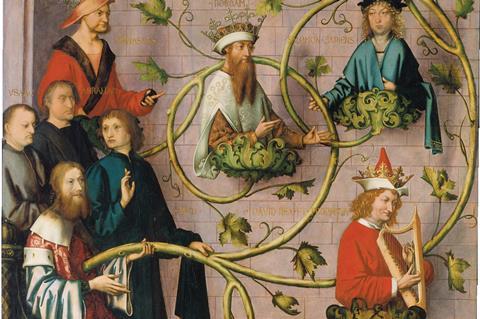
I have to admit that the opening of Matthew’s Gospel was a mystery to me for years. I couldn’t understand why someone inspired by the Holy Spirit to convey the amazing story of Jesus, God’s Son, should start with a dry, dusty list of people who “begat” other people centuries earlier. I wondered why I needed to know who Amminadab’s father was, or how many generations separated Jehoshaphat and Zerubbabel. It seemed an unlikely route to deep spiritual encounter. Verse 18, and the story of Jesus’ nativity, came as a relief.
Yet when I was commissioned to write a short commentary on Matthew’s Gospel, I found myself regretting this superficial judgement. The writer’s motive soon became very obvious. Far from giving superfluous information, Matthew was painstakingly establishing Jesus’ credentials for his original Jewish audience. For them, a genealogy was not a boring list of ancient names, but an essential proof of identity. By starting with Abraham, the father of the Jewish people, he was building up evidence for Jesus’ indisputable place in the covenant family of Israel.
Matthew was also committed to showing Jesus’ royal descent. In naming Jesus as the Son of David, he knew his readers would grasp the implications. They would know God’s covenant with David (2 Samuel 7:11-16): that one of his descendants would be the ultimate king on God’s throne. So Matthew draws up the genealogy around this royal promise. He structures it into three groups of 14 generations – not as a strict historical record, because many names are omitted – but as an ancient literary device in which Hebrew letters represent numerical values. Scholars have pointed out that the numerical value of David’s Hebrew name adds up to 14. By emphasising this three times, Matthew was underscoring David’s importance and Jesus’ significance in his kingly line. Similarly, Matthew’s readers would know the story of the exile and the people’s experience of emptiness during their absence from Jerusalem. They would remember the promise of the Messiah. In relating Jesus’ genealogy in the way he does, Matthew places Jesus’ coming as the Christ, the Son of David and legitimate heir to the throne, firmly within the long story of Israel.
A scandalous family tree
If Matthew had left his genealogy there, it would have served its purpose well. Any traditional Jewish reader would have been deeply impressed by the flawless, prestigious résumé he was building. But Matthew then does something quite unexpected – and somewhat baffling. He discards the protocol of a traditional royal family tree. In the ancient world, genealogy documents were carefully curated for public scrutiny and would list only pure-blooded, prestigious men known for their contribution to the public good. Plenty of these could be found in Jesus’ ancestral line, including many heroes of faith. So why, instead, would Matthew choose Jacob, who stole his brother’s blessing (and whose name means ‘deceiver’), Judah, who sold his brother Joseph into slavery, and King Manasseh, who practised pagan child sacrifice and filled the streets of Jerusalem with innocent blood? In fact, many of the listed ancestral kings had reputations as murderers, adulterers, power-seekers or idolaters.
The women Matthew chose
The other extraordinary departure is that Matthew includes women in Jesus’ family line. Admittedly, the patriarchs’ wives – Sarah, Rebekah and Rachel – are hugely significant in Hebrew scripture and gave birth to his early ancestors. Yet these are not the women Matthew chooses. Instead, he picks four women whose backgrounds were far from the centre of respectable Jewish life.
First, Matthew mentions Tamar (v3). Her story in Genesis 38 is messy and tragic, stained with deception and desperation. Left widowed and abandoned after a broken promise from her father-in-law, Judah, she resorted to disguising herself as a roadside prostitute to trick him into fulfilling his family obligation. It’s a story in which a desperate, discarded woman uses seduction to obtain justice.
Next we meet Rahab (v5), who was not only a Canaanite – from a pagan nation that was historically Israel’s sworn enemy – but also a known prostitute in the city of Jericho (See Joshua 2). By all the cultural standards of the day, Rahab was a dubious choice for inclusion. Yet her faith transformed her from an enemy outsider into a protector of Israel’s servants and an important part of the messianic line.
Matthew’s genealogy is a mirror of God’s heart
Ruth, a Moabite, follows her in the ancestral list (v5), another outsider from a people group so despised in Israel that the law forbade them from entering the assembly of the Lord for ten generations. Yet her love and faithfulness towards her Jewish mother-in-law (see Ruth 1:16) brought her into the household of Boaz and, ultimately, into the ancestry of King David.
Finally, did you notice Bathsheba (v6)? Possibly not, because Matthew doesn’t actually use her name but refers to her as “Uriah’s wife”. This is a subtle but quite definite allusion to King David’s seduction (or perhaps rape?) of Bathsheba. His orchestration of the murder of her husband, Uriah, to cover up the pregnancy resulting from his adultery is a deliberate reminder that even the great King David sinned appallingly before God (see 2 Samuel 11).
The heart of God
Matthew’s genealogy is not just a historical record, but a mirror of God’s heart. It shows that God does not look for those with perfect pedigree, spotless histories or flawless morality before He invites us into His presence. Jesus steps into the thick of our messy, broken humanity and confirms that God’s grace can work in any of our lives. If our personal history is so damaged that it cripples us with pain and wakes us in the night with dreadful memories, God, in Christ, can bring release and healing. If we feel abandoned or unloved, God reaches out to fulfil His life-giving purposes through us.
When the deceptive, the broken and the forgotten belong in Jesus’ family line, Matthew’s inspired text shows us that there is room for us, too. This list of old names is anything but boring. Though scarred and scandalous, it is a wonderful hymn of praise to God’s grace.
























No comments yet