












Elaine Storkey explores the Old Testament clues that point towards Father, Son and Holy Spirit – centuries before Jesus’ birth
I used to visit schools as part of Christian lecture programmes for final-year students. On one occasion, I was challenged by a bright philosophy student about the difference between the Old and New Testament views of God. It wasn’t the usual distinction about harshness and judgement versus love and forgiveness. It was about God’s very personhood. This student asked me how a single divinity in the Hebrew scriptures could turn into a multiple divinity in the New Testament. When the Old Testament ‘One God’ now becomes ‘Father, Son and Holy Spirit’, aren’t we talking about entirely different Gods?
It was a reasonable question, but one that early Christian theologians had thought about centuries before. They strongly rejected any idea of a contradiction between the Old and New Testaments about the identity and nature of God. They believed there are allusions to God in three persons even in the Hebrew scriptures. Irenaeus (around AD 180) quoted Genesis 1:26: “Let us make mankind in our image, in our likeness” (my emphasis) to show that all three persons of the Trinity were involved in the creation of humankind.
Others, including Basil (around AD 370), pointed to Genesis 1:2, where it says: “the Spirit of God was hovering over the waters”. The Hebrew word suggests a mother bird warming her eggs, waiting for life to burst forth. The Old Testament’s view of the Spirit’s role in creation doesn’t end there. Isaiah 32:15 points to a day when “the Spirit is poured on us from on high”. Psalm 104:30 reminds us that the Spirit will “renew the face of the earth” (NKJV).
Higher than the angels
Thinkers such as Origen, Irenaeus and Justin Martyr believed that whenever God appears in the Old Testament, such as to Abraham or Moses at the burning bush, it is Christ in pre-incarnational form. Sometimes, the text describes Him as an angel but then gives Him an authority that no angel holds.
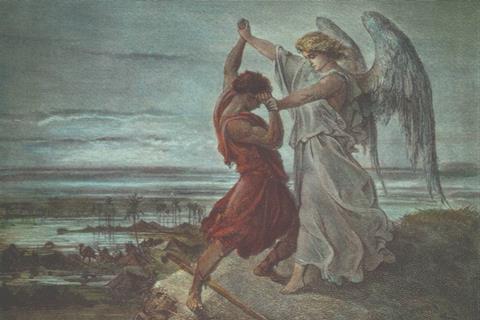
For example, in Genesis 16:9-13, Hagar is approached by a divine being who promises that He will multiply her descendants – no angel can do that. Not surprisingly, she identifies the One who speaks to her as the “God who sees me” (v13). Similarly, in Genesis 32, Jacob wrestles all night with a “man” who refuses to disclose His name but finally blesses him. Jacob identifies Him as the God whom he saw “face to face”, yet who spared his life (v30).
Because the Son is the One who discloses the Father to us (see John 1:18) these instances were regarded by early Christian theologians as appearances of Jesus, before His incarnation as “the Word made flesh” (see John 1:14).
There are allusions to God in three persons even in the Hebrew scriptures
Hundreds of years before Christ’s birth, the Hebrew prophets saw His coming. Isaiah prophesied that God’s Spirit – full of wisdom, understanding, counsel, might and knowledge – would rest on a descendant of Jesse whom God would send (Isaiah 11:1-4). When Jesus stood up in the synagogue to read another of Isaiah’s prophecies (Isaiah 61), He declared that it was fulfilled in Him: “The Spirit of the Lord is on me, because he has anointed me to proclaim good news to the poor…proclaim freedom for the prisoners and recovery of sight for the blind, to set the oppressed free” (Luke 4:18)
We are given a strong foretaste of Jesus’ character, work and suffering in Isaiah’s prophetic ‘Servant Songs’ (see Isaiah 42,49-50,52-53) and see them fulfilled in the Gospels. Isaiah’s vision of the gentle servant who would not “break a bruised reed…[or] snuff out a smoldering wick” (42:3, NCB) comes to life in Jesus’ compassionate ministry. Isaiah’s terrible vision of the suffering servant who was “pierced for our transgressions [and] crushed for our iniquities” (53:5) becomes real in Jesus’ agony and crucifixion. We know that “by his wounds we are healed”.
Same Spirit
The Spirit who empowered leaders and spoke through the prophets of the Old Testament is the same Spirit who guided Jesus’ followers in the New Testament. The Spirit of the Lord who “came powerfully upon David” (1 Samuel 16:13) also came upon Elizabeth when her cousin Mary, pregnant with Jesus, came to visit (Luke 1:41). The Spirit that led Ezekiel to rebuke the disobedient people (Ezekiel 2:1-3) also filled Stephen when he spoke to the Sanhedrin and was martyred (Acts 7). And Joel’s prophecy that God would pour out His Spirit “on all people” to prophesy, dream and see visions (Joel 2:28) was fulfilled in the New Testament on the Day of Pentecost (Acts 2). That promise continues for Christians today.
Throughout the ages, Christian theologians have accepted that the Old and New Testaments together give us an evolving understanding of God, and God’s relationship with us. What begins as a glimpse of Father, Son and Spirit becomes clearer as God’s revelation unfolds until one picture in the Gospels beautifully summarises their relationship. As Jesus, the Son, is baptised, the Holy Spirit descends on Him like a dove, and the voice of God the Father speaks from heaven, acknowledging Jesus as “My beloved Son” (Matthew 3:16-17, NKJV).
This unity is affirmed again and again in Jesus’ own relationship with Father and Spirit. He says: “I and the Father are one” (John 10:30); “Anyone who has seen me has seen the Father” (John 14:9). He promises the Holy Spirit to guide those who love Him. We can be confident that the God of the Hebrew scripture is the same Trinity that Christians worship today.
























No comments yet