









The former Irish President has claimed that baptising infants is a breach of their human rights. Nonsense, replies Gavin Ashenden. Being baptised into a loving church family is the greatest gift we can offer our children, and echoes God’s free gift of grace to us all
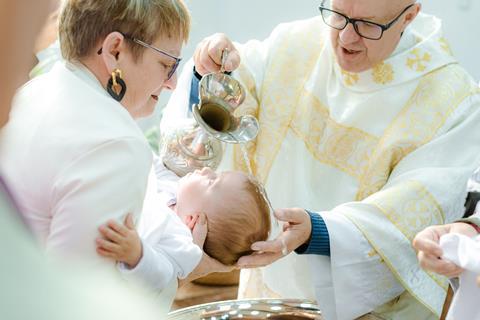
Ireland used to be known as a land of saints, and her reputation for Catholic evangelism was second to none. She produced holiness and conversions in great numbers, but recently, seems to has fallen out of love with the Church.
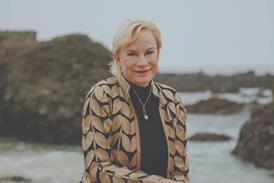
The latest example of that comes from former Irish president, Mary McAleese, who has written a book called The Baptism Bluff: Human rights in the canon law of baptism (Orpen Press).
It won’t surprise you to know that it’s a rant about the Church requiring all Catholics to overlook the fact that babies cannot give informed consent to promises of baptism. And more than that, “nobody can consent on their behalf to robbing them forever of the vital realm of choice.”
The reason this qualifies as a rant is because it is so profoundly unreasonable. It presents itself as a principled defence of keeping babies free of malign religious influence. But this is based on two false presuppositions.
The first is that there is nothing good in being a practising Catholic, being baptised into Christ and receiving the sacraments. The second is that children are somehow a blank slate that nobody has any right to exercise control over or in any way interfere with their capacity for choice.
The choice of the child
Let’s leave aside the argument, first of all, that being brought up in a community of love, forgiveness, faith, hope, patience, kindness, and all the marks of the Holy Spirit that the Christian community offers is some kind of imposition.
If we go to the argument that no-one should do anything that interferes with the choice of a child, the level of hypocrisy that McAleese brings is simply staggering. This is exactly what the State - and parents - do all the time.
Perhaps McAleese just doesn’t like it when the Church exercises such influence; after all, the secular State has long been attempting to usurp the Church in controlling this relationship with families and social care.
God’s love does not wait for our consent before it is offered
A child raised without baptism is also formed by an account of the world that their parents choose for them. A secular upbringing is not the absence of an imposition, simply a different one.
Consider for a moment what the State itself confers on a child without consent, and the vacuity of McAleese’s argument becomes obvious. A child born to Irish parents is an Irish citizen from birth, with duties of allegiance and obedience to the law. Under the Irish Nationality and Citizenship Act 1956, a citizen may only renounce their citizenship once they are over 18, living outside Ireland and hold or are about to acquire another nationality. In a time of war, it cannot be renounced at all without ministerial consent.
Where parents consent on a child’s behalf, the law never asks for the child’s agreement. That’s why parents may consent to vaccination, and why the court will uphold vaccination as a state imposition, ignoring not only the choice of the child - which can’t be given - but sometimes even parental objection.
So, in terms of education, nationality and health the State - and McAleese - pay no attention to the child’s choice at all. Instead, she only finds the principle difficult if the choice being exercised is by loving Christian parents, where baptism is the sign of the shared faith of both the family and the community.
A gift freely given
The question, then, becomes whether baptism is a good or a harm, and here the human rights argument meets its own limit. For a secular court to declare baptism harmful, it would first have to decide what baptism is.
That is a theological question that the State has always declared itself incompetent to settle. Nor does the Church’s view of the baptised restrain anyone. No temporal power enforces the canons, and a baptised adult in Ireland may leave the Church tomorrow without the slightest civil consequence.
What Mrs McAleese seems to want is not the freedom to leave, which everyone already has, but for the Church to forget that the baptism happened. The State does not erase its own registers, and to compel the Church to erase hers would violate its own freedom of religion.
For Catholics, and for the Orthodox, Anglican, Lutheran and Methodist traditions that also baptise infants, this is no technicality. Infant baptism enacts the priority of grace. God’s love does not wait for our consent before it is offered. It comes first, and our freedom is how we later make it our own, in confirmation and in every renewal of our baptismal promises.
Augustine pressed the baptism of infants against Pelagius for exactly this reason. A theology in which salvation begins with my choice is not a new liberation but an old error. A gift received before we could ask for it is still a gift. Most of what is best in us arrived that way.


















No comments yet