











A pastor in Ohio has hit the headlines after introducing his second wife to his church and claiming that monogamy is ‘unbiblical’. Responding to the story, the Evangelical Alliance’s Peter Lynas argues the Bible contains polygamy but never condones it
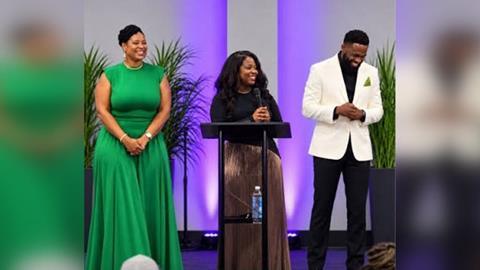
On Sunday 25 October a congregation in Cleveland, Ohio, gave its pastor a standing ovation. Israel Ford, who leads LifeWorks Church with his wife Lydia, had just introduced Shakayla Talley Ford as his second wife. His first wife Lydia called it a “polygynous marriage”.
Ford posted the video online, calling the teaching that a man should have one wife “unbiblical” and pointing to Exodus 21:10 as proof: “If he marries another woman, he must not deprive the first one of her food, clothing and marital rights.”
It would be easy to dismiss this as another pastor justifying his own choices. But it raises an important question: is monogamy simply a product of Western culture rather than God’s intention?
Polygamy is marriage to more than one person at once. Polygyny, the form Ford practises, describes one man with several wives, while polyandry is one woman with several husbands. Polyamory describes having multiple romantic or intimate relationships with the knowledge and consent of everyone involved. It does not necessarily involve marriage.
By staying silent, we do worse than offend. We leave people confused about what it means to follow Jesus
In the UK, bigamy is a criminal offence, though some polygamous marriages contracted abroad are recognised for limited purposes. Polyamory is the more live question. Scottish Green Party activists have pushed for its legal recognition, and ethical non-monogamy has moved into dating apps and mainstream journalism.
Even The Great British Bake Off has a polyamorous contestant. Many younger adults in our churches have friends who live this way. The deeper question is whether the Church can still explain why marriage has the shape it does.
Back to the beginning
The Bible’s account of marriage begins in Genesis 2:24: “That is why a man leaves his father and mother and is united to his wife, and they become one flesh.” When Jesus was asked about divorce in Matthew 19, He went straight back to this verse, quoting the Greek version that makes the pair explicit: “the two will become one flesh” (v5, my emphasis).
When the Pharisees asked why Moses allowed divorce (see Deuteronomy 24:1-4), Jesus’ answer unpicks Ford’s whole argument: “Moses permitted you to divorce your wives because your hearts were hard. But it was not this way from the beginning” (Matthew 19:8).
That is how to read Exodus 21:7-10. The law regulated things God never intended, but that regulation is not an endorsement. It specifically protects daughters sold into servitude - and then marriage - by their fathers: if her husband takes another wife, he must not cut her food, clothing or marital rights. It safeguards the most vulnerable person in a broken arrangement. Reading it as a charter for polygamy is like reading Deuteronomy 24 as a celebration of divorce.
The Bible is honest about its characters, and it records polygamy without flinching. The first man said to take two wives is Lamech (Genesis 4:19), in the violent line of Cain. Then come Abraham and Hagar (Genesis 16), the rivalry of Leah and Rachel (Genesis 29), Hannah taunted by Peninnah (1 Samuel 1), and Solomon, whose wives turned his heart from God (1 Kings 11:1-4). Each time the Bible describes polygamy but, importantly, it does not prescribe it. It also clearly shows the cost - usually to the women involved.
The New Testament is explicit. Church leaders are to be, literally, “the husband of one wife” (1 Timothy 3:2, Titus 1:6, ESV). These are the qualifications for Ford’s own role, as many online critics were quick to point out.
Why it matters
Monogamy is more than a rule. Paul quotes Genesis 2:24 and says “it refers to Christ and the church” (Ephesians 5:31-32). Marriage is a living picture of the gospel. Christ has one bride and gives Himself wholly to her. A husband divided between several wives tells a false story about the faithful love of God.
The case for polyamory rests almost entirely on consent. If everyone knows and everyone agrees, who is harmed? Consent matters enormously, and the Bible’s stories of women given away without a say are a reminder of how much. But consent on its own has never made a marriage. Christian marriage is a covenant, made before God, whose shape we receive rather than design. People can agree to many things. They cannot agree their way into a different kind of marriage. That would change the entire biblical metaphor of Christ and His bride.
Why do so many churches struggle to talk about marriage at all? I suspect many pastors steer clear because any conversation about marriage soon leads to more challenging areas such as same-sex marriage, sexuality and gender identity. Wary of division and of upsetting people, many choose to say nothing.
But silence is costly. By staying silent, we do worse than offend. We leave people confused about what it means to follow Jesus, whether they are married, single or same-sex attracted, and we create spaces of shame where people feel unable to share their stories.
Christian marriage is a covenant, made before God, whose shape we receive rather than design
Part of what makes Ford’s claim possible is a wider shift in how our culture understands marriage. Once marriage is defined by love and consent alone, it becomes hard to say where the limits lie. Why not any number of people? Why not two people of the same sex? And if you no longer love each other, why not end it and move on to someone else? We have been reluctant to tell a better story about marriage.
Churches have long faced a harder version of Ford’s question: What should a man with several wives do when he comes to faith? The 1988 Lambeth Conference upheld “monogamy as God’s plan” but agreed such a man could be baptised with his believing wives and children, provided he did not send any wife away and took no further wives. That holds clarity about God’s design together with care for some of the most vulnerable.
In the Cleveland video, Shakayla Talley Ford said some people in relationships like hers had been thrown out of churches. The reality is that churches welcome people in all sorts of complicated situations: broken marriages, lonely singleness, hurts carried from the past. But we don’t affirm every type of relationship, and we do need to recover our voice.
One Christ, one bride
This starts with preaching marriage as God designed it: one man and one woman in a lifelong covenant. That is the standard the Bible sets, even as we acknowledge that many of us fall short of it.
We protect it by celebrating weddings, investing in marriage preparation and supporting couples well into their married lives. We honour singleness as a good and whole calling, as Jesus and Paul both lived it.
We walk patiently with couples who are struggling. We have the tough conversations about cohabitation – that it is not a wise path towards marriage, and cohabiting couples are more likely to split up than married ones. And we open our homes and our lives, both to show what marriage looks like and to welcome those who are single, not yet married or struggling in their relationships.
The Bible describes polygamy but, importantly, it does not prescribe it
Our culture tells us that happiness depends on sexual freedom and fulfilment. That story has not delivered, and many of those living in it are beginning to notice. Sexual freedom has not led to fulfilment, and fulfilment was never the whole of happiness.
Marriage is not an area where Christians need to be defensive or embarrassed. Instead, we can humbly but confidently say: “Can I tell you about a better story, and the person at the centre of it?” Because marriage points beyond itself to Jesus, the bridegroom of the Church, and to the day when God says, “I am making everything new” (Revelation 21:5). We might not all be spouses, but we are invited to be part of God’s family.
Israel Ford said he would rather please God than people – so would I. That means trusting God’s design for marriage: one man and one woman, given to each other for life, as a picture of Christ’s love for His Church.
The Church should be confident enough to say that, and kind enough to live it.
























No comments yet