






Poor lawmaking should always be challenged, says Evangelical Alliance’s Peter Lynas. But Christians must not conflate every legal case involving public evangelism with religious persecution. It simply isn’t accurate
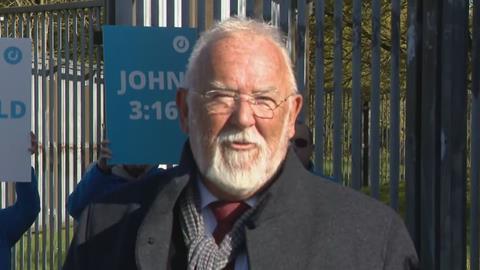
The conviction of retired Baptist pastor, Clive Johnston, for breaching an abortion buffer zone in Coleraine raises important questions about free speech, religious liberty and the wisdom of how Christians engage contentious public issues.
Johnston was convicted after holding an open-air service near a hospital where abortion services are provided. Reports indicate he preached from John 3:16, sang hymns and addressed a small gathering before being asked by police to move on. He was later prosecuted under Northern Ireland’s ‘safe access zone’ legislation, convicted on two counts and fined.
He is expected to appeal – and I hope it succeeds. Not because every aspect of this event was wise or beyond criticism, but because the case exposes the problems created by poorly drafted laws.
A poor law
From the outset, the Evangelical Alliance, along with many other organisations, raised concerns that abortion buffer zone legislation was framed too broadly and would eventually criminalise activity that falls well short of harassment or intimidation. This case appears to confirm those fears.
A free and democratic society should be extremely cautious about laws that place vague restrictions on speech, prayer or religious expression in public spaces. Once legislation relies heavily on subjective interpretations of what may influence or upset another person, difficult cases become inevitable.
That does not mean, however, that every action taken under the banner of Christian witness is prudent, effective or pastorally sensitive.
If we exaggerate every contested case into proof of wholesale persecution, we risk undermining our own credibility
There is an understandable instinct among many Christians to rally immediately around any case involving preaching or public evangelism. But we should resist the temptation to flatten every legal controversy into a simple story of faithful Christians versus hostile authorities. Reality is often more complicated than that.
In relation to this case, there are a number of ways Christians should reflect.
First, we should each be challenged about our approach to abortion and buffer zones. At a meal recently, a visitor from overseas asked why the UK Church is so quiet on the issue of abortion. It’s a fair question. The UK has some of the most liberal abortion laws in the world, and Christians should care deeply about seeking change.
Second, buffer zones may sound reasonable and compassionate but, in practice, they create serious free speech concerns. Laws framed too broadly inevitably create confusion, inconsistency and overreach. They are another step towards greater restrictions on freedom of expression and religious liberty.
Third, bad laws should be challenged. Some will write, some will campaign, some will pray - and some may even choose to test the law to the point of arrest. There are good reasons for each of these approaches, but it is also OK to disagree. We don’t need to question someone’s faith because they favour a different tactic.
Telling the truth
Finally, we need to be careful and accurate in speaking about this case. The ruling is limited to the very specific circumstances of this buffer zone legislation. It is not about wider gospel freedoms. This incident occurred on the side of a busy stretch of dual carriageway close to the entrance of the hospital. While there is a footpath, it is hardly an obvious location for an evangelistic event. It was clearly intended, at least in part, to challenge the boundaries of the law, as the judge noted.
There are many other places in Coleraine where the gospel can be, and is being, shared. I know that because it’s where I live. I know many people who met Jesus in this town through faithful and effective street evangelism.
The UK has some of the most liberal abortion laws in the world, and Christians should care deeply about seeking change
There is a danger in overstating what this case represents. It is not evidence that the UK has criminalised Christianity or outlawed the gospel. Christians across the UK continue to enjoy the freedom to preach publicly, gather openly and express Christian convictions in public life. Those freedoms remain significant by global standards.
If we exaggerate every contested case into proof of wholesale persecution, we risk undermining our own credibility and obscuring the genuine legal concerns that do exist. We should challenge laws that are imprecise, disproportionate or open to abuse. We should defend fundamental freedoms of speech and religion. But we should also be willing to reflect critically on how Christians conduct themselves in highly charged public debates.
Bad laws do lead to bad outcomes. That is certainly part of what happened here. But Christians should remember that gospel freedom is never merely about asserting our rights.
The freedom to preach is not for the preacher’s benefit but for the hearer’s good. We are called not simply to ask: “Am I allowed to do this?” but: “Will this help people truly hear Christ?” Christians, of all people, believe the end matters as much as the means.

























3 Readers' comments