









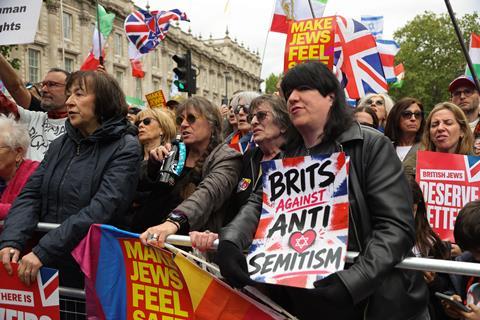
Having been in close proximity to the recent anti-semitic attacks in Finchley and Golders Green, Mavis Crispin and her North London church community took to the Bible to decide how to best respond. Here, she provides practical steps you can take to advocate against antisemitism
My childhood experience was shared with Jewish children, some refugees, who were withdrawn from Christian assemblies, just as I was, coming from an atheistic family. I learnt a lot and continued to learn as I later qualified as a teacher and joined the staff in a school with many Jewish children and teachers. Now, as a priest, I’m often engaged with Judaism in my parish, for example during the Holocaust Education Week.
Last night, I was with a church group in North London who gathered to discuss the current, alarming situation through a biblical lens and deliberate what our response should be. The group consisted primarily of older people who were able to recall their acquaintance with Jewish people having lived alongside Jewish communities for some years. Our experience was positive hence why we were surprised by the claim that a third of the population step into antisemitic ways of thinking drawing on a pre-existent reservoir (Birkbeck Institute for the Study of Antisemitism).
What does scripture say?
As a group we wanted to learn, understand and consider actions. One question was why is it worse now than in our younger days? We focused on world events such as the 7 October attacks, the growth in the importance and influence of social media, the decline in public trust in institutions, the rise in home schooling and the decline of the influence of the church. Some of our church history has been complicit over many centuries so repentance is part of our response.
Natural in such a group is to turn to the Bible, including the Hebrew scriptures which we share.
In smaller groups, we looked at the call and covenant of Abraham in Genesis with the promise that through his ancestors all nations will be blessed alongside the story of Esther, who, as Queen in the land of exile risked her life to save her people, thus preventing a genocide. An example to us to advocate for righteousness within the legitimate and peaceful avenues of communication.
I share in dog walking and conversations about our Judeo/Christian heritage and different ways of looking at the same text.
In the New Testament, Paul’s letter to the Church in Rome (Romans 11) gives us a metaphor of the olive tree – Israel, into which the gentile believers are grafted thus sharing the same spiritual root.
The relationship between Jewish and Gentile believers is also discussed in the Acts of the Apostles at the Council of Jerusalem – the first of the great church councils convened in the early centuries to sort out both doctrine and practice. With the dissemination of the gospel in mind, Paul and others argue for minimal requirements for church membership. For example, circumcision, so significant to Jews was abhorrent to Greeks and Romans.
Some would say that the minimal requirement (prohibitions on eating blood or strangled animals and fornication and idolatry) were reminiscent of Noah’s covenant and therefore predate both Abraham and Moses. Jews do not want to impose any practices on others and are not usually seeking to proselytise.
The Law which had already been reframed by Jesus in his Sermon on the Mount, is taught and also modelled in his everyday life and interactions with both disciples and Jewish leaders. The gospel of grace and freedom anticipated in the Old Testament and unfolded in the Kingdom message is axiomatic for those days and our times.
For me a good underlying principle in our daily living is found in Paul’s letter to the Corinthians (1 Corinthians 8) avoiding things that undermine others even if they are quite legitimate – for example eating pork when sharing a meal with Jewish people.
With respect to our relationships within local communities and especially during these times of heightened antisemitism my thoughts centre around the word advocacy. Jesus is described as our advocate with the Father and the Holy Spirit is the advocate within.
Practical steps and prayer
Prayer is a priority – prayer for those in authority, for the Jewish people and also those who perpetuate acts of violence, as well as for ourselves. We need to pray for wisdom, courage and compassion.
My prayers are not only at home and church but as I walk about in this community in North London – past synagogues, Jewish schools and even family and other groups. We encourage each other to reach out socially and recreationally. I, for example, share in dog walking and conversations about our Judeo/Christian heritage and different ways of looking at the same text.
We welcome all schools to our church outreach programme around festivals, and workshops about justice and significance of our buildings. We are vigilant about image and phraseology in our published material and use our buildings for community use as I know synagogues do too. I know one church that invites whole congregations to events which is reciprocated.
Neighbourhood chat groups and coffee shops are also good ways to keep in touch. I also walk/drive past our buildings when returning home to note and maybe report anything suspicious. More difficult, is to call out language unbecoming to people made in the image of God. More widely we may wish to advocate through the media where challenge is invited.
If more and more people could call on the common Grace of God for the common good and we ‘walk the walk as well as talk the talk’ we may make a difference in our own hearts as well as to the peace of our cities. In this way, could we be placed here ‘for such a time as this’?




















No comments yet