












Nominal Christianity may be declining in Britain, but a new survey from Evangelical Alliance suggests that the number of people who identify as evangelicals or hold evangelical beliefs is growing. It’s also one of the youngest and most diverse parts of the UK Church, says Peter Lynas

“How many evangelicals are there in the UK?”
It’s one of the questions I’m regularly asked as I travel around churches, speak at events or appear in the media. Often, it’s closely followed by another: “Who actually counts as an evangelical?”
For years, those questions were surprisingly difficult to answer. We usually pointed people to a Tearfund survey from 2007, which estimated there were around two million evangelicals in the UK. It was an important piece of research, but it was nearly 20 years old. Since then, the UK has changed dramatically, the Church has changed, and the evangelical movement has changed, too.
This report shows a movement that is larger than many expected, younger than many imagined and more diverse than many stereotypes suggest
As the Evangelical Alliance celebrates its 180th anniversary, we decided it was time to find out again. Working with Whitestone Insight, we commissioned one of the largest pieces of research ever undertaken into evangelical identity and belief in the UK. Nearly 8,500 people took part, giving us a rich picture not just of how many evangelicals there are, but who they are, what they believe, and where the movement is heading.
The results are remarkably encouraging.
Our research found that 17.6% of UK adults are “somewhat evangelical.” That doesn’t mean everyone uses the label. It includes people who either identify as evangelical, accept the defining beliefs of evangelical Christianity, or both.
Within that wider group, we identified two important categories.
Broad evangelicals: There are around 5.5 million people who both identify as evangelical and affirm evangelical beliefs.
Classic evangelicals: There are around 2.6 million people who identify as evangelical, affirm those beliefs, and belong to Protestant traditions.
That gives us a much clearer understanding of evangelicalism than we’ve ever had before. But it also raises another question: what do we mean by “identify” and “believe”?
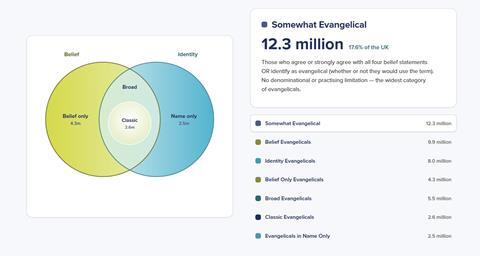
Identity and belief
Some Christians happily describe themselves as evangelical. Others hold the same convictions but avoid the label because of cultural or political associations. That’s why we measured identity and belief separately.
For belief, we used historian David Bebbington’s classic definition of evangelicalism, often called the Bebbington Quadrilateral. Evangelicals are characterised by four core convictions:
- the authority of the Bible
- the centrality of Christ’s death on the cross
- the necessity of personal conversion
- the importance of actively sharing and living out the gospel
Rather than asking theological exam questions, we asked people whether they agreed or strongly agreed with statements reflecting those convictions. This allowed us to distinguish between people who embrace evangelical beliefs, people who embrace evangelical identity, and those who do both.
And that’s where three striking trends emerged.
1. Evangelicalism is growing
For years we’ve heard the story that Christianity is in decline in Britain. And there’s truth in this, if we’re talking about nominal Christian identity. Census data shows fewer people ticking the “Christian” box, but that’s not the whole story.
Beneath the decline in cultural Christianity is a growing core of people who actively believe and practise their faith. The 2007 Tearfund research estimated that there were around two million evangelicals in the UK.
More than 40% of evangelicals are under the age of 35. That is significantly younger than the wider Church population and the UK population overall
Our new research, using a different methodology and population base, identifies around 2.6 million classic evangelicals and 5.5 million broad evangelicals. Taken together, the evidence points to an evangelical movement that is larger and more significant than many people have previously supposed.
In other words, evangelical Christianity is proving far more resilient than many assume.
2. Evangelicalism is increasingly diverse
The stereotype of the evangelical Church often lags years behind reality. Our research found that around one third of evangelicals are from ethnic minority backgrounds.
This reflects what many churches already experience every Sunday: evangelicalism is one of the most ethnically diverse expressions of Christianity in the UK. This is a real strength and means evangelical churches often reflect the communities around them, bringing together people from different nations, cultures, languages and traditions around a shared commitment to Jesus.
3. Evangelicalism is younger
Perhaps the most encouraging finding is the age profile. More than 40% of evangelicals are under the age of 35. That is significantly younger than the wider Church population and younger than the UK population overall.
While many historic denominations face ageing congregations, evangelical churches are seeing substantial numbers of children, teenagers, students, young adults and young families attend.
This echoes other recent research showing growing church attendance among younger generations. The evangelical Church is not simply surviving; its future looks increasingly positive.
A reason for confidence
Every piece of research has limitations, and no survey can capture every expression of evangelical life. But this is the clearest picture we’ve had in decades. And we have more research on the way that explores in more detail what evangelicals believe about a range of topics.
This report shows a movement that is larger than many expected, younger than many imagined and more diverse than many stereotypes suggest. Evangelicals make up 64% of practising Christians in the UK.
Beneath the decline in cultural Christianity is a growing core of people who actively believe and practise their faith
This should give confidence to local congregations faithfully serving their communities, often without making headlines. It should encourage Christian leaders investing in the next generation. And it should remind us that the story of Christianity in Britain is more hopeful than the dominant narrative often suggests.
The Evangelical Alliance has spent 180 years serving and uniting evangelicals across the UK. This research doesn’t simply tell us how many evangelicals there are. It helps us understand who we are: a growing community of people committed to the authority of scripture, the good news of Jesus Christ, the call to personal faith, and the mission of together making Jesus known.
That’s a story worth telling.

























No comments yet