






In a little-noticed change to his official accounts, King Charles appears to have revised his pledge to “defend the faith”. Former Chaplain to the Queen Gavin Ashenden gives his view on what it means
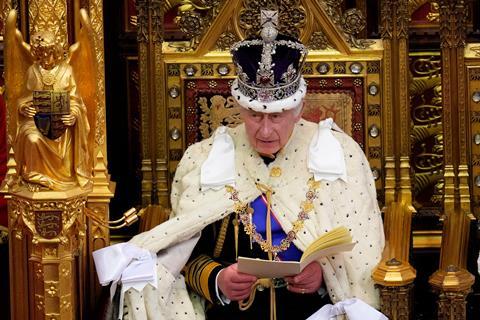
When King Charles made public his accounts this week, he surreptitiously slipped into the document a quite significant change.
In a few amended lines in the Sovereign Grant Annual Report, the duties of the monarchy have been covertly changed. The King’s title as “Defender of the Faith” has been replaced by “Protector of the Space for Faith within the Multi-faith Nation.”
One of the first questions that arises is whether he has the power to change the coronation oath that he swore. Since the monarchy is a creation of parliament, and the oath he swore was part of the settlement in 1688, there is no constitutional evidence that he is in a position to amend it. In fact by doing so, it looks like an attempt to change his oath, which becomes a matter of oath-breaking.
It’s up to parliament to decide whether or not they are sufficiently concerned about the way they have constructed the constitutional monarchy we live under, but it has raised a series of anxieties, ranging from questioning King Charles’ integrity, to asking what exactly a multi-faith space looks like. This is, after all, a new job title that the King has given himself.
Invading the safe space
It’s certainly true that the people of this United Kingdom now comprise a series of different faiths. But what does the idea of a “space for faith” mean?
Christians are committed, by their obedience to Jesus, to penetrate the space for faith with the good news about the love of Christ for all humanity, so that Muslims, Hindus, Sikhs, Buddhists and Zoroastrians can be given the opportunity to weigh the claims of Christ.
When Jesus told his followers to go out into the world carrying the news of the Kingdom in order to convert people and transform society, this was an injunction to invade the safe space of the multi-faith environments they lived in.
Why would the King, as defender of the Christian faith, want to change the priorities that Christ gave to his followers? If the Christian evangelists had never come to this island to invade the multi-faith space with the good news of Jesus, this island would have remained pagan. On what basis would that constitute an improvement for the people of this island in the eyes of the King?
Charles swore to defend the Christian faith, and there is much that needs doing.
The problem is that Islam is equally ambitious to invade the safe space of a multi-faith environment. Muhammed divided the world into two areas. They are the Dar al-Islam (House of Islam), where Islamic law prevails, and the Dar al-Harb (House of War), where it does not. Muhammad invites his followers to pierce the zone of multi-faith with the call to submission and even sanctioned violence. In Surah 9, verse 29, he invited Muslims to fight those who do not believe until they are overcome and pay the jizya tax.
Islam and Christianity are both committed, as a matter of obedience to their founders’ vision, to piercing the sanctity of the King’s proposed zone of multi-faith safety. It’s not altogether clear that other religions would be willing to observe a hermetic seal between their own practices and other people’s beliefs. Buddhists are often only too happy to explain the path to enlightenment as the Buddha taught it, also proactively piercing the sanctity of Charles’s multi-faith safe space.
So where does the idea of a safe space in a multi-faith environment come from? And why is it so important to King Charles that he’s prepared to abandon his commitment to Christ, the Church of England and the Christian culture of his country?
Most people trace it to his regard for the psychologist Karl Gustav Jung and ideas that Charles first encountered from his tutor, Laurens van der Post. Jung considered religion to be a psychological phenomenon, useful in creating a symbolic language that allowed consciousness and unconsciousness to integrate independently of the content of the religious belief. The idea of a multi faith safe space, in Charles mind at least, perhaps originates from him.
So we have a king who has deserted Christian allegiance, turned his back on his coronation oath, repudiated the support and promotion of a Christian culture, and wants to impose this Jungian template, designed to achieve the elusive goal of personal integration, or ‘individuation’ on all other religions.
Defence needed
Yet Charles swore to defend the Christian faith, and there is much that needs doing. Christians are having difficulty with freedom of speech and conscience in Charles’ realm.
Christian converts at Hyde Park’s Speakers Corner have been attacked by those who are furious that they have abandoned the Islamic faith, without the police taking the requisite action.
Why would the King, as defender of the Christian faith, want to change the priorities that Christ gave to his followers?
Christians who believe that abortion is murder are arrested by the police for standing on the pavement silently and appearing to pray. The very same Parliament that invites the King to ‘defend the faith’ has passed legislation attacking it. You might think this was an area in which the Defender of the Faith might interest himself. But apparently not.
The prominence of Jungian ideology at the heart of the monarchy is one that very few adherents of any major world religion would accept or promote. It seems odd that he’s willing to break - or amend - his coronation oath (depending on how you see it), and abandon the faith of his fathers (and mother) in order to promote this integrative psychological programme. The concept of faith seems more important to him than the integrity of any single way of believing.
Some people are now asking whether or not his behaviour is sufficiently subversive as to raise questions about his capacity to fulfil the office of King, and the oaths of that office, in good conscience.





















9 Readers' comments