







Britain and America have enjoyed a close alliance for centuries, with King Charles’ visit to the White House the latest expression of this “special relationship”. But as attitudes to free speech diverge, particularly affecting Christians, Lois McLatchie Miller says this relationship may come under strain
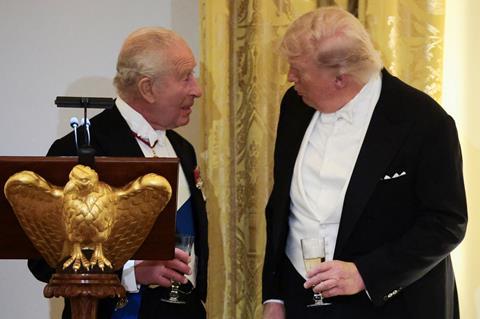
When King Charles III sat down with Donald Trump over tea at the White House this week, the symbolism was difficult to ignore. Two nations once divided by revolution – sparked, of all things, by a tax on tea – now mark their friendship with ceremony and ease, nearly 250 years on.
For generations, Britain and America have described themselves as partners not only in power, but in principle – a friendship rooted in shared Western values, inspired, at least initially, by a moral Christian framework. The “special relationship” has never been sustained by diplomacy alone, but has depended on a deeper sense that we recognise the same fundamental truths about human dignity and freedom.
Democracy done different
Today, that shared understanding is beginning to look more fragile. One of the clearest fault lines is freedom of speech.
In the United States, protections grounded in the First Amendment remain strikingly robust. The assumption, however countercultural it may feel, is that even deeply offensive speech should not be policed by the state, but answered in the open – tested, challenged, and, where necessary, rejected in the public square.
In the United Kingdom, the trajectory has been rather different. Increasingly, the state has taken on the role of arbiter – not merely of actions, but of words, tone, and even perceived offence. Reports of police visiting individuals’ homes to demand apologies over social media posts are no longer unusual. While often framed as efforts to preserve harmony in a diverse society, such interventions raise deeper questions: who decides what may be said, and on what basis?
Christians, more than any other group, are on the front face of exposure to unjust censorship.
Nowhere is this more evident than in the enforcement of abortion “buffer zone” laws across parts of the UK. These laws, which prohibit certain activities within 150 metres of abortion facilities, were introduced with the stated aim of protecting women from harassment. That is a goal few would dispute.
Yet the scope of these laws extends far beyond preventing obstruction, harassment or violence – all of which were already illegal. They reach into the realm of thought, motive, and peaceful expression. The law bans not only malicious behaviour, but “influence” – a term elastic enough to include conduct that is silent, consensual, and entirely peaceful.
Consider the case of army veteran Adam Smith-Connor, convicted in 2024 for standing quietly across the road from a clinic, praying silently in his own mind. Or Clive Johnston, a retired pastor in Northern Ireland who faced trial this month after preaching a sermon that included the words of John 3:16 within a buffer zone – on a Sunday, when the clinic was closed, and without having mentioned abortion at all. In England, retired scientist Livia Tossici-Bolt was convicted for holding a sign offering conversation: “Here to talk, only if you want.”
The UK grows more comfortable with restricting peaceful Christian expression, while the US remains committed to protecting it
In any other context, these actions would be unremarkable. Prayer, preaching, and offering to speak with a willing listener are ordinary expressions of Christian faith. What made them punishable was not the content alone, but their location – and the assumption that certain beliefs, when held in certain places, make even peaceful conduct inherently problematic.
A strain beneath the surface
From a Christian perspective, the freedom to live out one’s faith is not simply a political preference; it is a matter of conscience. The ability to pray – even silently – or speak from the word of God without fear of sanction touches on something profoundly spiritual. When the state begins to regulate not just what we do, but what we think and believe in particular spaces, it crosses into territory that previous generations would have recognised as deeply concerning.
It is perhaps no surprise that this divergence has drawn attention from across the Atlantic. In the United States, even those who strongly support abortion have defended the principle that public spaces must remain open to peaceful expression. In McCullen v. Coakley (2014), the Supreme Court – including Ruth Bader Ginsburg – unanimously struck down a buffer zone law in Massachusetts, emphasising that the streets are a place for conversation, persuasion, and the free exchange of ideas.
More recently, Vice-President J. D. Vance has publicly raised concerns about the censorship of individuals like Smith-Connor. The State Department has repeatedly condemned the misuse of “buffer zone” laws to repress Christian expression, suggesting that the UK risks drifting from principles long understood to underpin liberal democracy.
Of course, Britain and America remain close allies in many respects. Intelligence cooperation, defence partnerships, and economic ties continue to bind the two nations together. And King Charles’ visit is, rightly, an expression of that enduring friendship.
But friendships shaped by shared values are uniquely sensitive to shifts beneath the surface. When the underlying vision of freedom begins to change – when one nation grows more comfortable with restricting peaceful Christian expression in the name of social order, while the other remains committed to protecting it – the relationship itself inevitably feels the strain.
As the King raises a toast to the “special relationship,” the question lingers: what, ultimately, makes it special?
If it is more than history or convenience – if it is truly grounded in a shared commitment to liberty, built on a Christian-inspired framework of human rights – then preserving it will require more than warm words and ceremonial gestures. It will require a renewed confidence in the very freedoms that once defined both nations.





















4 Readers' comments