





Donald Trump’s posting of an AI-generated image depicting himself in the likeness of Jesus Christ has sparked fresh controversy. The incident comes after the President criticised Pope Leo XIV and published an expletive-laden threat to obliterate Iran. It’s raising pressing questions about the influence of the Christian leaders around Trump, says Lois Mclatchie Miller. Are they offering meaningful spiritual formation, or inadvertently fuelling a messiah complex?
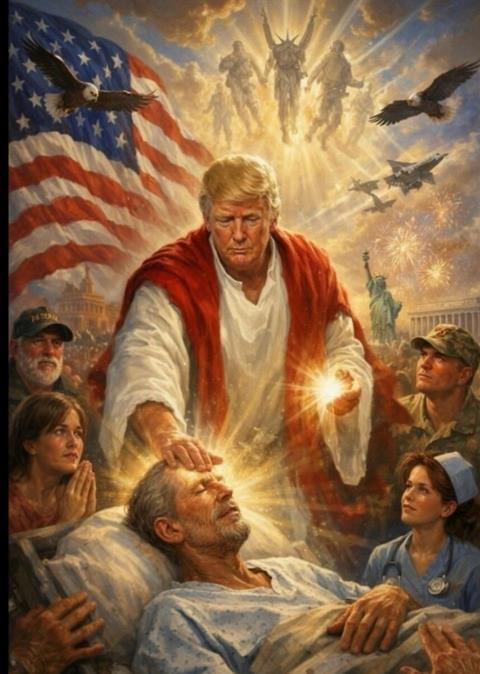
When Donald Trump shared an image of himself as Jesus Christ, it presented a fork in the road for the many American Christians who backed him. Would they continue to defend their choice of president unwaveringly, or call out this inexcusable blasphemy?
The AI-generated image showed Trump’s face replacing that of Jesus as he glowed with divine power and healed the sick. Yet after 24 hours of intense backlash, a rare turnaround saw the post taken down, with Trump claiming he had thought the image depicted him as a doctor, rather than Christ. This bizarre excuse has sparked a wave of memes from left and right, mocking the confusion of a depiction of a robed, kingly Jesus with modern medical staff.
The social media post came after weeks of build-up in which the president has been engaging in troubling rhetoric, antithetical to Christian teaching. In his posts about the Iran war, he dropped “F-bombs”, threatening to put the Iranian people through “hell”, and claiming an “entire civilisation will die”.
Such verbiage has been uncomfortably matched with religious rhetoric from the same administration implying that this is a “holy war”. US Secretary of War Pete Hegseth spoke of the US military’s unmatched ability to rain “death and destruction from above” on its “apocalyptic” Iranian foes, while “the providence of our almighty God is there protecting those troops”.
But the central Christian doctrine of the imago Dei is that all people – even those living in enemy territory – are made in the image of God. This foundational value does not prohibit war, but it does set its limits. It demands proportionality and respect for civilians – not relishing in bloodthirsty threats of annihilation.
God complex
And now, the posting of the blasphemous image of the President implies that the idea that America is the self-appointed fist of God in this “apocalyptic” war has evolved – into Trump’s own imagination that he himself is the Christ at the center of it all.
Trump’s personal flaws have been the obsession of Western media discourse for some time – often unfairly so. UK Christians can be over-zealous with their criticism of our American brothers and sisters who have aligned themselves with the controversial president. But many Christians did not vote for Trump out of naivety or cult-like devotion, but with clear moral trade-offs in mind.
For many, the stakes were tangible - protecting unborn life, resisting the medicalisation of children through gender interventions, protecting single-sex spaces, preserving the freedom to speak openly and share the gospel - among other reasons. A Trump administration would allow for such agendas to be furthered for the public good – a Democrat alternative would have pushed the opposite direction.
These are not abstract culture-war talking points, but matters which directly impact human flourishing. A serious Christian ethic often involves prudential political choices. Christians’ loyalty is to God and advancing his message for human flourishing – and where the Trump administration has enabled that, they have been worthy of support.
Yet by the very same token, it is incumbent on those same Christians to call out the President when his actions are antithetical to Christian truth. A vote for a candidate does not mean undying loyalty.Where following one’s preferred politician and following Christ diverge, it is clear which should take priority.
Pope Leo XIV has offered helpful leadership on this tension, having given simple, important statements of late such as “God does not bless any conflict”. For that, he has been harshly and bitterly rebuked by Trump online.
But as Leo heads up a spiritual opposition to the unjust aspects of this war, it raises an uncomfortable question: Who is shaping the spiritual imagination around this presidency?
Formed in His image
The President’s spiritual advisors – most notably, figures like Paula White Cain – have publicly compared Trump’s experiences to those of Jesus. Most recently, after describing the Passion of Jesus, she added, “And Mr President, no one has paid the price like you have paid the price. It almost cost you your life. You were betrayed and arrested and falsely accused. It’s a familiar pattern that our Lord and Saviour showed us.” Clearly, this was intended metaphorically. But metaphors matter, especially when directed toward a man already inclined toward grandiosity.
Christian leadership is not flattery and unbridled empowerment, but formation. Biblical prophets in the courts of the king confronted wrongdoing where they saw it, without being clouded with heady visions of power.
If that function is not being performed - if it is, in fact, being reversed - then the problem is not only Trump’s rhetoric, but the Christian ecosystem surrounding him. Unending sympathy and failure to challenge the President will not make him more amenable to Christian causes – it will empower him to further this kind of flawed behaviour.
Everyday Christians, however, have an ability to speak truth into politics, even where those with more personal access will not. If they want to shape this administration rather than be shaped by it, then they must speak clearly now. They cannot defend the dignity of every human life while excusing rhetoric that disregards it. They cannot profess allegiance to Christ while remaining indifferent to His appropriation. They cannot speak of moral limits while justifying their erosion.
A Christianity that appears willing to bend its most sacred truths to accommodate political power will find its credibility diminished - not only among its critics, but in the wider world watching closely. Its voice on justice, dignity and restraint will carry less weight, because it will have shown those principles to be negotiable. But a Church that speaks up, even where there might be a short-term political cost, will retain integrity on the world stage.
We trust not in politicians, but in God alone.



















18 Readers' comments