












In the avalanche of books and museum exhibitions that are now pouring forth about the late rock music icon David Bowie a fascinating possibility is emerging. Could the Picasso of Pop have found God? Tony Cummings explores
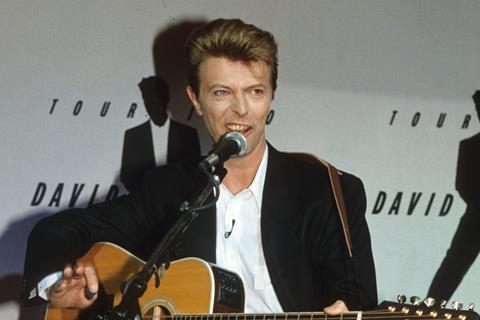
In case you needed proof that our culture’s obsession with all things David Bowie endures even a decade after his death, I can report a staggering seven, yes seven, different books about the rock star are due to be published in the next four months.
Possibly the most creatively attuned celebration to any public figure’s life opened on last week at London’s Lightroom. There the rock icon’s life is being remembered in a lavish multi-media presentation, David Bowie: You’re Not Alone. It has been compiled from thousands of hours of Bowie footage, together with interviews, photography, drawings, lyrics, personal notes and audio recordings. It is a spectacular endeavour that NME has described as an “immersive experience”.
Bowie’s early life
To fully appreciate the art of Bowie one needs to view his decades-long search for meaning in his life alongside the clues that God leaves each human being about his existence and the need for them to seek and find a relationship with Him.
Bowie, then David Jones, had a good start.
Growing up with one half-brother and two half-sisters in a bleak, high rise flat in Brixton, London, and then in a humble home in Lambeth, Bowie’s love of music took hold as a child. By 1957 his love of music and the stirring of a spiritual sense led him to become a choirboy at St Mary’s Bromley.
From his entrance into the pop music world as Davey Jones to his death on 10 January 2016 he was an archetypal culture vulture, absorbing musical, literary, cinematic and spiritual influences like human blotting paper.
When in 1969 Bowie enjoyed his first hit with ‘Space oddity’ the mass public took it as an intriguing story about a spaceman lost in the enormity of the universe, never to be able to get back to base. But author Peter Ormerod suggested that Bowie could be drawing from Kierkegaard to explore Major Tom’s space launch as “a leap of faith”, “a technological suspension of the ethical” like Abraham’s setting out to sacrifice Isaac.
When rock music stardom came to him David sadly plunged into spiritually very dark places. He had periods of drug abuse; he became deeply involved with the occult, Buddhism, messianism and Kabbalah, and his sexuality became pretty confused. But somehow the recording star’s pursuit for spiritual truth continued to peek through.
Bowie described much of his music as “a search for a spiritual foundation”
In 1975 he recorded the seminal Station To Station which featured the song ‘Word on a wing’. The song came to be described by Bowie as a “signal of distress” and a “call for help.” On it he sang a prayerful plea, “Lord, I kneel and offer you my word on a wing / And I’m trying hard to fit among your scheme of things”.
A brand new Bowie
From that time a seemingly new Bowie began to pursue his art.
A strong hint that something profound had happened in the superstar’s life came on 20 April 1992 at Wembley Stadium during the Freddie Mercury Tribute Concert. As well as Bowie the concert featured other guests such as Robert Plant of Led Zeppelin, Slash and Axl Rose.
As the Mental Floss website reported, “Between songs, Bowie knelt down and recited The Lord’s Prayer in tribute to both Mercury and another friend who was ill with AIDS at the time.”
Bowie described much of his music as “a search for a spiritual foundation” and it is clear that many of his lyrics relate to this search.
In an interview he spoke about his creative process. “Searching for music is like searching for God. They are very similar. There’s an effort to reclaim the unmentionable, the unsayable, the unseeable, the unspeakable; all those things come into being a composer, and to writing music and to searching for notes and pieces of musical information that don’t exist.”
The remarkable album Blackstar (stylized as ★), released in 2016 is, with its inventive arrangements from jazz musicians and its enigmatic meditations on morality and the afterlife, much more than the musical statement of an artist knowingly making his final swansong. He died of liver cancer two days later. In one remarkable and moving moment he sings, in the persona of Lazarus, “Look up here, I’m in Heaven.”
When the Reverend John Davies reviewed for Church Times two books published in January 2026 – David Bowie And The Search For Life, Death And God by Peter Ormerod and Lazarus: The Second Coming Of David Bowie by Alexander Larman – he wrote about how both books affirmed “the continuing influence in our culture of his restlessly exploratory spirit”.
True. But also both books give clues that Bowie’s search may have found an answer. But only clues.
Neither book gives any clear evidence of where Bowie’s spiritual search took him before his death. When a musical giant of another era, Bob Marley, learned of his cancer, he renounced his beliefs in Rastafarianism and asked to be baptised into the Church. We don’t know of such a turnaround in David’s life. In truth, it is likely he will remain an enigma.
























No comments yet