











Hollywood heavyweight Tyler Perry brings Christian faith and Christmas together in a new Netflix film starring CeCe Winans. But the Gospel legends and unapologetic Christian message are overshadowed by an unconvincing script and a disastrous use of AI, says Nathanael Smith
Two genres that rarely wow critics with their quality are Christian films and Christmas films. Both are known for their sentimentalism and simplicity, choosing the path of least resistance to tell stories that favour easy emotions over dramatic satisfaction. So can American cinema powerhouse, Tyler Perry, defy the reputational challenge of both genres by bringing the two together? The answer, unfortunately, is no.
The plot starts out as absurd, and then gets sillier. A washed-up popstar, Isaac, with some sort of vague, prodigal son past, is guilt tripped by his dying dad into taking over his great grandfather’s church in a rough (and aesthetically unconvincing) New York neighbourhood.
Why any church member would want a pastor’s nepo baby with no passion for the job (or Jesus) to take over their church is never addressed, it is simply the plot device. Issac has a teenage son, Jacob, who does not want to move from Atlanta, and a non-verbal younger son, Esau. Quite why you would name your two sons after one of the most famous fraternal rivalries is similarly skipped over.
This is theoretically a Christmas film, so when Isaac arrives at his new parish, he discovers tens of thousands of dollars of debt and imminent foreclosure - and has to find a solution, you guessed it, by Christmas. His wife says the answer is prayer, but Isaac doesn’t believe it works. Thankfully, there’s a group of five glowing angels who live in the attic, that Esau can see but no one else can. Oh, and there’s a man on the street who wants to tempt Isaac back into the music industry, with the suspicious name Ehtmai Lived. I warned you it got sillier.
At this point, it should also be mentioned that this is a musical of sorts - the way to bring people back into the church, it turns out, is worship music.
The good
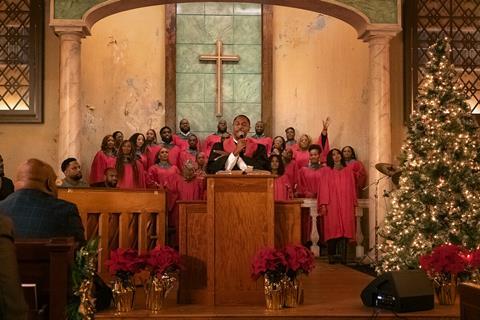
There’s lots to criticise about this film, but it would be unfair to not also mention the few positives. The music, arranged by Kirk Franklin and performed by a slew of gospel legends, is fantastic. Perry has talked about how thrilled he was to get such a stacked cast of singers - many of whom hadn’t acted before (which sadly, does show).
The other striking thing about The Gospel of Christmas, and one which may be reason enough for some readers to watch it, is how unashamed it is in its Christian faith. This is a film that revolves around the power of prayer, features scripture being read frequently, and celebrates the triumph of God over evil. The New York neighbourhood has declined, the film posits, because the church has. Bring back the church and the community will be restored.
All this combines to create one or two genuinely powerful moments. I didn’t enjoy the film but it’s hard not to get goosebumps as CeCe Winans sings ‘Goodness of God’ with gusto, or a gospel choir declares soulfully that prayer really does work. In those moments, you see glimpses of the film this could have been.
The bad
Unfortunately, everything surrounding these moments doesn’t really work - cinematically or dramatically. The screenplay and performances have a soapy quality about them, while every plot development is delivered with the broadest strokes and each resolution feels incredibly simplistic. It means you never feel invested in the drama because the characters and the dialogue don’t feel particularly authentic.
The triumphant ending - it’s not a spoiler to say this ends happily, that’s kind of the point - isn’t earned. It takes place right before Christmas, just to remind you that you are watching a Christmas film, and it ties everything up in a bow that’s far too neat. That’s not how anyone experiences life, and a more interesting film would have won a happy ending after a little more wrestling and some more space for difficulty.
And the AI
And then, at the end of the film, Tyler Perry makes a creative decision so disastrous that it lost any of the good will it had built up with its sincere depiction of faith. One scene features a mind-boggling use of generative AI so ugly and egregious that it betrays everything that has gone before.
A row of angels lines an alleyway, the AI obvious from the dead-eyed stares, the glossy sheen and the uncanny small movements. Generative AI suggests laziness, unwillingness to pay actual artists and a contentment with stealing from creative work that already exists.
It may seem petty to pick on one scene, but Christians should resist ‘art’ made by generative AI. Creativity is a reflection of God as the ultimate creator. When humans create art, they are imitating the inventiveness, imagination and beauty of our creator. It should show something of our soul. AI could imitate a psalm or a poem, but what would be the point?
There are countless Christian artists out there trying to make a living with the gifts that God has given them, and directors like Perry do them a disservice by taking ugly, unnecessary AI shortcuts.
Ultimately, Christians should seek other films to enjoy this Christmas time. You will likely find it a more rewarding experience, despite the faith that is evidently on display in some of the musical moments here.
The Gospel of Christmas is available now on Netflix


























No comments yet