









This tale of three elderly nuns trying to save their convent falls flat as both comedy and drama, says our reviewer. And why do filmmakers keep assuming nuns are intrinsically funny?
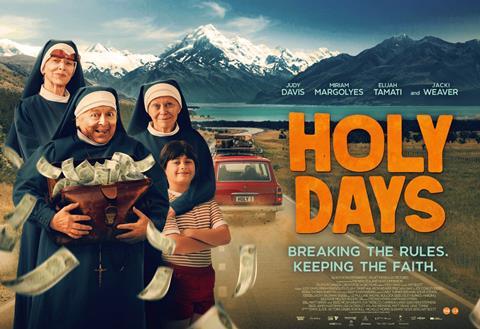
There’s an interesting idea at the heart of Holy Days, a new dramedy from New Zealand, which asks what importance religion can still have at a community level, even when society gets more secular.
It’s the kind of idea that should lead to a thoughtful drama, but Holy Days doesn’t seem that interested in exploring that idea.
It’s an odd film that is curiously incurious. It isn’t funny enough to be a good comedy, nor dramatic enough to be a good drama, but might just about pass the time for people looking for a clean, faith-themed film to watch with family.
Holy Days follows the story of three nuns in the 1970s trying to save their crumbling convent and a young boy, Brian, who spends time every day with the nuns while trying to process the death of his mother several years ago. The three sisters and Brian hear that the contracts for the convent are on the South Island, which may save it from greedy developers, so they go on a road trip; japes and shenanigans ensue.
Director Nat Boltt has assembled a cracking cast here of veteran actors, including garrulous British thespian Miriam Margolyes, but the star of the show is young Elijah Tamati as Brian. The novice actor comes across authentically, and his sweetness and innocence is the heart of the film. When Holy Days is just Brian and the sisters being friends, the film finds a gentle rhythm that, while never compelling, feels warm and well observed.
It’s just a shame that the drama of the film never truly lands. The plot builds towards a convoluted climax involving a snowstorm on a mountain where budgetary constraints become evident. Part of the reason the final act feels muddled and flat is that the audience is never truly invited to invest in the stakes of the story. We’re told that the convent is important, but we never see why or how it is important to its community. Sure, Brian is there every day, but the first act doesn’t establish a sense of character or place, which means that the drama of the third never sets the heart racing.
So without strong drama, the film instead turns to comedy. For some reason, many screenwriters seem to think that nuns are inherently funny. Whether it’s men dressing as nuns (Nuns on the Run), witnesses hiding out in convents (Sister Act) or sex comedies designed to offend (The Little Hours), film makers keep returning to the theme to try and mine some comedy from the women in wimples.
The nuns are depicted with clear warmth and affection
The problem for Holy Days is that, in spite of all these previous attempts, there is nothing actually, intrinsically funny about nuns. The filmmakers try nonetheless, and most of the humour that the film attempts boils down to: “look at these nuns doing things you might not expect a nun to do!” One of them smokes, they dance, they spit out their dentures. You can tell that the film is aiming for laughs, but it consistently falls flat.
Thankfully, however, the film never wants to make the nuns’ faith the butt of the joke - instead, it’s a part of who they are. The nuns are depicted with clear warmth and affection, and the screenplay does actually have them quoting scripture and praying. A feckless priest and greedy bishop get shorter shrift from the film, but this is not a film interested in making scathing comments on the state of the church - it only skirts round issues such as forced adoption.
Ultimately I watched this and wished for something more. It is heartening to see open discussions about faith in a film this accessible. Brian and Sister Agnes debate the likelihood of miracles, and how much they should be expected in modern life - but any miracles that do happen in the film lack any sense of wonder or divine intervention.
And as the nuns face a future in which their convent might be demolished by developers, we get the smallest hints of this question about the place of religion in an increasingly secular world. But if it wanted to say something incisive about today, why is the film set in the 1970s?
The film wants us to believe that the tireless service of the sisters, and the solidity of their faith, brings comfort, calm and hope to this rural New Zealand community - and obviously that is exactly the kind of thing that the church should be doing. But it doesn’t say this with any kind of conviction. The audience mostly wants to root for the nuns because they are nice to Brian.
The film ends with a dance party, which I’m fairly certain is the absolute weakest way to close out a film. It’s the surest sign that Holy Days doesn’t quite have enough ideas in the tank to make it one of the great faith films.

Holy Days is showing in UK cinemas from 14 August






















No comments yet