












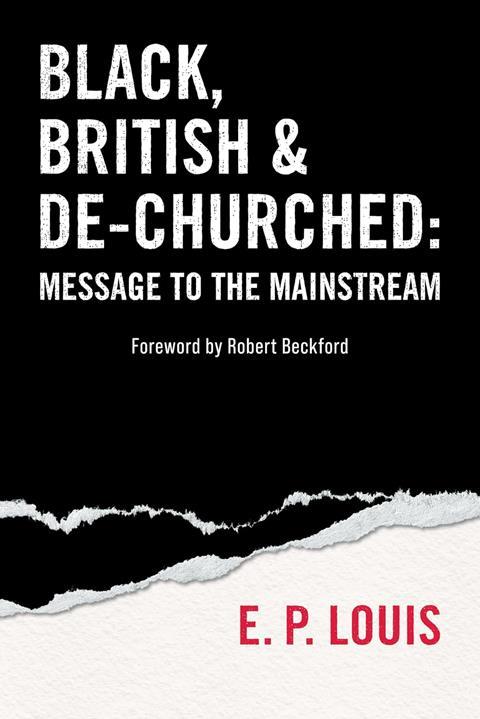
A new book by E.P. Louis argues that many Black Christians are not rejecting God, but a form of Colonial Christianity they’re encountering in British churches

In Black, British and De-churched: Message to the Mainstream (SCM Press), E.P. Louis confronts a question many churches are quietly asking: why are some Black British Christians leaving mainstream congregations for alternative, Bible-centred religious spaces?
Drawing on ethnographic research, Louis explores the growth of Afroasiatic Diasporic Religions such as Rastafari, the Nation of Islam, the Holy Qubtic Church and Black Hebrew Israelite communities. Rather than dismissing them, she treats them as serious theological and sociological voices, asking what their appeal reveals about gaps in British church life.
Central to her argument is Black consciousness, which she describes as an intentional effort to: “explore and embody ‘Blackness’ in all its diversity, evolution and complexity”. Drawing on thinkers such as Kwame Anthony Appiah, Louis explains her use of the capitalised ‘Black’ as a reminder that it refers to a social construct – a product of: ”what white supremacy has created”. It signals not biology, but a shared history shaped by racism and resilience.
What makes this book compelling is its nuance and empathy. Louis acknowledges that many of the ‘de-churched’ remain committed to scripture. They are not rejecting God so much as what she refers to as Colonial Christianity, a form of faith entangled with empire, which combined: ”the mission to convert lost souls with the mission to dominate nations to satisfy imperialist ambition”. Engaging voices such as Cornel West, she echoes his warning that even in our “most prophetic moments”, we can remain complicit in systems of hierarchy and exclusion.
Louis’ autobiographical reflections add warmth and vulnerability. She recounts her own colourblind Christian upbringing and the disorientation she felt once she started studying theology in predominantly white spaces, where her charismatic background seemed subtly undermined. Loving God yet feeling out of place in predominantly white churches is a tension that resonates with many. It helps explain why movements that promise to decolonise Christianity can feel affirming, or even healing.
Louis situates this trend within wider events, including the Windrush Scandal and the rise of the Black Lives Matter movement. Increased awareness of racism has not always translated into meaningful change at congregational level. In that vacuum, alternative spaces that centre Black identity and explicitly resist anti-Blackness can feel not extreme, but necessary.
Louis also engages directly with the language of being ‘woke’, tracing the term from its roots in Black political consciousness to its more recent, polarised usage. Within this frame, some Black people reject what they perceive as the ‘White man’s religion’ and seek a faith that feels culturally and politically alert to threats against Black life. She highlights both the sense of empowerment this offers and the theological tensions it raises for the mainstream Church.
The structure and tone of the book makes it feel almost like a manual for church leaders. Louis expresses her desire that: “deep compassion will be birthed for the de-churched. A compassion that breeds action.” That pastoral impulse runs throughout. She is not interested in scoring points, but in prompting reflection that might shape next Sunday’s sermon and the next generation’s discipleship.
At times the academic framing is dense, but the heart of the book is unmistakable. Louis writes as someone who has wrestled deeply and chosen engagement rather than departure.
Black, British and De-churched challenges British Christianity to examine its blind spots with humility. It asks not only why some are leaving, but what their leaving is trying to teach us.
Black, British and De-churched: Message to the Mainstream (SCM Press) by E.P. Louis is out now

























1 Reader's comment