












A children’s book publisher has drawn criticism from many Muslims for its portrayal of a lesbian woman in a hijab. The controversy speaks to the changing definitions of ‘left’ and ‘right’ in British politics, says Lois McLatchie Miller. She argues that Christians must remember that no political coalition can fully represent our convictions
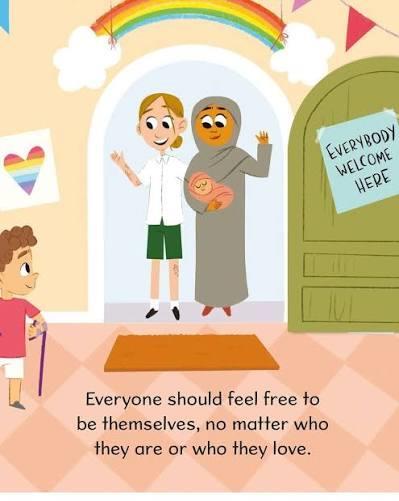
A row over a children’s picture might seem an unlikely place to glimpse the future of British politics. Yet that is precisely what happened last week.
The controversy centred on an image published by children’s book company, Ladybird, to promote Pride month. It depicted a lesbian couple raising a child, and one of the women was wearing a hijab.
Muslim media outlet 5 Pillars responded with outrage at what it regarded as a complete misrepresentation of Islamic teaching, noting that Ladybird books are widely used in schools and read by children as young as two years old.
Predictably, a tornado of social media commentary followed. But beneath the usual online outrage lay a more significant question - and one that Christians are increasingly being forced to confront. In a political landscape where both left and right appear to be changing shape, where exactly do believers fit?
Proverbs calls us to act with wisdom at all times, not blind loyalty to a team
For decades, many Christians felt they broadly understood the political map. The left was associated with secular liberalism, economic redistribution, government interventionism, and increasingly ‘progressive’ views on marriage, sexuality and family life. The right was associated with tradition, nationhood, the shrinkage of state and social conservatism.
Today those boundaries are dissolving before our eyes.
Deepening divides
The Ladybird controversy exposes deep tensions within the progressive coalition. For years, the left has attempted to unite a remarkably diverse collection of interests: secular liberals, LGBT activists, environmental campaigners, ethnic and religious minority communities. This alliance often appeared stable because its members shared common political opponents – largely on issues of foreign policy and immigration.
Yet when fundamental questions of morality arise – and none more acutely so than regarding the Islamic position on marriage and sexuality - the coalition becomes far more fragile.
Many Christians will observe this with little surprise. The attempt to build political unity around identity categories rather than shared moral convictions was always likely to face difficulties when those convictions came into conflict.
But those of us on the right should resist the temptation to view this simply as evidence of problems on the left. The controversy exposed something equally significant in our own backyard.
Until relatively recently, it was generally assumed that social conservatives would find their strongest political allies within the Conservative Party. Questions surrounding marriage, family life and cultural continuity were traditionally associated with the political right. Yet during the Ladybird row, some of the most vocal defenders of same-sex parenting came from representatives linked to the Conservative LGBT+ group. One former chairman responded to critics by saying that those who objected to such values should question whether they belonged in Britain at all.
This new libertarian flavour among the right sits at odds with its foundations. Edmund Burke, often regarded as the grandfather of philosophical conservatism, viewed the traditional nuclear family as the primary institution through which societies transmit wisdom and moral order to the next generation.
Roger Scruton, perhaps Britain’s most influential conservative philosopher of recent decades, similarly argued that while our generation now generally accepts homosexuality as a way of life, nevertheless, “the bond between husband and wife, like that between parent and child, has a moral nature that transcends the sphere of contract. We resonate to the old rites of passage, and wonder what business it is of the State finally to set them aside, with no obvious reason, and with no clear mandate for doing so.”
Changing spaces
In short, both major political coalitions now contain profound internal contradictions. The left seeks to simultaneously champion progressive sexual ethics and the communities that reject them. The right seeks to simultaneously defend traditional social institutions and celebrate forms of personal autonomy that often undermine those same institutions.
Neither side sits comfortably with the full implications of its own worldview. For Christians, this creates a growing sense of political homelessness.
Perhaps this should not surprise us. Scripture has never divided humanity according to modern party labels. Christian teaching challenges assumptions on both sides of the political spectrum. It affirms the dignity of every person while maintaining a distinctive vision of marriage and sexual ethics. It champions compassion for the vulnerable while also recognising personal responsibility. It upholds justice and mercy; truth and grace – praising the reflection of God’s character on both sides where they are present, while condemning the manipulative misuse of these principles for harm.
Scripture has never divided humanity according to modern party labels
The most important lesson of the Ladybird controversy is not that the left is fracturing or that the right is changing - but that Christians cannot assume any one political coalition fully represents their convictions.
It’s great to serve the country as part of a political party. Christians should certainly run for office in whatever capacity they feel will enable their best contribution. But we should also resist becoming unthinking captives of any one tribe. Proverbs calls us to act with wisdom at all times, not blind loyalty to a team. That means praising truth where we see it, and challenging both sides when we don’t.
As old alliances crumble and new ones emerge, the Church has an opportunity to recover a distinctly Christian voice - one that is neither captive to progressive ideology nor dependent upon conservative branding. Our loyalty is not to a party or an identity group, but to Christ.
In an age of political confusion, that independence may become one of the most powerful forms of public witness we can offer.























4 Readers' comments