









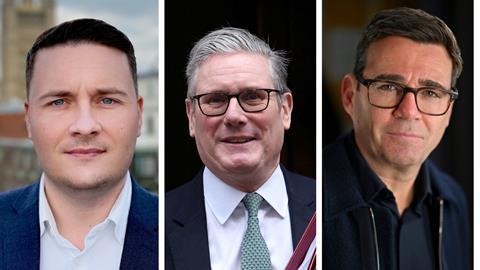
Will Wes Streeting and Andy Burnham challenge Keir Starmer for the Labour leadership? Our ‘stick or twist’ approach to political leadership is making people anxious, says Tim Farron MP, but God institutes government to provide order and justice
The prospect of our seventh Prime Minister in ten years has prompted many people to start asking: “Is Britain ungovernable?” As yet another round of political chaos takes hold at Westminster, I believe the short answer is ‘no’ - but we may be living on borrowed time.
Last week, Wes Streeting resigned as health secretary, followed by several junior ministers, saying they had lost confidence in Keir Starmer’s premiership.
Then, Josh Simons MP gave upd his Makerfield seat to give Manchester mayor, Andy Burnham, a shot at returning to the Commons and challenging for the Labour leadership. Time will tell if the people of Makerfield will fall into line and elect Burnham as requested.
Those who enjoy political drama might be munching on the popcorn right now. But most people simply want to get on with their lives and are, frankly, fed up with more political shenanigans. They want the government to act in the common interest and to do a decent job of running the country.
Governing well
There are two aspects to the question of whether Britain is ungovernable. Firstly, are our leaders still capable of governing? Over recent years, Downing Street has become a revolving door for PMs deemed not up to the task, by their own parties as well as voters.
The Institute for Government believes that, actually, the institutions, rules and culture required for successful governance are largely intact - or at least the means for reform are available. The failure of recent years, it says, is a leadership incapable of working within the unwieldy government machine to get things done. A task that requires “the courage to articulate trade-offs, and the skill to communicate a vision of where the country should be going.”
As Christians, we can share the hope we have in Christ with the anxious world around us
Starmer came in promising reform, but vague on detail and lacking in delivery. And his is not the only recent government to have repeatedly avoided tackling the biggest (and most politically unpopular) issues, such as social care for our growing elderly population.
No wonder the public loses trust when promises fail to materialise, and politicians are seen to be protecting their own careers. This short-termism – thinking only about the next set of election results, polls or headlines – is made even more short term by social media and 24/7 news. The important becomes trivial and the trivial becomes important. PMs are repeatedly defeated by events, with no capacity or inclination to carry out the deeper, longer-term reforms that the country needs.
Deepening divides
The second question of whether Britain is becoming ungovernable is whether people are still willing to be governed. Here I think the answer is, broadly, ‘yes’. Despite the steady post-war decline in deference and trust in authority, the vast majority of people do live by moral codes, pay their taxes and act within the acceptable limits of civil society.
However, the deepening divisions since Brexit, between those who “want their country back” and those who want progressive change, are constantly whipped up into rage and fear by online media, disinformation and the intent of a minority of influential agitators to cause disruption.
The important becomes trivial and the trivial becomes important
It’s easy to sit behind our keyboards and shout at people on social media, or even to march for nationalism, socialism, environmentalism…or whatever ‘ism’ we think will improve our society. But this is a cop-out if we are not also seeking to serve our neighbour in any seriously practical way.
Today we face the combination of a distrustful, noisy electorate and a paralysed succession of governments unable to articulate a hopeful, honest vision of our country’s future.
A firm foundation
But let’s not get too despondent. As Christians, we can share the hope we have in Christ with the anxious world around us.
The Christian hope is that Jesus will, one day, return to make all things new. As we live in the tension between Christ’s first and second comings, the Church has a responsibility to pray for good government, to be curious about – and compassionate towards – other people, and to be politically literate.
Let’s try to understand the concerns of our neighbours and join with our churches in collective prayer for them.
Let’s pray for our national and local leaders, as they try to tackle the problems we all face. God institutes government to provide order, pursue justice and promote flourishing. So, let’s pray for wise and competent leadership, and for grace to acknowledge the scale of the task.
As Jeremiah 29:7 instructs, we should “seek the peace and prosperity of the city” – and country – in which God has placed us. “Pray to the Lord for it, because if it prospers, you too will prosper.”























No comments yet