











Chine McDonald ponders whether Christians are really reacting to dangerous ideas — or merely to the discomfort of sharing church with people from different classes and cultural backgrounds
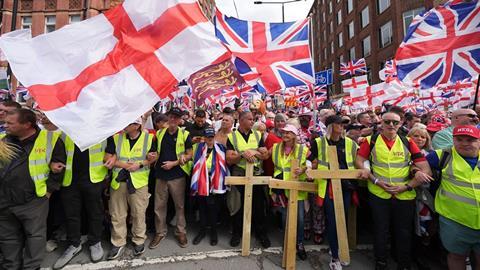
Over the past couple of years, I’ve been in many rooms where a sense of anxiety has been expressed about the co-opting of Christianity for political purposes. We’ve seen crosses carried at Tommy Robinson rallies and ‘Jesus is Lord’ declared alongside anti-immigrant and anti-Muslim rhetoric. In much of the handwringing, I’ve perceived a sense of classism. Sentiments expressed by Luton-born Stephen Yaxley Lennon (aka Tommy Robinson, no education section listed on Wikipedia) are received very differently than if they came from Reform adviser, Dr James Orr, a University of Cambridge professor.
For me, this is less about the rights and wrongs of Christian nationalism and more about who, or what, holds the power in our churches. Research from the Evangelical Alliance more than a decade ago found that 81% of evangelicals went to university, when most average Britons did not. The Church of England is currently attempting to address issues of class, vocation and ministry; with hurt and frustration experienced over its “middle class bias”.
If you were to attend a church-related public event today, the content would likely be similar to a university lecture: a long keynote speech followed by a Q&A. I admit I’m a sucker for these, just as I am for hours-long podcasts that discuss theological issues from an intellectual and academic perspective. The information age lends itself to long discussions of niche concepts. But we kid ourselves if we think that everyone consumes information in this way.
Many Christian leaders are concerned that people with Christian nationalist beliefs might show up at their churches. There is an – incorrect – assumption that they come from different socio-economic classes to those most churches are made up of; I sometimes wonder whether it is their class rather than the content of their opinions we feel uncomfortable with.
The Church isn’t supposed to be a place where we just hang out with people who are like us
The Church isn’t supposed to be a place where we just hang out with people who are like us. The comfort of similarity feels like a feature of many churches today, rather than the messy, awkward beauty of different people being reconciled around the saving work and personhood of Jesus Christ. That is difference in every way: race, socio-economic status, gender, physical ability and disability, politics and class.
The early Church was made up of people who likely felt uncomfortable alongside others who were different to them. But that was partly the point of this new vision of God’s kingdom. Did Jesus come so that we might live our lives surrounded by those who studied at the same institutions as us, who vote like us, dress like us and worship like us?
This is not to diminish the reality that many people feel unsafe in churches where their beliefs make them feel unwelcome or less than. Behaviours that run counter to the gospel must be challenged. The problem comes when it’s only those people over there who need to be transformed. What about me? And you?
Every one of us can and should be changed by the good news of the Christian faith. When people who are not like ‘us’ arrive at ‘our’ churches and their presence feels disruptive, we should welcome them with open arms. It’s profound love that can drive out hate. Exclusion entrenches hate, hard though that is for many of us – myself included – to hear.
For me, it’s not what people come into church believing or thinking, but rather how they can be changed by discipleship and formation, based on the countercultural vision of human flourishing we see in scripture. May God send revival, but may it start with me.

























1 Reader's comment