












Taylor Swift and Travis Kelce’s wedding has been celebrated by women across the West as if it were the news of a close friend. Lois McLatchie Miller argues that the fascination reveals a longing for love that our culture has often taught women to minimise – and one that the Church can breathe life back into
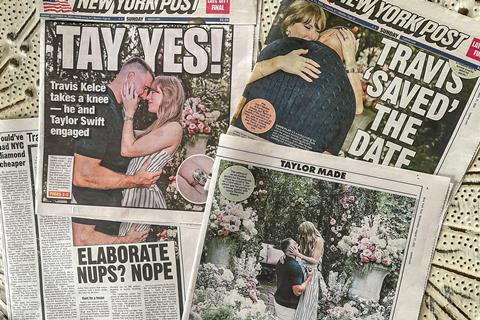
In an era of political division and cultural fragmentation, one subject has united millions of women across the West online: Taylor Swift’s wedding.
The lavish Manhattan ceremony, after all, had been a long time coming. America’s answer to a “royal wedding” continues to dominate headlines a week later. Social media has been filled with speculation about the dress, the vows and the guest list. Women who had grown up listening to Swift celebrated as though a lifelong friend had finally found her happy ending.
It would be easy to dismiss the frenzy as celebrity culture at its most excessive. But Taylor Swift has become something more than a celebrity. For many millennial women, her music has been the soundtrack to growing up. Her songs have narrated our hopes, heartbreaks and disappointments. And perhaps that is why our fascination with her wedding reveals something much deeper.
The soundtrack to millenial longing
For those of us born in the 90s, as teenagers, we sang along to ‘Love Story’, where Romeo doesn’t die but instead kneels and says, “Marry me, Juliet, you’ll never have to be alone.”
The fantasy wasn’t wealth or fame, but faithful, covenantal love.
Those early songs – many dominated with themes of marrying a childhood sweetheart or dancing romantically in the rain – reflected an assumption that marriage was something worth hoping for. It wasn’t embarrassing to admit that one day you wanted a husband and children. It was simply part of growing up.
Then the culture shifted.
As millennials entered adulthood, women increasingly heard that fulfilment would come through career, travel and independence. There is, of course, nothing wrong with ambition. Scripture celebrates women using their gifts in every sphere of life. Proverbs 31 describes a woman who buys fields, runs businesses and provides for her household.
The problem came when our culture – powered by Cosmopolitan articles and Gossip Girl episodes – began treating marriage and family not as goods to be cherished, but as obstacles to self-fulfilment. The highest ideal became autonomy.
Taylor’s music evolved alongside that cultural moment.1989 celebrated reinvention and independence. Her famous “girl squad” became a symbol of female empowerment. In ‘New Romantics’ she summed it up: “We’re too busy dancing to get swept off our feet.”
Yet beneath the confidence, another story was emerging.
As Swift entered a seven-year relationship with actor Joe Alwyn, her songwriting returned repeatedly to marriage. ‘Lover’ echoed wedding vows (“Ladies and gentlemen will you please stand…I take this magnetic force of a man to be my lover”). On another track on the same album, she sang “I like shiny things but I’d marry you with paper rings”.
But the proposal never came.
Called to commitment
When the relationship eventually ended, Swift’s songwriting became strikingly honest about the pain of living in a culture where commitment is increasingly delayed – or never arrives. On The Tortured Poets Department she laments, “You swore that you loved me but where were the clues? I died on the altar waiting for the proof.” Bitterly, she accuses Alwyn, “You let me give you all that youth for free” – with no return on her investment.
In ’The Prophecy’, despite unimaginable wealth and worldwide fame, she pleads in a prayer-like chorus ‘on her knees’: “I don’t want money, just someone who wants my company.”
It is difficult to imagine a more powerful reminder that career success and public acclaim cannot satisfy the deepest longings of the human heart.
That should not surprise Christians. The Bible begins not with human achievement but with relationship. “It is not good for the man to be alone” (Genesis 2:18). Marriage is never presented merely as a social convention but as part of God’s good design, ultimately pointing beyond itself to Christ’s covenant love for his Church.
Of course, not everyone is called to marriage. Jesus honoured singleness, and the New Testament presents it as a genuine vocation. Nor should anyone suggest that women must choose between meaningful work and family life. Scripture leaves room for both. But neither should Christians accept the modern assumption that marriage and motherhood are somehow lesser aspirations for capable women.
Perhaps that is why Swift’s wedding has resonated so widely. It arrives at a moment when marriage itself has become increasingly out of reach for many young people.
The problem came when our culture began treating marriage and family not as goods to be cherished, but as obstacles to self-fulfilment.
In Britain, marriage rates have halved since 1970. Pensioners are statistically more likely to marry now than young men. At the same time, surveys consistently suggest that the majority of young people still hope to marry one day. The desire has not disappeared; the culture surrounding it has.
Taylor Swift’s career has unintentionally illustrated that tension. After years of celebrating self-sufficiency, the emotional climax of her story wasn’t her armfuls of awards or her record-breaking tour – it was finally shaking off her forever-boyfriend afraid of commitment, and embracing her forever-husband for better or for worse.
In promoting marriage on a worldwide scale, Taylor has accidentally achieved what the Church have been too shy to do for some time. But the Church has an even more powerful and healing message about marriage – not that it brings personal fulfilment, but that it is an imperfect mirror to the deep, unfailing love that God has for us.
The audience is ready. Millions of millennials want to know what our culture has recommended they postpone, delay or dismiss. Christians have an opportunity to speak into that longing – not by idolising marriage, nor by diminishing singleness, but by recovering a beautiful vision of covenant, commitment and family as gifts from God.

























No comments yet