


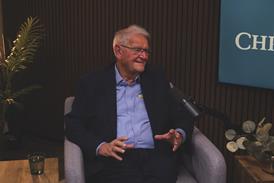









Rather than staying at the surface level, Andrew Bunt invites Christians to think more deeply about the worldview foundations shaping today’s conversations about sexuality. Here’s how you can engage with clarity, humility and conviction

It’s June and that means it’s Pride Month. But I probably don’t need to tell you that – it’s pretty obvious. Rainbows and mentions of Pride are popping up all around us.
Some of us will feel a bit uncomfortable as Pride Month takes centre stage, because it reminds us of something else that is also pretty obvious – traditional Christian beliefs on sexuality and gender contrast sharply with the dominant perspectives in Western culture. Our understandings of the right context for sex, of what marriage is, and of how we find our identity as a man or a woman are radically different.
Those differences are pretty obvious. What we don’t always so easily spot is that the differences actually run much deeper. In fact, they go right down to our most foundational beliefs – to our worldview, the set of beliefs that shapes how we view and understand everything. Perspectives on sexuality and gender flow from and rest on those deeper, worldview-level foundations.
As a Chrisitan who experiences same-sex attraction and who has sometimes struggled with my identity as a man, I’ve found it really helpful to think about those foundations. I’ve found that it’s only when I get God’s perspective on key worldview foundations that I can make sense of what God says about my sexuality and my gender.
I’ve also found that thinking deeper is helpful when talking to those who don’t share my Christian beliefs. Often, we can have much more fruitful conversations by going deeper and talking about the foundations that lie beneath.
Many of us will find ourselves in conversations about sexuality and gender this month. That might be with friends, colleagues or family members. Why not try taking those conversations deeper – down to the level of worldview foundations? Here are three relevant foundations you might want to bring into your conversations this month.
What is the ultimate authority you should obey?
Everyone obeys an authority. We may not really think about it or even be aware of it, but we all do.
Many people in the modern West believe they should be their own ultimate authority. It’s the ‘no one has the right to tell me what to do’ attitude. However, most also recognise the need for some limit to personal authority to avoid harm to others.
It’s easy to see how this gets applied to sexuality. We are told that we should have full authority to use our sexuality and express our sense of gender however we like, so long as it doesn’t harm others. Consent becomes the only real basis for sexual ethics. Anything else (such as the Chrisitan sexual ethic) is seen as an unjustified, oppressive usurping of our rightful authority.
But is this a good view of authority? I’m not sure we always know what is best for us. And the need to limit our personal authority through the harm caveat shows the whole thing doesn’t really work. Our authority gets immediately trumped by something else. Consent is how the harm caveat gets applied to sexuality – but is consent enough? We can consent to things that aren’t good for us and it’s almost impossible to ensure that consent is freely given; there are just too many variables involved to be able to guarantee that it is.
The Christian view is different. We believe there is an ultimate authority outside of us whom we should obey. That authority is our good creator God – the one who knows what’s best for us (because he made us) and wants what’s best for us (as proven by the sending of his son). He doesn’t take away our right to choose what to do, but he gives us a reliable authority to follow, instructions that are for our ultimate flourishing.
This is why Christians trust God’s sexual ethics – those revealed in the Bible. They are the good, life-giving instructions of the God who made us and who loves us. This perspective doesn’t remove the need for consent – it underpins it and complements it. Consent is important, but it’s insufficient to protect us from the harms that can come through a misuse of sexuality. God’s instructions help us know how to use our sexuality, and how to respond to our gender, in ways that are good for us and for others.
What is true freedom?
Freedom is a big deal in modern Western society, and rightly so. Freedom is the route to flourishing. But the question is, what is true freedom?
Many in the modern West view true freedom as the ability to do what you want without external restraints. You’re most free when you can ‘follow your heart’ and ‘live your authentic life’. Often the harm caveat gets added again, but the basic idea is that true freedom is about getting to do what you want to do. Anything that might seek to stop you from doing that is seen as harmful and oppressive.
That’s why some people think Christian teaching is harmful and oppressive to people like me. The Bible’s teaching that sex is reserved for marriages of a man and a woman tells me I shouldn’t act on my same-sex sexual desires, but if you view true freedom as the ability to do what you want without external restraint, that’s an oppressive limit to my freedom.
Of course, the problems here are already quite obvious: not all desires are good, and following our desires is not always good for us or for others. I think most people already know that, if they stop and think about it.
When I choose not to act on my same-sex sexual desires, I’m not giving up my freedom, I’m choosing to live in true freedom
The Chrisitan vision of freedom is different. Because we are the creations of a good creator, true freedom is the ability to live as we’ve been created to live. That means we are most sexually free, not when we can act on all our sexual desires, but when we steward our sexuality in line with God’s plan revealed in scripture. When I choose not to act on my same-sex sexual desires, I’m not giving up my freedom, I’m choosing to live in true freedom.
But the Bible also shows us that this true freedom is actually only possible for those who trust in Jesus. Apart from Him, we are slaves to sin, unable to live as we’re created to live. But united to Him by faith, we are freed from slavery to sin (Romans 6:6) and we are empowered by the Holy Spirit to live God’s way (Romans 8:3-13). It’s only in and through Jesus that we can be truly free.
Should we embrace progress?
Many modern Westerners see history as an inevitable journey towards what is good. Obviously people recognise exceptions to that, but in general, newer is seen as better and dominant perspectives are assumed to be right. You can spot this when people talk about being on the ‘right (or wrong) side of history’. The idea is of history as a journey of progress that you want to keep up with.
This is definitely where we’re at with sexuality today. Many people see Christians as ‘on the wrong side of history’ and think our beliefs are just a lingering hangover from the unenlightened past. On gender, I wonder if this idea of progress is why in recent years so many people seemed to go along with certain views of gender identity, often even against their own instincts. Now that there are more dissenting voices, the right side of history doesn’t seem quite so clear and so people are feeling more confident to express their doubts. Recent cultural shifts on gender show the problems with this view of progress: there is no guarantee that new ideas are better or that dominant perspectives are right.
A Chrisitan view of progress is somewhat more nuanced. We do believe we’re heading for a better time, but that won’t come through the inevitable journey of history but ultimately through the coming again of the Lord Jesus Christ. In the meantime, life now is a mix of good and bad. We can’t assume that what is new is better or what is dominant is right. Instead, we have to assess all things by what God says – the good instructions of our good creator.
This is just a taster of how thinking deeper can shine light on the differences between modern Western and Christian perspectives on sexuality and gender. Worldviews are complex and there’s lots more we could explore, but this is a starter. Why not see if you can take your conversations about sexuality and gender this month deeper? Make them conversations about authority, freedom or progress, and see what happens.
Andrew is the author of Getting God’s Perspective: A Short Christian Introduction to Worldviews, Sexuality and Gender (IVP)























1 Reader's comment