










When hundreds of theatregoers rose to their feet cheering for Jesus, Coco Parkinson-Huggins found herself unexpectedly moved to tears. The controversial West End musical offers a profound revelation to those with eyes to see, she says
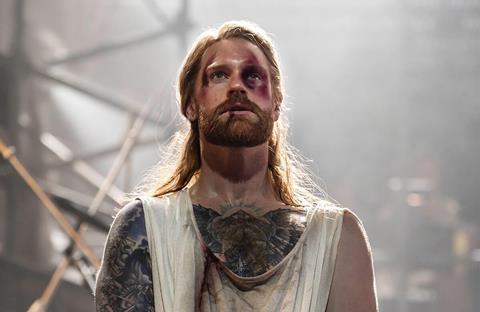
Hundreds of people stood up and cheered for Jesus. Men and women, young and old, were visibly moved. A few - including me, had tears in their eyes. But this was not in response to a baptism, a rousing sermon or a worship band; no, it was in response to a West End musical: Jesus Christ Superstar.
A generation ago, my attendance at this musical as a Christian would have proved contentious for some. I can confidently say, however, that it provoked one of the most profound spiritual encounters I have had in recent years.
Sam Ryder’s performance as Jesus has been met with critical acclaim by some, including by The Telegraph, who called it “divine” and “astonishing”. The Guardian, however, said Ryder’s Jesus “does not seem like the dangerous revolutionary that temple High Priest Caiaphas (Bob Harms) regards him to be, but rather a nice guy, verging on the bland”.
The irony of calling Jesus “a rather nice guy” is not lost on me, but I see where the reviewer is coming from; there is a kind of uncanniness or “set apartness” about Ryder’s portrayal, compared to the excess of those around him. This is, I think, a strength not a weakness.
Who do you say He is?
Throughout the musical, we see Simon the Zealot, Mary Magdalene, Doubting Thomas, Judas and others all trying to cast Jesus in a particular way. For Simon the Zealot, Jesus is a warrior-saviour, sent to save the Jews from “the filth from Rome who rape our country”. Many might see glimpses of the more militant approaches to Christianity we see today in this view.
For Judas, Jesus seems to be a socialist teacher with good news for the poor. None capture the essence of who Jesus is, but Mary Magdalene comes closest when she sings: “I don’t know how to love him / I’ve been changed, yes, really changed… / When I’ve seen myself / I seem like someone else / I don’t know how to take this / I don’t see why he moves me / He’s a man / He’s just a man.”
Many have suggested her relationship with Jesus is romantic - which is certainly blasphemy in my view. Christians know that Jesus was fully man and fully divine, but this production suggests an internal struggle between two natures.
Throughout the performance, I was confronted with Jesus’s humanity. I watched as Ryder portrayed a superstar of his age, crowded by people who all seemed to want him but not to know him. In the song ‘Simon Zealotes’, the crowd sing: “Christ you know I love / Did you see I waved? / I believe in You and God, So tell me that I’m Saved / Jesus I am with You / Touch me, touch me, Jesus.”
I was reminded of Luke 5:17-19, where the friends of a paralysed man were so desperate for him to meet with Jesus and be healed, that when they couldn’t get through the crowds they climbed up onto the roof and lowered him through it. Even contemporary celebrity culture still struggles to match this level of devotion.
Watching Ryder perform, it was hard not to wonder whether it was a reflection of his own personal faith. When sharing photographs of himself in the show with his four million followers on Instagram, he pre-empted potential criticism by captioning a post with “Anyone close to me knows that I honour that [Jesus’s death] every day. All glory to God.”
Faith made personal
Then there was the crucifixion scene, which I found near-impossible to watch. For some, the absence of a resurrection, as much as the portrayal itself, makes it so. But for those who choose to believe, the show’s ending, in which Ryder steps off the cross and the lights go dim, offers a nod to the resurrection; a handing over to us. A fully interactive Act Three in which we move from being an audience, watching Jesus work before us, to being part of His plan and the continuation of His Story.
For those who choose not to believe, the story simply ends and life continues as it did before. In 2022, when the show celebrated its 50th anniversary, Cameron Smith described it as “radically agnostic”, saying: “two people could easily come away with completely different interpretations.”
In this production, I’d argue that it’s more than that. It not only narrates much of the gospel story but speaks to what the gospel is on a fundamental level.
When you see Jesus Christ Superstar, you see what you want to see. You can see a great musical about a historical figure. You can see a desecration of the gospel. Or you can see the humanity of Jesus and his suffering - and choose to live in Act Three.
I choose to live in Act Three.

Jesus Christ Superstar is at the Theatre Royal Drury Lane from 16 October 2026 to 9 January 2027 before commencing a UK tour






















No comments yet