










Macklemore has been dropped from Ed Sheeran’s US tour following his “Free Palestine” comments. But what does the phrase mean and is it inherently antisemitic? Gavin Drake takes a look at the various ways those two contentious words are understood
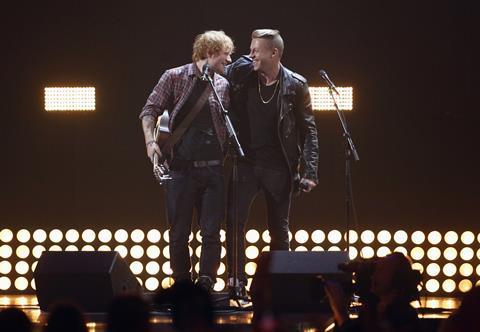
American rapper Macklemore has been dropped from the remaining dates of Ed Sheeran’s US tour after using his opening performances at New Jersey’s MetLife Stadium to declare “Free Palestine” and condemn Israel’s actions in Gaza. The tour promoter said venues had objected to the way Macklemore delivered his message and that retaining him could have led to shows being cancelled.
The rapper sought to distinguish opposition to Israel’s conduct from hostility towards Jewish people, telling Jewish members of his audience that criticism of Israel was “in no way” criticism of them.
The controversy has generated renewed questions about whether criticism of the Israeli government is antisemitic and whether support for Palestinians necessarily means opposition to the Jewish state.
Questions about the geopolitical status of the Holy Land predate the creation of modern Israel in 1948. Biblical and subsequent history records control passing through the hands of Canaanites, Israelites, Philistines, Assyrians, Babylonians, Persians, Romans, Byzantines, Muslim caliphates, Crusaders, Ayyubids, Mamluks and, from 1516, the Ottoman Empire. After the First World War, the territory became British-administered Palestine.
The United Nations proposed separate Jewish and Arab states in 1947. Israel was established the following year, while the West Bank and Gaza came under Jordanian and Egyptian control until Israel captured them in 1967. Today, Israel is a sovereign state, while the West Bank, East Jerusalem and Gaza are internationally regarded as occupied Palestinian territory. The widely recognised State of Palestine has yet to secure full sovereignty.
One phrase, competing meanings
So what does “Free Palestine” mean?
At its most straightforward, it is a call for Palestinians to be free from occupation and displacement. It can mean an independent Palestinian state alongside Israel, or equal rights and freedom for everyone living between the Jordan and the Mediterranean.
Understood in that way, “Free Palestine” is a laudable call. It is not antisemitic to defend Palestinian rights, condemn settlement building, oppose the actions of an Israeli government or demand an end to occupation.
But the same words can carry a very different meaning. For Hamas and other rejectionist movements, a free Palestine means replacing Israel with a Palestinian state throughout the entire territory. At its most extreme, that vision would require the expulsion, subjugation or killing of Israeli Jews.
That is why the chant “From the river to the sea, Palestine will be free” is so contentious. Some campaigners say it demands equal freedom throughout the land. Many Jews hear a demand for the eradication of their country — an understandable fear when the words are used by organisations committed to Israel’s destruction.
Many supporters of both Israel and Palestine have abandoned the idea of two states. Some Palestinian supporters regard Israel as a colonial power created by European invaders who stole Palestinian land. Benjamin Netanyahu’s government, meanwhile, is accelerating the authorisation and expansion of Jewish settlements across the occupied West Bank, fragmenting Palestinian territory and making a contiguous Palestinian state increasingly difficult to establish.
Jewish safety and Palestinian freedom are not competing moral goods from which Christians must choose one.
The planned E1 development between East Jerusalem and the settlement of Ma’ale Adumim now encompasses 3,401 homes and would divide the northern and southern West Bank while separating it from East Jerusalem. Finance Minister Bezalel Smotrich — subject to an asset freeze and travel ban under UK sanctions — has openly described the project as a means of “burying” the idea of a Palestinian state.
Israel’s fragmented political system compounds the problem. Elections rarely give any party an overall majority, allowing small extremist parties to exercise disproportionate influence because larger parties need their support to form a governing coalition.
Yet responsibility for the failure of peace does not belong to Israel alone. Hamas committed the atrocities of October 7, 2023, rejects Israel’s right to exist and has ruled Gaza without democratic accountability. The Palestinian Authority is discredited and Palestinians have not had national elections for many years.
Violent extremists do not represent every Israeli or every Palestinian, but they repeatedly determine the conditions under which everybody else must live.
Pick peace or pick a side
Something similar happens to the public debate elsewhere. Macklemore made an important observation: neither he nor Sheeran was the victim in their dispute. Whatever consequences they faced, they remained wealthy and successful performers who could return safely to their families. The people who continued to suffer were Palestinians and Israelis.
The controversy surrounding Palestine Action offers another example. The group was not proscribed because it supported Palestinian rights, but after a campaign of organised break-ins and extensive criminal damage, including attacks on defence companies and RAF Brize Norton. In one raid on Elbit Systems, a police officer was seriously injured.
There is a legitimate argument about whether terrorism legislation was a proportionate response. But once again, Palestinians living under occupation and Israelis living with the consequences of terrorism have become supporting characters in an argument largely about ourselves.
That temptation extends to language about Zionism. Some people insist that they are not against Jews but only against Zionists. Yet Zionism, in its mainstream Jewish meaning, affirms the Jewish people’s right to national self-determination in their ancestral homeland and supports Israel’s continued existence as a Jewish state.
Jewish attachment to the land and to Jerusalem cannot be dismissed as a modern invention. At the conclusion of the Passover Seder, and in many traditions at the conclusion of Yom Kippur, Jews say: “L’shanah haba’ah b’Yerushalayim” — “Next year in Jerusalem”. The longing is centuries older than modern political Zionism.
Christians should understand that longing, while also hearing the cries of Palestinians — including Palestinian Christians — whose families have lived in the land for generations.
During the final days before his arrest, Jesus approached Jerusalem and wept over it. He looked upon people whom He loved — loved so much that He would die for them — and saw violence and destruction ahead. His lament reaches beyond one moment in Jerusalem’s history and speaks into every generation that fails to recognise the things that make for peace.
Christians cannot pray honestly for the peace of Jerusalem while ignoring injustice against Palestinians. Nor can we campaign for Palestinian freedom while remaining indifferent to Jewish fear or repeating the prejudices which helped to produce centuries of persecution.
Every Israeli and every Palestinian bears the image of God. Neither people is collectively guilty for the actions of its leaders. Jewish safety and Palestinian freedom are not competing moral goods from which Christians must choose one.
Psalm 122 calls us to pray for the peace of Jerusalem — not just for the city, but for all the people of the Holy Land. We should especially pray that Israel’s Knesset after elections scheduled for October 27 contains a majority committed not to domination or revenge, but to the difficult work of justice, security and peaceful coexistence.
A truly free Palestine cannot exist while Israelis live in fear of destruction. Israel cannot truly be secure while Palestinians remain occupied and denied freedom. Peace will begin only when both peoples are allowed to thrive.




















No comments yet