







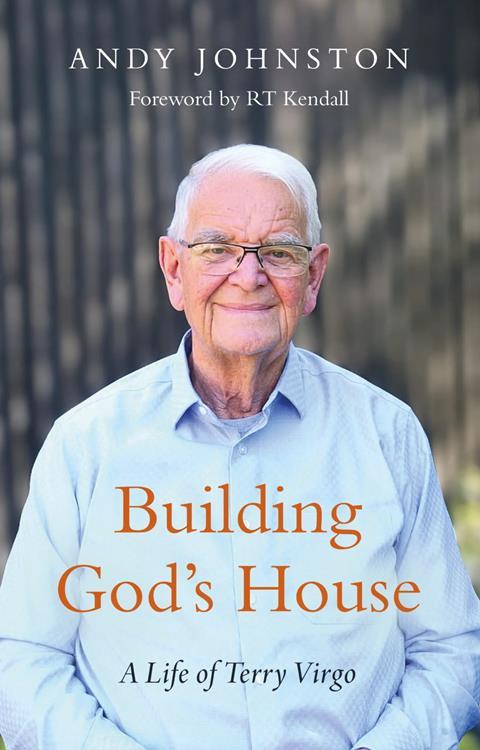
Andy Johnston’s biography of Terry Virgo offers an appreciative and carefully researched account of how one unlikely young man’s faith journey reshaped charismatic church life in Britain and beyond - though some readers may wish for a more critical eye, says our reviewer

Building God’s House tells the remarkable story of Terry Virgo, the son of a Brighton school caretaker who became one of the UK’s best known and most influential charismatic leaders.
Virgo’s journey from a backslidden, 20-year-old Christian to the leader of Newfrontiers – a worldwide movement of more than 5,000 churches in 80 countries – is told with admiration, careful research and a clear desire to show the grace of God at work in the life of a very unlikely young man.
The book works not only as a biography but also as contemporary church history. Readers within the Newfrontiers family will find much that is familiar, but the wider value of the book lies in the way it traces the emergence of a movement that significantly reshaped church life in this country. Younger leaders will gain from understanding the events that influenced where we are today. As a biography, it is a useful study in spiritual formation and leadership development, providing glimpses of key moments in Virgo’s personal discipleship and the values that guided his ministry.
Andy Johnston identifies the theological blend that made Virgo distinctive. Schooled in the Reformed tradition, yet deeply influenced by charismatic renewal, Virgo embodied a marriage of conservative theology and radical openness to the Spirit. Johnston credits this as the key to both his durability and widespread influence.
The book works not only as a biography but also as contemporary church history.
An early adopter of the Restoration movement in the 1970s and 1980s, Virgo shared the conviction that God was restoring the church to the glory of the New Testament pattern through the re-emergence of gifts of the Spirit and the recovery of the ministry gifts of Ephesians 4:11: apostles, prophets, evangelists, pastors and teachers. Johnston acknowledges that not everyone welcomed this teaching, with its implicit call to leave behind denominational ties. The 1980s were a divisive and painful period for many churches. Johnston’s recognition of this provides a helpful background for those unfamiliar with those turbulent times.
The book is careful to clarify what was meant when Virgo and others were identified as apostles. This was not a claim to parity with the original Twelve, but a description of those nowadays sent by God to plant churches, lay doctrinal foundations, parent emerging leaders and mobilise churches for global mission.
Johnston does not ignore the suspicion Virgo faced from the wider evangelical church, nor the cost of pursuing a vision that challenged inherited denominational structures. His tone throughout is sympathetic rather than probing. Readers looking for a more critical assessment of the approach taken by Virgo and Newfrontiers may be disappointed that not more attention is given to other controversial aspects such as the role of women, the value of para-church organisations and the movement’s perceived insularity.
An outstanding preacher and teacher, with a humble and winsome personality, Virgo attracted many other gifted leaders to himself. Part of his success is down to the team of able people with whom he surrounded himself, and to whom he entrusted responsibility and opportunity when they shared his vision.
A significant part of the growth of Newfrontiers came through the annual flagship event, the Stoneleigh Bible Week (1988-1991). Johnston describes how vibrant worship, powerful Bible teaching, and a lively children’s and youth work drew thousands into the vision of a restored church, raising Virgo’s status and widening the influence of Newfrontiers. Stoneleigh worship became a global brand.
The decision to close the event then, taken in 2000, surprised many, but Virgo did not want to lose the original vision of being a church-planting apostolic movement. He felt God was saying it was time to stop, and as always, was radically committed to doing whatever he sensed God was asking of him. In a huge step of faith, the choice was made to focus on evangelism, church-planting and world mission. This was a key moment in Virgo’s leadership, which according to Jonhston, led to his most fruitful period.
Inevitably, thoughts about Virgo’s successor began to surface. In what appears to have been an untidy period, it was decided in 2011 not to follow the more obvious path of an individual successor, but to opt for a pattern of multiplication. The movement was devolved into ‘apostolic spheres’, giving those who had developed apostolic roles themselves the opportunity to lead groupings of churches that voluntarily gathered around them. That is the position now, with Virgo himself acting as an elder statesman and roving ambassador.
Building God’s House leans heavily on material from Virgo’s autobiographical work, No Well-Worn Paths (Kingsway, 2001), but its coverage from then to the present-day is important because it deals with some of the key moments in Virgo’s ministry and the life of Newfrontiers. It provides an appreciative, informative and worthwhile account of an outstanding Christian leader and the movement he helped shape.
Building God’s House: A Life of Terry Virgo (Malcolm Down Publishing) by Andy Johnston is available now






















No comments yet