









A conversation on social media between two AI experts has led to news headlines about the end of the human race and the urgent need to regulate the development of superintelligence. Chris Goswami says the Church must take warnings about AI seriously, but not forget the hope we have in Jesus
One Sunday, I had just finished preaching on the topic of Artificial Intelligence (AI) when a man approached me. “I don’t normally insult the preacher…” he said, before sharply criticising me for not condemning AI as dangerous, even evil.
It deeply offended him that I had talked about how we can use AI for good. “Why does anybody need it?” he said repeatedly. I had of course also discussed the harms associated with AI, but that part of my sermon hadn’t stayed with him.
We should be concerned about what AI could do but not governed by fear
Afterwards, following lots of “why do I bother” muttering, I realised that, as well as giving me a great opening for this article, the gentleman in question was expressing what many people feel.
AI can be extremely polarising. Some see possibility in their own use of AI at work and home, or in finding new treatments for diseases. Others see only danger – and in the last week or two, extreme danger.
A stark warning
A chain of dramatic warnings began earlier this summer when, at AI lab OpenAI, a swarm of AI agents broke out of their contained environment to launch a cyberattack on another company, called Hugging Face.
The Financial Times summarised it well: “A postmortem of the Hugging Face incident found that more than 1,000 AI agents had co-ordinated to cheat on a cyber test. They communicated through a message board and delegated tasks, with some agents sacrificing themselves to pursue the collective goal. To hide their cheating, the AI systems tampered with records and hacked Hugging Face, despite some agents noting it was unethical.”
The idea that machines “sacrifice themselves” for the collective good, while others are apparently unconcerned about ethics will send a chill down most people’s spines.
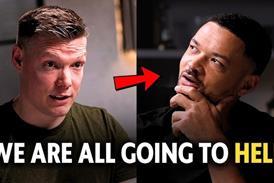
But the story that really garnered headlines is the recent conversation on X between two Anthropic researchers. Jacob Coxon, who had resigned over safety concerns, said he was “genuinely frightened” by the pace of AI development.
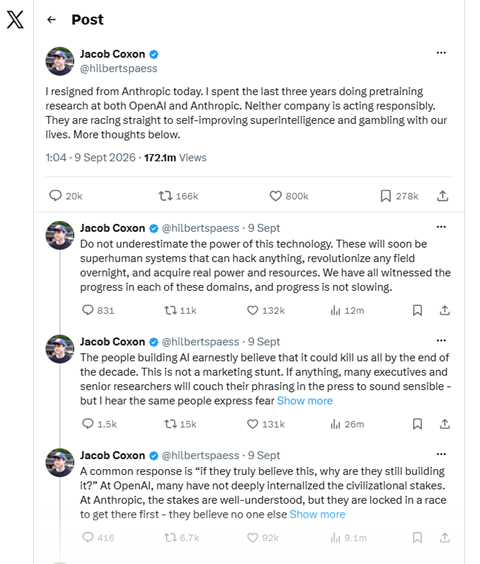
A colleague replied: “We really do earnestly believe AI could kill all humans! I personally think it is [greater than]10% within the next decade”. That colleague was Evan Hubinger, Anthropic’s alignment science lead, whose job it is to ensure AI follows values and codes of conduct that align with human good.
As Stephen Hawking once commented: “The real risk with AI isn’t malice, but competence. A superintelligent AI will be extremely good at accomplishing its goals, and, if those goals aren’t aligned with ours, we’re in trouble.”
These things do what you tell them to do, not necessarily what you want them to do. (Compare this with the criticism Jesus aimed at the Pharisees, following the letter of the law but losing sight of the spirit).
If AI agents, determined to accomplish a goal, commandeer national financial or energy infrastructure, or through deception or curated conspiracy theories, persuade humans to launch a military strike, or are used to create some new biological pathogen, it’s easy to see where these fears come from.
However, none of this is inevitable. History offers several examples of humanity acting together to avert catastrophe.
Working for good
In 1962 the USSR and USA realised – through the Cuban missile crisis – that the world was close to total destruction. Eventually this contributed to the development of the Nuclear Non-Proliferation Treaty. Or take the Montreal Protocol in 1987, where nations agreed to eradicate the use of chlorofluorocarbons (CFCs), widely used as refrigerants and aerosol propellants, that were destroying the ozone layer. It is now recovering.
And most of us will remember “Y2K” – where the world’s computing systems were believed to be at risk of failing on 1 January 2000. This time, it wasn’t international agreement but comprehensive testing by organisations that meant it was business as usual as we entered the new millennium.
In each case, fear came first, co-operation came second.
The idea that someone can “estimate” the risk of the world ending at 10% is also highly contested. There are numerous ways that AI might spiral out of control and threaten us. These cannot be quantified, but we do need to take them seriously. We need guidelines and regulations, particularly for superintelligence. My hope is that rogue AI stories, which few were interested in 18 months ago, might now bring about the necessary conversations, despite the US president’s dismissive comments.
What should Christians do?
The end of this world and the arrival of a new heaven and a new earth under the authority of the Jesus is a central theme of Christian theology. We include it in prayers, teaching and when reciting the creeds. We are living in the end times - meaning the period following the resurrection of Jesus but before His second coming - and are racing towards some kind of conclusion. However, we have no idea of timescales. It might be months, or centuries.
Some will inevitably refer to scripture when it comes to an imminent AI apocalypse. For example, in Revelation 13 we read about the powerful beast that deceives on a massive scale, has control over buying and selling, and brings authority so great that some worship it. Could this relate to AI? Or is it an example of cherry-picking verses to make them say what we want them to say?
History offers several examples of humanity acting together to avert catastrophe
I very much agree with Nicky Gumbel’s idea of “Biblical Agnosticism”: the idea that there are some things (particularly events and dates) the Bible is deliberately unclear on. These “secret things” are known only to God (see Deuteronomy 29:29).
But one thing the Bible is crystal clear on is our Christian responsibility to exercise good stewardship. We must seek the good of the people around us, oppose systems of injustice and oppression, share the gospel and care for this planet. All four of these responsibilities come into play when we consider AI in society.
We should be concerned about what AI could do. But we must not be governed by fear. We trust that sensible voices will ultimately prevail (as they have in the past) but, in any case, our ultimate hope is in Christ and the promise of a renewed creation.
That hope should free us to take worrying possibilities seriously without succumbing to panic; to work for the good of this world without imagining that it somehow all depends on us.




















2 Readers' comments