











The US Vice President J.D. Vance suggested in a recent interview that the antichrist could already be among us. David Griffiths believes his comments are reasonable. He argues our modern world is beginning to resemble the kind of civilisation that scripture predicts
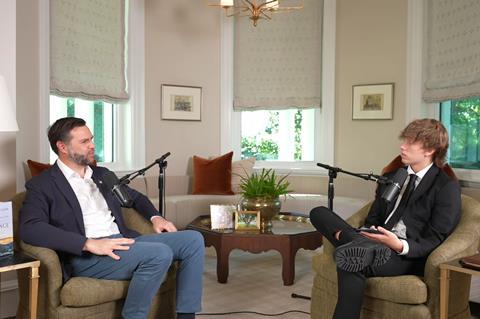
In his recent interview with the podcaster and evangelist Bryce Crawford, US Vice President J.D. Vance spoke candidly about his fascination with end times prophecies and declared he would “not be shocked if the antichrist was already among us.”
Because of his use of the term “antichrist,” sections of the press have been eager to find a sensationalist angle. But anyone watching the interview looking for a controversial scoop would come away disappointed. Its tone was very relaxed and informal, covering the topics of faith, family, and personal history, all with Vance’s new book, Communion, on clear display.
It is only the nature of his high office that makes his mention of the antichrist newsworthy, although at no stage did Vance hint at anything more than his own private speculation. The closest he came to saying something of concern was when he confessed he felt “a certain darkness” about some of the things unidentified world leaders he has met with have said, some of which “set off every spiritual alarm bell” in his body. But that personal perspective doesn’t confirm that any of those leaders were the incarnation of satanic evil.
To those outside the faith, the entire subject may be an odd — even concerning — thing to talk about. But to many evangelical Christians, discussing the idea that the antichrist might already be in the world is not that unusual.
The rise of the individual & the fall of humanity
When considering the end times, many of us will look at how disjointed and vulnerable to chaos the world has become. War, the effects of the COVID-19 pandemic, the AI revolution, earthquakes, eclipses and weather anomalies have all fuelled anxieties that things may be drawing to a close.
But as Jesus stated, “wars and rumours of wars” do not necessarily mean the end is near. It is not world events but something of a more spiritual nature that makes me believe the end could be coming soon.
In 2 Thessalonians 2, the figure we commonly call “the antichrist” is described as one who will proclaim himself to be God, echoing the prophecies of Daniel (Daniel 11:36–37), Jesus (Matthew 24:15), and John (Revelation 13:5–8). It is this specific characteristic of exalting himself above all things, including God, that reveals his satanic character.
Were the Man of Sin to appear now, many would welcome him because he is already familiar to them.
This kind of self-exaltation has become eerily common. A lot of modern thinking is grounded in the idea that human beings are the ultimate authority, that an individual’s version of truth is more important than what is really true, and that people finding and expressing their “authentic selves” is the key to happiness, success, and fulfillment.
It is also possible that, because the spirit of antichrist is already in the world (1 John 4:3), the philosophy that human beings, not God, are the ultimate authority is a manifestation of this spirit, and it is this tendency rather than a particular individual that is prophesied in scripture.
While I do not strongly favour a particular eschatology, I am more inclined to believe in a pre-millennialist, futurist view here, and see the Man of Sin as the human embodiment of the spirit of antichrist. One reason why I favour this opinion is Paul’s use of personal titles such as “son of perdition,” and “the lawless one” to describe him (2 Thessalonians 2:3-9).
A culture primed for the man of sin
Much of the rapid growth of the sort of individualism where the self comes above everything else is very likely to be a consequence of the decreasing social influence of Christianity. This has led to many people effectively replacing the greatest commandment — to love God above all things and to love our neighbours as ourselves — with the infamous occult motto “do what thou wilt shall be the whole of the Law.”
With the number of people classifying themselves as Christian in England and Wales reaching a record low of 46% in the 2021 Census — down from 72% in 2001 — an ongoing decline in Christian influence is certainly evident. The population of those identifying as Christian fell by 9% and 11% in the historically Christian lands of Europe and North America between 2010 and 2020.
By itself, this decline does not mean we are going through the great falling away that Paul warned of in 2 Thessalonians. But combined with the significant rise of occult spirituality — many of which promote philosophies that claim human beings can become their own gods — the overall picture starts to look more like the one Paul painted.
The spiritual character of the modern world — particularly the West — bears troubling resemblance to the civilisation scripture tells us will characterise the end of the age. That civilisation will be one which departed from the faith and rejected truth (2 Thessalonians 2:3,10–12), subscribed to the spiritual teachings of demons (1 Timothy 4:1), and increased its tendencies towards self-centredness (2 Timothy 3:1–5).
The times may therefore be ripening for the coming of the Man of Sin. Were he to appear now, many would welcome him because he is already familiar to them. He represents what they already think, and what they already want.
Despite the possibility that such a man may currently walk among us, we should avoid anxious speculation. While cultural Christianity may have declined, the Gospel of Christ has lost none of its power.
For now we must simply live a prepared, Christian life, rejoice in Christ, and pursue the fulfilment of the Great Commission.






















4 Readers' comments