












Donald Trump’s Easter address was rich in biblical language and bold claims — with some even comparing him to Jesus Himself. But Chris Goswami warns that this blend of faith and political power risks reviving a Christianity of the past: one shaped more by power, dominance and coercion than by the way of Jesus
Perhaps like me you heard the Archbishop of Canterbury’s Easter address, speaking of God’s pre-dawn work of resurrection – that even in the darkness of Sunday morning, God was at work. Or perhaps you attended your own church celebrations for Easter Day… But you may have missed President Trump’s Easter address.
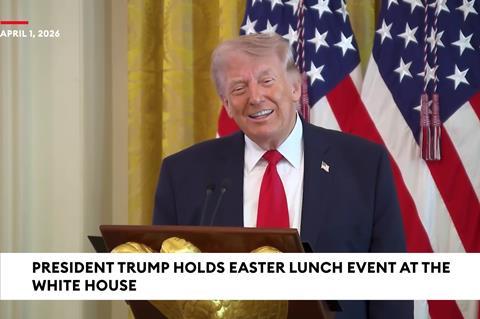
It took place last week at the White House as an “Easter Lunch” where President Trump gave a lengthy address that included an account of the Easter story. “On Palm Sunday, Jesus entered Jerusalem as king,” said Trump, “They call me king now, do you believe it?” This was a flippant, tongue-in-cheek-remark, but the comments that followed his speech were more serious.
Paula White-Cain, tele-evangelist and senior faith advisor to Trump, drew a direct comparison between Trump and Jesus: “Mr President, no one has paid the price like you have paid the price. It almost cost you your life. You were betrayed, and arrested, and falsely accused,” she lamented. “It’s a familiar pattern that our Lord and Saviour showed us, but it didn’t end there for him, and it didn’t end there for you.”
Most of us on hearing comparisons between Donald Trump and Jesus, would fall off our chairs. And these weren’t the only biblical references. Franklin Graham, referring to Iranians as enemies of the Jews, compared Trump with Esther: “The Iranians want to kill every Jew with an atomic fire, but you (Lord) have raised up President Trump for such a time as this.”
These remarks came during a fervent and lengthy time of prayer for Trump (during which he, however, appeared distracted in a how long are these prayers going to take? kind of way).
Trump recounts the Easter story
Most of Trump’s 40+ minute speech was him rambling on about his predecessors’ failures, contrasting them with his own successes, on borders, immigration, and military campaigns. It was a repeat of criticisms of NATO mixed in with personal insults directed at European leaders, although he was mildly respectful of King Charles, and he did engage in friendly banter with his audience.
Overall, it was what we’ve come to expect. Crude political boasting, partisan attacks, barbed jokes. But then there was a sudden change of tone as he read out a prepared text that accurately portrayed the last days of Jesus on earth. It was mixed in with unsubstantiated comments about rising Bible sales and growing church attendances, but otherwise it broadly summarised the Easter narrative from Jesus’ entry into Jerusalem to the cross and the resurrection.
Unless we live in the US, this will surprise us – I have spent almost 3 years in different parts of the US and the way this country’s politics and religion are tightly bound still surprises me.
Trump also restated his stance against transgender ideology, his campaign to restore the word “Christmas” (as opposed to Happy Holidays). And significantly on Israel he commented, “I know you’re big Israel fans. Frankly…I think [Christians] like Israel more than Jewish people like Israel.” All playing to a grateful audience.
Who was the audience?
The room was filled with well-known evangelical Christian leaders with whom Trump feels very comfortable (in a way that no European leader would). The lunch event helps to further illustrate why many American evangelicals remain drawn to Trump – he offers them recognition, a voice in the public square, and, frankly, honour.
Trump’s group of well-known Christian leaders, which he has carefully curated, has even been referred to as his court evangelicals. A reference to courtiers in medieval Europe who had a seat at the table, and significant influence, as long as they continued to flatter and praise the monarch.
This is a gospel of good news for a select few. It is an aggressive militaristic blend of Christianity – and, 500 years ago, it took a Reformation to overcome it.
Nevertheless, we couldn’t imagine a UK (or European) PM telling the account of Easter, and even boasting of how Christians have changed society for the better. In fact, many of us might wish for a political leader who was half as outspoken for the Christian faith as Donald Trump. It’s easy to buy into this.
Comparing Trump to Jesus?
But what about the comparisons of Trump to Bible characters, even Jesus? To what Bible character could we compare Donald Trump?
Many evangelicals say their support for Trump is biblical, likening him to the Old Testament King Cyrus – and this has been discussed often. Despite being a Persian ruler from another religion, Cyrus is anointed in Isaiah 44-45 as God’s shepherd, to deliver ancient Israel from Babylonian captivity. There is this idea of an imperfect vessel used for good, and applying it to Donald Trump. The end justifies the means – you can see how all this appeals to Christians wanting to defend traditional Christian values.
What about the comparison with Jesus? Jesus is often cited as the most influential person in history and we see in Trump, possibly the most influential person of our time. For example, I find it astonishing, that this man comments unthinkingly on social media and, literally the next day, my pension-fund falls in value. But this is more to do with the volatile, highly-strung world we now live in where a very small number of strong men affect the lives of billions. Comparing Trump to Jesus is at best misguided and will (and did) offend many.
I think an alternative comparison might be to one of several Old Testament Kings in the times following the Judges. Despite a few good eggs mostly these were, self-absorbed, narcissistic, cruel men with many failings. Powerful but at the same time compromised and prone to using religion to serve their own ends.
Reviving the past
The final speaker, pastor and tele-evangelist Robert Jeffress summarised the mood of the gathering by crediting President Trump with ushering in a worldwide spiritual revival. Is a worldwide revival possible? Yes, it is, but revival of what exactly?
It seems to me this is reviving a Christianity that harps back to previous centuries. At that time, yes churches were full, but mainly because the church persecuted people who disagreed, sponsored military campaigns abroad, and worked on the principle that you could terrorise people into the pews. Its attitude to leaders was that personal moral failure could easily be overlooked by national dominance.
Where in this kind of “revival” is any concern for the marginalised? Where is love for the neighbour “not like me”?
This is not the way of Jesus. This is a gospel of good news for a select few. It is an aggressive militaristic blend of Christianity – and, 500 years ago, it took a Reformation to overcome it. Jesus didn’t grasp worldly power, he actually laid it down. He didn’t use people, he served them. This is our uncomfortable, authentic Easter gospel.

























7 Readers' comments