





As Islamist groups continue to target thousands of Christians in eastern Congo, violence, displacement and disease are combining to create a devastating humanitarian crisis. Open Doors’ Ben Cohen speaks to some living through the chaos
Sometimes something that should be a huge blessing can turn into the most terrible curse.
According to Jean Pierre Elikia*, that’s exactly what has happened to his home province of Ituri in the Democratic Republic of the Congo (DRC). “People sometimes say that when God distributed the wealth of the world, he poured everything into Ituri.”
Jean Pierre works for the media in Ituri. He has watched as his beloved home has been torn apart, first by violence, now by the latest outbreak of a deadly strain of the Ebola virus – the 17th such outbreak in the country.
“The violence begins with neighbouring countries that covet these resources,” he says. Among the bounty underfoot are gold, cobalt and rare earth minerals such as tantalum, used in the manufacture of smartphones and computers.
“Neighbouring nations try to seize our resources by force. Unfortunately, they are supported by multinational companies which help to finance efforts to destabilise our country. Because of this, certain armed groups take advantage of the situation to spread violence and division.”
This destabilisation is driven by a myriad different armed groups in the country – there are over 100 – violently vying for control. Even with outside assistance the DRC government has struggled to respond.
Terror in the villages
One such group is the militant Islamist group Allied Democratic Forces (ADF), and they are the biggest threat in this area.
The ADF has targeted and killed hundreds of Christians in Ituri and the neighbouring province of North Kivu – along with Muslims they consider heretical. The attacks are unrelenting and are, at time of writing, ongoing.
The attack in Ntoyo village in North Kivu is just one gruesome example from last September. Those of a sensitive disposition may wish to skip the next few paragraphs.
The attack began at the Roman Catholic church where the terrorists attacked worshippers gathered at a funeral service.
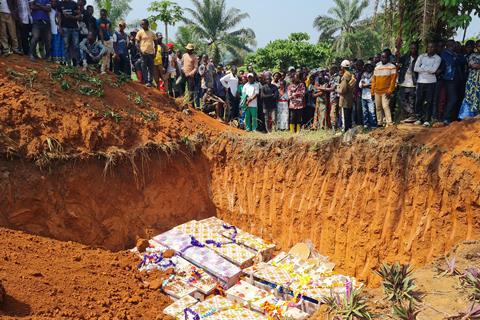
“At this funeral, they coldly murdered 26 Christians,” says Rev Mbula Samaki from the region. “Those who tried to flee were shot dead and others were killed with machetes.”
Thousands of women and children are snatched away as slaves and forced to participate in future attacks.
Videos shared via messaging apps, showed a bloodbath; dead bodies strewn on the ground and stacked in mud-brick huts. The surviving families’ shrieks of agony can be heard in the video.
Founded in Uganda, the ADF has since 2019 pledged allegiance to the Islamic State (IS) group. According to Open Doors partner Amora Fraja* there is a cold sadism to their attacks, like so many other IS groups across Africa.
“Sometimes you find a bike rider that has been beheaded whilst being tied on his motorbike. You find children who have been killed on their mother’s backs. It’s gruesome.”
Thousands of women and children are snatched away as slaves and forced to participate in future attacks. Ironically, the ADF’s overriding mission is not to control the region’s mineral resources. It is to turn the region into an Islamic state or caliphate.
However, as other groups like the Rwandan M23 vie for control of the region’s resources, the ADF ride the wave of chaos and instability, leaving a trail of destruction and trauma in their wake.
Chaos and contagion
It’s a trail that has driven hundreds of thousands from their homes. And it has made matters so much worse as medical professionals try to stem the spread of Ebola.
According to Jean Pierre, ADF militants will target hospitals in a village and take doctors and nurses hostage to treat their fighters. And they will also steal drugs and medical equipment. It leaves many villages without any medical services.
These are perfect conditions for deadly disease to spread, says Illia Djadi, senior analyst for Open Doors in sub-Saharan Africa:
“Instability creates a power vacuum and weakens state structures.”
“People lack basic services, proper housing and sanitation. Many are living in refugee camps, schools and church compounds.”
“This region is tropical rainforest and experiences heavy rainfall. Thousands of people are crowded into small spaces with no sanitation, no clean water and very limited access to healthcare.”
“All these factors combine to create fertile ground for epidemics to spread again and again.”
Jean-Pierre says that the current Ebola outbreak leaves those driven from their homes doubly afraid. “They are more afraid because they know that people living in their own homes can at least afford soap to wash their hands and protect themselves. For the displaced, even that is difficult. They feel extremely vulnerable.”
“We hope the arrival of Ebola may force the ADF to stop their violence,” he adds. “They could attack a village that is already infected and become infected themselves.” However he sees no sign of this, although they seem to have shifted their focus to North Kivu province, which is not currently the epicentre of the violence.
He says the World Health Organisation have brought supplies into Bunia, the main city in Ituri. However, they have a major task on their hands; many local organisations and hospitals are no longer functioning properly since the suspension of the US Aid programme.
While both the violence in the region and the Ebola outbreak have made international headlines, Christians in the region who have been targeted and driven from their homes feel their story has gone unheard.
“Much of what is happening is not being acknowledged,” says Amora. “It’s being swept in a bundle of conflicts in the Eastern DRC, whereas this violence is something specific that they are going through.”
Jean Pierre agrees that the Christians of Ituri and North Kivu are desperate for their voices to be heard: “Our desire is that Christians around the world pray for peace. And we ask that Christians around the world advocate for us with their governments and leaders. We are suffering greatly.”
*Names have been altered for security reasons




















No comments yet