











When Bangladesh’s new government won a landslide victory earlier this year, they promised to create a tolerant and inclusive society for all faiths. But Christians say attacks against them are increasing. Open Doors’ Asha Lindsay* explains what’s happening
In May, Pastor Kashem was returning home from a market when he was attacked by four men on motorbikes. “They beat me with sticks and warned me, ‘If you continue preaching Christianity or sharing the gospel, we will not spare you next time,’” said Kashem. The assault was so severe that if witnesses had not intervened, Kashem may not have survived.
Atahar, a Christian convert from Islam, had just finished cleaning his shop in a village in northern Bangladesh and was sitting down with a cup of tea before opening when a mob of 500–700 people started gathering outside. Telling him that no Christian was allowed to do business in the area, they tied his hands with a rope and manhandled him outside.
“I lost my source of income, and I do not know how I will feed my family,” said Atahar. That day, two other Christian businessmen were banished from their shops as well. All three families have been banned from using public roads in the village.
These are just two of a myriad of stories documenting the spike in attacks against Christians in Bangladesh since elections on February 12.
Where is the rainbow nation?
The Bangladesh National Party (BNP), who won a landslide victory, had promised a “rainbow nation”, inclusive of all ethnicities and religions.
The BNP’s manifesto states: “Regardless of Muslim, Hindu, Buddhist, Christian, people of the hills, or people of the plains, and regardless of rich or poor – together we shall build a national unity and an indivisible national identity.”
It goes on to state: “Religion is individual, the state is for all, ending all divisions through the unified ‘Bangladeshi’ national identity.”
So why are Christians and Hindus saying that attacks against them have increased?
The election also saw the main opposition party Jamaat-e-Islami, securing an historic 68 seats – 77 in alliance. Jamaat previously governed in coalition with the BNP between 2001 and 2006. The period is remembered for its targeted attacks on minorities, particularly Hindus.
Sources in the country have told the charity Open Doors that it is mainly constituencies where Jamaat made gains, that have emerged as hotspots for persecution.
Robi*, an Open Doors partner in Bangladesh, said: “In the election, Islamic political parties secured the highest number of parliamentary seats in Bangladesh’s history.
“While not all persecution is directly linked to election results, many Christians feel that the current political environment has emboldened some local religious leaders and extremist elements to act more openly against Christians, especially converts from Islam.
“As a result, Christians in these areas are facing public interrogation, threats, social boycotts, restrictions on their movements, and pressure to renounce their faith. In several areas they are facing physical attack.
“Some incidents are even recorded and shared on social media by the radical Islamist attackers, where negative comments and threats against Christians continue to spread.
Robi* added: “What we are seeing is rooted in a broader trend that had already been developing since the political transition of 2024.”
Hasina’s history and Bangladesh today
In 2024, Bangladesh’s longstanding leader Sheikh Hasina was ousted from government following mass protests, forcing her into exile in India.
Hasina is by some measure the longest serving Prime Minister of Bangladesh with her Awami League party leading between 1996 and 2001 and again from 2009 to 2024. Although she held onto the secular model that the country’s foundation was based on, she undermined her support by becoming increasingly hardline and cracking down on dissent.
It is thought that up to 1,400 people were killed by government security forces during the 2024 protests. She remains in India, having been sentenced to death in absentia. Her opposition to Jamaat and the more radical Islamic forces was one reason why secular Bangladeshis and some Christians supported her.
Her tenure as PM in Bangladesh was regarded by the Indian government as a “golden era” in Bangladesh-India relations. However, while she outlawed some of the more radical Islamic parties, many perceived her as too subservient to India, which fuelled an anti-India sentiment.
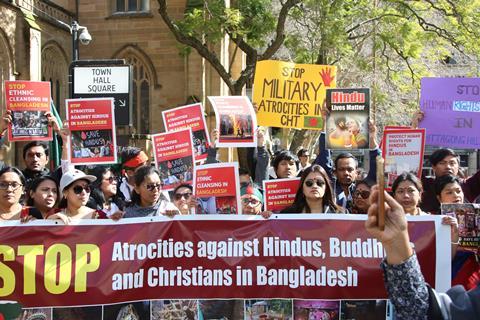
National elections had been seen as a chance for a fresh start. However, that hope is fading due to growing Islamist political influence, anti-India rhetoric and increased persecution of minority groups.
Attacks on minorities in the country – particularly Hindus – have risen, with hundreds of cases also reported of Christians being targeted, most of whom are converts from Islam. Robi* said: “There is still hope that the government can restore law and order, but it must act quickly, firmly and fairly.
“Christians are living with fear of attack, rejection, social boycott and displacement. Many are worried that those responsible for violence may not be punished.
“We pray that the authorities will protect every citizen, bring attackers to justice and allow people of every faith to live safely. We also pray that believers will receive courage, peace and strength to remain firm in their faith during this difficult time.”
Bangladesh is number 33 on Open Doors’ World Watch List, an annual ranking of the 50 countries where Christians face the most extreme persecution.
*Names changed for security reasons






















No comments yet