








The conviction of Finnish MP Päivi Räsänen for expressing her Christian views on sexuality and marriage have chilling repercussions, says Lois McLatchie-Miller. Whatever your beliefs, the right to express them freely should be fiercely guarded
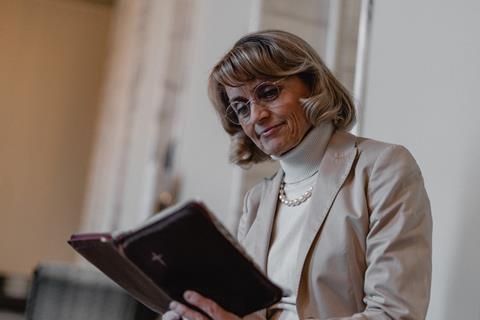
The conviction of Christian politician and grandmother Päivi Räsänen this week should send a chill far beyond Helsinki.
The Finnish Supreme Court found the former Interior Minister and sitting MP guilty of “hate speech” under a section of the Finnish criminal code titled “War Crimes and Crimes Against Humanity”. Her offence? The authorship, and later online distribution, of a 2004 pamphlet articulating traditional Christian teachings on marriage and sexuality.
Räsänen was acquitted over a separate 2019 social media post calling her church’s involvement in a gay pride event into question. Yet the court ruled that the online availability of the pamphlet amounted to authoring and distributing material that “insults homosexuals as a group.”
A society confident in its moral framework does not fear debate
Notably, Räsänen’s offence was not harassment, nor incitement to violence, nor even targeted abuse. It was the publication of a theological argument - one rooted in scripture and Christian teaching. It set out a view held by the Church across centuries: that marriage is between a man and a woman, and that sexual relationships are rightly ordered within that union.
One need not agree with her conclusions to recognise the gravity of what has occurred in Finland. A democratic society that cannot tolerate the peaceful expression of deeply held religious convictions is a society that has lost confidence in its own commitment to pluralism.
At the heart of this case is a profound question: Can traditional Christian teaching on sexuality still be voiced in the public square? The Finnish court has answered, at least in part: “No.”
Free to be, do and say
We are told that Räsänen’s pamphlet was criminally “insulting”. Yet this framing collapses an essential distinction between the dignity of the individual and the moral evaluation of behaviour. Räsänen explicitly affirmed the equal worth of all people as made in the image of God, even as she argued that certain sexual acts fall outside of that design.
If such distinctions are no longer permissible, then a vast swathe of Christian teaching is effectively disqualified from public life, leaving us no ability to comment on the morality of any behavioural choice whatsoever.
This should concern not only Christians, but anyone who values freedom of conscience. Today it is a Finnish MP articulating biblical teaching; tomorrow it could be anyone expressing a dissenting view on a contested moral issue. The principle at stake is not whether one agrees with Räsänen, but whether the state has the authority to criminalise the articulation of her – or your - beliefs.
It is particularly striking that this case centres on a pamphlet written more than two decades ago. When it was written in 2004, same-sex marriage was not even legal in Finland – and wouldn’t be for another 13 years later. What was once acceptable public discourse is being retroactively reclassified as unlawful.
For years, the debate over same-sex marriage has been treated as settled. In many countries, it is framed as a closed question, its moral legitimacy beyond dispute. But the reality is more complex. There remain serious, good-faith arguments - ethical, philosophical, and yes, religious - that continue to challenge the redefinition of marriage.
Today it is a Finnish MP articulating biblical teaching; tomorrow it could be anyone
Figures such as Katy Faust, who leads the organisation Them Before Us, have drawn attention to one such dimension: the implications for children. Faust argues from a rights perspective, children need both a mum and a dad. The fact that men and women bring different, complementary skills to parenting is a biological fact. Ten mothers cannot compensate for the role of a father; and vice versa. Allowing the creation of families headed by same-sex couples jeopardises that balance.
The creation of children through surrogacy arrangements, for example, where they are intentionally deprived of ever having a mother in order to be raised by two dads, raises profound ethical concerns. These are not arguments rooted in animus, but in a particular vision of what children need and deserve. One may wish to contest these claims. But can we no longer even hear them?
Debating freedom
A society confident in its moral framework does not fear debate. It engages with it. It tests its assumptions, refines its arguments, and allows competing visions of the good to be aired openly. And in situations where children are involved, that open debate is all the more important.
The teachings articulated by Räsänen are not fringe beliefs; they are mainstream within Christianity. If they can be deemed criminal in Finland, it is not unreasonable to ask where similar boundaries might be drawn elsewhere across the continent.
The challenge now is not simply legal, but cultural. Are we willing to defend the right to speak, even when the speech in question is unpopular or uncomfortable? Or will we allow a new orthodoxy to take hold - one that tolerates no dissent or disagreement?
The answer will shape not only the future of religious freedom, but the health of our public discourse.
Räsänen’s conviction should serve as a wake-up call. The space for open, honest debate on questions of sexuality, marriage and human identity is shrinking. If it disappears altogether, we will all be poorer for it.























No comments yet