




Conservative MP Nick Timothy has caused controversy after calling a public iftar gathering in London’s Trafalgar Square an “act of domination” by Muslims. Creating a culture of suspicion and exclusion towards people of other faiths is neither British nor Christian, argues David Taylor. He believes Christians should be the first to defend the right of Muslims to gather and pray peacefully
When I was first elected as a councillor I had a very clear plan, to put my Christian faith front and centre and to champion the Church and Christian community as much as I can. I think all Christians in politics should aim for this, but we must also handle the reality that we represent those of all faiths and none, all of whom are equal under the law.
That is why I was troubled to see the strength of feeling expressed by some fellow Conservatives towards the recent open iftar event held in Trafalgar Square.
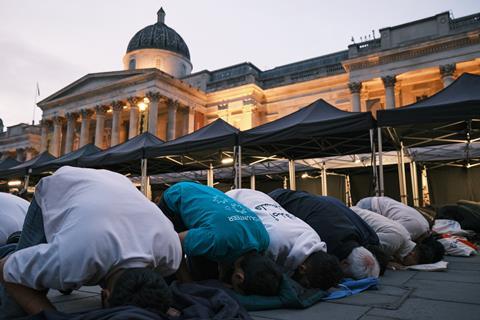
The three hour gathering, which included a moment of Islamic prayer, was described as being “divisive” and “a show of dominance” by senior figures, including Nick Timothy MP.
Faith events have been taking place in Trafalgar Square for decades. Many of us will have attended the regular Good Friday Passion play, and others will remember events like Soul in the City, where Christians gathered in that same space for worship and outreach. This open iftar event has been happening for a long time before Sadiq Khan was mayor, and Sikhs and Hindus have also held their own religious events there. The tradition of this being a widely used public square is as old as the square’s existence.
It is only now, in 2026, that we seem to have reached a point of real controversy over Muslims gathering there. That is what makes this moment feel so different. If we are honest, we have been comfortable with public expressions of faith and belief in that space for years, particularly when they have been our own. We cannot now decide that this is a problem simply because the people gathering are Muslim. We cannot have it both ways.
The reasons being given for concern do not always stand up to scrutiny, and more importantly, they are not applied consistently. Claims about gender segregation are not unique to Muslims and can also be found in parts of the Jewish community, yet the criticism is not applied in the same way. Arguments that religion should not be expressed in public spaces seem to fade when Christians gather for passion plays or open-air worship. Concerns about British values on sexuality and gender roles could apply just as easily to many Christian beliefs as they do to Muslims.
The argument that leaves me most uneasy, especially when it comes from those who share my faith, is that Christians would not be allowed to do the same in a Muslim country. In many instances, that is true. Christians face immense persecution across parts of the Islamic world. But surely that is no justification for us to begin treating people unequally under the law here. If we were to do that, then we become no different to the countries we are criticising. Where does it end? Do we bar non-Christians from public office because that is what happens elsewhere?
What made Christ so counter-cultural, and such a turning point for humanity, was that He behaved differently to everyone else. Jesus treated people with dignity and equality, and reserved his harshest judgment for those who claimed to be protecting the religious order while missing its heart. He did not use power to exclude, but love to invite.
If we argue Muslims should not gather and pray, we are not defending Christianity. We are undermining the very freedoms that allow our own faith to flourish
I am concerned that some of the language and reaction we are now seeing risks drifting into something else. Muslims are being singled out, and this is not by accident. Social media commentators will rage about “Muslim grooming gangs”, yet remain silent about the long and painful history of abuse within the Church or the many recent scandals involving church leaders. We see easily disprovable myths, such as the claim that Muslims do not pay council tax if they pray at home, spread widely and believed despite clear evidence to the contrary.
There are a growing group of voices who, intentionally or not, are contributing to a culture of suspicion and exclusion towards Muslims. That is not British and it is not Christian. More worrying still, it is beginning to shape political thinking, with calls for restrictions on public prayer and religious gatherings. Such proposals would not only affect Muslims, they would also have prevented the kind of Christian witness we have seen in Trafalgar Square for years.
I want to be honest. As a Christian, I do not see thousands of Muslims gathering for prayer as a neutral moment. I believe that the way to the Father is through Jesus Christ alone. I long for heaven to be full, and moments like this remind me that many do not yet know him.
But that belief does not give me the right to deny others freedom. It calls me to witness, not to restrict. It calls me to love, not to exclude.
If we begin to argue that Muslims should not gather, should not pray, or should not be visible in public life, we are not defending Christianity. We are undermining the very freedoms that allow Christianity to flourish.
Christians should be the first to defend the right of Muslims to gather and pray peacefully in Trafalgar Square. Not because we agree, but because we believe in a society shaped by justice, dignity and freedom.
If we fail to do that, then we are not protecting our faith.






















3 Readers' comments