








J Mack Stiles promises to unlock the wonder of the first Christmas. But this short, evangelistic offering is neither a book or a tract, and struggles to speak the language of the very people it hopes to reach, says our reviewer

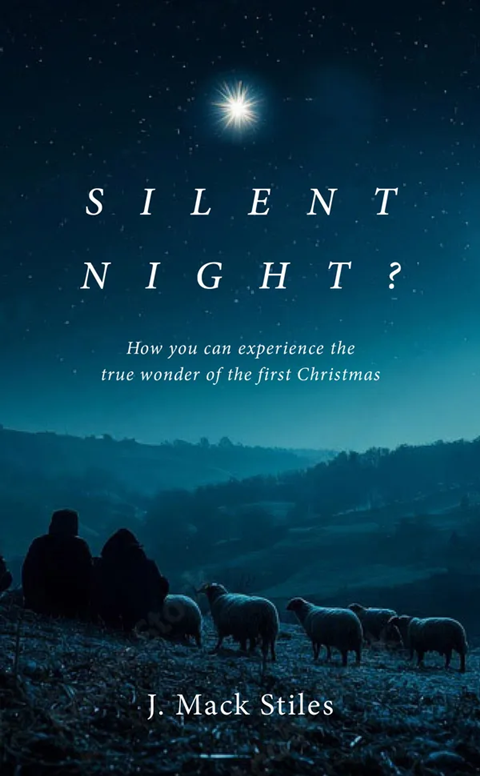
Is it a book? Is it a tract? No. It’s a trook.
The first thing you notice about this book is its size. At only 52 pages, and comfortably smaller than A5, it makes you wonder what has been left out. With the strapline: “How you can experience the wonder of the first Christmas,” and much being made of the author pastoring in the Middle East, I had been hoping for facts that demythologise Christmas and reveal more of its original character. But the size put a stop to those dreams, and to hopes that newer, deeper insights might be disclosed.
It soon becomes clear that the book is not aimed at Christians, most of whom will discover nothing new here, but has been written as an evangelistic tool hung on the hook of Christmas.
Silent Night? takes phrases from the eponymous carol and uses these as stepping stones for an ‘Admit, Believe, Commit’-style approach. Chapter one poo-poos the idea that it was calm (given that births are not known for their serenity and the town would have been full of crowds pouring in for the census). By page 15, Stiles is already asking the reader: “Are you willing to respond to Jesus in faith, like the shepherds who heard the message and went to find their saviour?”
It needs more content to be a real book, and it’s too bookish to be an evangelistic tract
The same applies to chapter two, which is based around the phrase: “Holy Night” claiming that the opposite of ‘holy’ is ‘sin’ and therefore: “you can trust that Jesus is the Lord…by simply turning from disbelief to faith.” It’s not simple. People need reasons to make life-changing decisions.
The chapter on “Our redeemer,” uses the story of Hosea to explain redemption – and that story is a strong example. But over half the chapter talks about the author’s friend, who looks like Santa Claus. It may earn its place in a normal-length book, but here it feels disproportionate and shoehorned in to link it back to Christmas.
Repent and believe
The book ends with bullet points urging the reader to acknowledge, repent, believe and follow. So far, so formulaic.
And this is where I have more concerns. The second point states: “Repent: turn away from your sin and your old way of life, choosing to follow God’s path instead. Repentance is a change of mind and direction.” Why use the word and then have to explain it? Why not write in terms that unchurched people actually use?
Similarly, the word ‘sin’ is little used today in the biblical sense. Stiles even writes that we ”don’t understand the word ‘sin’ today very well, either.” So why use it? The term technically refers to an arrow missing the target, which fits with Romans 3:23: “for all have sinned and fall short of the glory of God”, and Jesus’ parables about debt. Perhaps these images would have been more useful in making the concept relatable.
The book is not wrong in what it says, but like sin, its writing falls short of the ideal. There are, however, some nuggets. God steps into our brokenness; peace and friendship with God go deeper than any earthly comfort; Jesus’ birth was prophesied hundred of years before it happened.
But it needs more content to be a real book, and it’s too bookish to be the evangelistic tract that it wants to be. It’s hard to see how it would be used, other than for churches to offer free to guests at Christmas services – but at around £4, it would be an expensive giveaway.
























No comments yet