









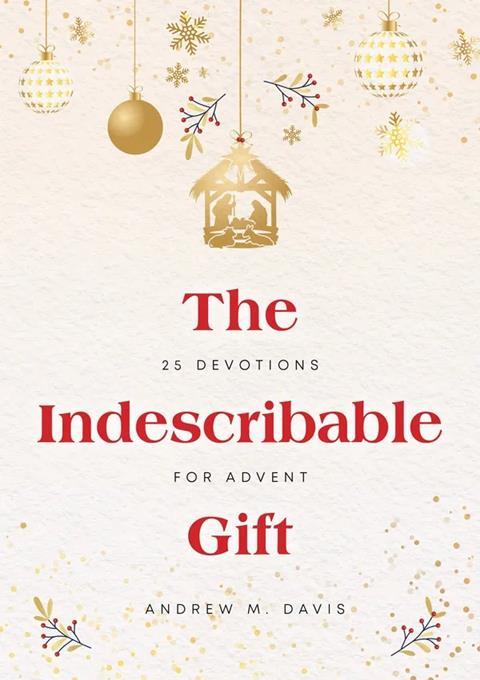
Andrew M Davis’s The Indescribable Gift offers 25 daily devotions and scripture memorisation to help Christians refocus on Christ this Christmas. It deserves a place on your bedside table, says our reviewer

There is an irony about Advent. The season intended to prepare Christians for the coming of Christ easily becomes one of the busiest and most distracted periods of the year. Even within the Church, Advent may disappear beneath carol services, Christmas fairs, school events and the practical preparations for Christmas Day. Andrew M Davis’s The Indescribable Gift offers a simple corrective: 25 short daily devotions intended to turn our attention back to Christ and to the extraordinary mystery at the heart of Christmas.
The book’s title comes from Paul’s exclamation: “Thanks be to God for his indescribable gift!” (2 Corinthians 9:15). The precise interpretation of this phrase has generated some discussion but, for the author, the gift is Christ Himself. God is not merely a giver of gifts; in Jesus Christ, God gives Himself. This conviction provides the theological centre of these reflections.
Andrew M Davis is a pastor in North Carolina, and the author of a number of books on Christian discipleship and biblical exposition. His approach here is therefore scriptural rather than speculative. Readers looking for an academic exploration of the theology of the Incarnation, or for an engagement with the historical development of Advent should look elsewhere. This is a devotional book to be used rather than merely read.
Memorising Scripture
Alongside the daily readings, Davis encourages scripture memorisation so that, by Christmas, the reader will have committed Luke 2:1–20 and Isaiah 9:6–7 to heart. Luke gives us the familiar historical narrative: decree, journey, Bethlehem, manger, shepherds and angels. Isaiah, by contrast, gives us the prophetic and theological horizon against which that narrative is understood: the child who is born is the One upon whose shoulders government rests, the Prince of Peace whose kingdom shall have no end. Read together, they resist sentimentalising Christmas. The child in the manger is not simply an appealing infant at the centre of a familiar seasonal tableau. He is the fulfilment of Israel’s hope and the bearer of God’s kingdom.
Today, the Bible sits on our shelves and, increasingly, on our phones, but possession is not the same as interiorisation. Davis therefore invites us not simply to read the Christmas story but to carry it within us. As Mary “treasured up all these things and pondered them in her heart” (Luke 2:19) so the reader is encouraged to make the words of the Nativity part of the furniture of their Christian imagination.
God is not merely a giver of gifts; in Jesus Christ, God gives Himself
The book is written from an evangelical perspective, and some readers may wish for greater attention to the liturgical and ecclesial dimensions of Advent. Mary, too, can bear considerably more theological reflection than evangelical devotional literature has traditionally afforded her.
Yet it would be unfair to criticise this small volume for failing to be a different kind of book. Its theological priorities are clear and consistent: the authority of scripture, the centrality of Christ, the wonder of grace and the necessity of a personal response to what God has done.
At just 64 pages, it does not impose another formidable task upon an already crowded December. The reflections are brief enough to be part of a daily devotional routine, while the discipline of scripture memorisation gives the enterprise greater substance than its size might suggest. It could be used individually, by a couple or a family, and might also provide material for a church Advent group.
The gift of Christmas
Perhaps the most important achievement of Davis’s book is that it redirects attention from Christmas gifts to the Gift. Christianity makes the astonishing claim that, at a particular moment in human history, the eternal entered time, the creator entered creation and the Word became flesh. Familiarity can blunt the strangeness of that proclamation. Bethlehem becomes comfortable, the manger becomes decorative and Incarnation becomes a theological term whose implications we cease to contemplate. This book asks us to take another look.
This is therefore a modest book about an immeasurable subject. For those seeking a companion through Advent which is accessible, scripturally grounded and unashamedly centred upon Christ, this little book deserves a place beside the Bible during the weeks before Christmas.
The Indescribable Gift: 25 Devotionals for Advent (10 Publishing) by Andrew M. Davis is out now




















No comments yet