













How did Christmas become all abut gifts, food and picture-perfect homes? AJ Gomez traces the making of the modern British Christmas
It’s the most wonderful time of the year! You’re probably scouring the internet for the perfect present, attending plays and pantomimes and preparing puddings. Those frequent trips to the supermarket to stock up on Christmas treats are likely soundtracked by Wham! and the dulcet tones of Mariah Carey.
Somewhere between all the busyness, the Christian lament is that our culture has lost sight of the real ‘reason for the season’; that Christmas has become a tradition of its own, increasingly detached from its sacred roots.
Most popular Christmas music is more defined by lyrics about kissing under the mistletoe than the birth of Christ. Some worry that even the language around Christmas is changing for the worse. Last year, several schools attracted mainstream media attention for referring to Save the Children’s annual Christmas Jumper Day as a ‘Winter Jumper Day’ in favour of inclusivity.
But professor Martin Johnes, author of Christmas and the British: A modern history (Bloomsbury), says concerns that Christmas no longer focuses on the celebration of Jesus’ birth are almost as old as some of the traditions now blamed for drawing attention away from Him.
How the Victorians changed Christmas
If we want to discover where the practices, customs and traditions that now unify our Christmases came from, we must travel back to the Victorian era. In the 1840s, Christmas cards and crackers emerged, while gift-giving, mince pies and the Christmas feast became increasingly embedded in the British celebration of the season. “And from that moment,” Johnes says, “people start to say: ‘The Christian message of Christmas is starting to be lost among all of the other things.’”
Historian Tim Larsen, editor of The Oxford Handbook of Christmas (OUP) explains that Christmas was once characterised less by intimate, indoor family gatherings and more by “rowdy, outdoor parties” which saw local communities coming together. Over the course of the Victorian era, however, Christmas increasingly evolved into what Johnes describes as “a festival of the home”.
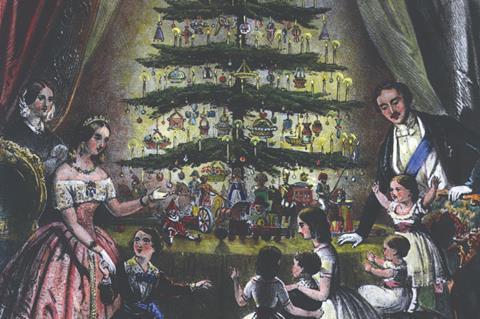
The rise of the Christmas tree is, rather ironically, perhaps the clearest symbol of that transition: a celebration that had largely taken place in streets and public spaces became something that happened inside your home. The German tradition was given almost celebrity status by the royal family in 1848, when a picture of Queen Victoria, Prince Albert and their children standing around their Christmas tree was published in The Illustrated London News (pictured right). “That makes it fashionable, and people start to copy it,” Johnes says.
A festival of the home
This new festival of the home did not immediately become everyone’s Christmas, however. The comfortable domesticity made aspirational by the royal family depended on conditions distributed very unevenly across Victorian Britain.
“To even put up a Christmas tree at home, you need a house big enough to take a tree, and warm enough that you wanted to stay home. If you’re going to have a Christmas feast, you need to be able to afford the food.”
The distinction could be seen in the rhythms of Christmas Day itself.
“Football used to be played on Christmas Day. You could go to the theatre. There were trains running. If you didn’t have a fridge and you wanted to buy a lot of food, you had to buy it very close to the date. So, there were shops open on Christmas morning,” Johnes explains.
With space, leisure and disposable income mainly limited to the middle classes, many Victorian working-class communities maintained their communal celebrations: “Christmas was more a celebration of the street. There might be a bonfire. You might even take your food to the local baker because you didn’t have an oven. People celebrated outside; they celebrated at church. They came together in different ways.”
For many working-class communities, Christmas was characterised by street parties that have been likened to alcohol-fuelled winter carnivals, that Larsen says were complete with gambling and other revelry. For wealthier families, Christmas was increasingly becoming an intimate celebration centred on the home. Church provided one of the few spaces in which social divisions could temporarily dissolve. Between the 1840s and 1860s, indoor carol services became increasingly popular alongside midnight and Christmas morning services, gathering the rich and poor beneath the same roof.
Even gift-giving, now considered one of the defining features of Christmas, looked very different for poorer families a century ago.
“What would a working-class kid get for Christmas before the second world war? Maybe a piece of fruit, maybe a handmade toy. The whole tradition of putting oranges in stockings [developed] because that was a real treat,” Johnes explains.
If the Victorians invented the modern Christmas, the postwar generation nationalised it
The balance eventually began to shift after the second world war, with the arrival of economic growth, high employment and rising wages. With increased disposable incomes, the working class were able to enjoy the kind of domestic Christmas that had previously been associated with the more privileged. If the Victorians invented the modern Christmas, the postwar generation nationalised it.
Improved housing and heating made staying at home more comfortable. Workers increasingly expected Christmas Day off work, and so businesses began to close accordingly. Television sets, which were beginning to become household staples, provided the entertainment that might once have been sought elsewhere. Football fixtures on Christmas Day disappeared as audiences chose to stay home, while trains and other public services also declined as fewer people ventured out.
Selling the perfect season
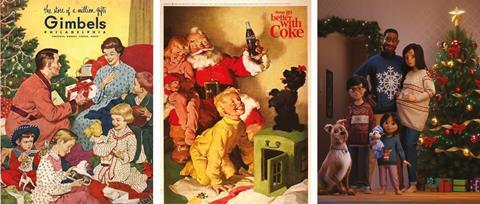
The invention of the Victorian department store – and the advertising culture that grew alongside them – had already introduced a commercial element to Christmas gift-giving. But with more people celebrating Christmas at home, retailers quickly recognised a new postwar market. Billboards shaped ideas of what the home should look like during the festive season. Newspaper adverts suggested what children ought to find beneath the tree. Television commercials presented the delicacies that belonged on the table.
Retailers monetised existing customs and advertising presented an idealised version of them. As consumers sought to replicate it, the ideal became increasingly normalised; expectation fuelled still greater demand. Piece by piece, businesses went beyond promoting toys, gifts, food and decorations to sell the idea of the ‘perfect Christmas’. Eventually, mass participation gave way to mass consumption.
And as that domestic Christmas became shaped by a common ideal, so too came the pressure to keep up.
That pressure became – and remains – particularly acute around children. “Once you start to see what other families are spending, you don’t want your kid to be the one who doesn‘t get the great presents,” Johnes explains.
The modern Christmas was consolidated in an age of rising prosperity. But while the economic conditions that enabled it have given way to today’s cost of living crisis, the spending expectations they created have endured, if not intensified.
According to The Cost of Christmas, a new report from Christians Against Poverty (CAP), 25 million people feel pressured to spend money at Christmas. And the pressure around children remains particularly pronounced: among parents with children under 18 who celebrate Christmas, 73% say they feel pressured to spend more than they can afford, compared with 49% of adults without children.
Katie Johnson, a CAP money coaching expert, adds that 8.6 million people say they feel pressured to spend more than they can afford on Christmas gifts for extended family and friends, while 8 million say the same of additional food for Christmas celebrations.
Make Christmas Christian again
The familiar Christian lament that we have ‘lost the reason for the season’ is right. But perhaps not quite in the way we imagine.
Johnes is careful to clarify that Christmas never really facilitated a society-wide meditation on the person of Jesus and His birth. Britain was once a far more explicitly Christian society, and that was reflected in the way people lived; Christmas was no different. Rather than an intentional focus on the person of Jesus Christ, however, he says Christianity’s influence was perhaps most evident in the general values that underpinned the celebration of His birth: charity, community and worship.
The incarnation begins not with abundance but humility: Christ relinquishing heavenly glory to enter the world as a child. The Nativity is marked by sacrifice, hospitality, generosity and gifts offered in worship. Yet our culture increasingly teaches us to measure our Christmas by what sits beneath the tree, what adorns the table and how closely our homes resemble the ‘perfect Christmas’ we have seen on TV.
Christmas, Johnes argues, has always reflected the society celebrating it. “It’s not so much that Christmas is changing, but our society. We live in a consumerist society where people want to buy things; people want to have things. Christmas is reflecting that. It is a window into our society.”
Therein lies our challenge. Christians are called not to conform to the patterns of the world (Romans 12:2). There is an irony, then, in allowing our celebration of Jesus’ birth to conform to the culture we believe He came to redeem.
Larsen pushes the challenge closer to home: “A lot of people say: ‘Christmas has become too secular’ and they point at [the] bad actors. I think you need to turn it around and say: ‘How can I make my own Christmas more Christian?’”
Complaints that society has taken Christ out of Christmas can – occasionally – be a projection of Christians who have allowed Jesus to become a supporting act in their own celebrations, he adds.
He points to the annual discontentment that Starbucks’ Christmas cup generates for not being ‘Christmassy enough’. “It’s like: ‘We don’t want snowflakes, we want angels.’ I think that’s displaced guilt. What’s really happened is your Christmas is not as Christian as it should be.
“You’ve got to let things go. You’ve made it all about buying lots of stuff. I think you need to turn it around and ask: ‘How can I make my own Christmas more Christian? What am I passing on to my children? What are the traditions that our family should have that can add more meaning and depth to the way [Christmas is] being done. I don’t think Starbucks is what’s ruining your kids learning the gospel.”
8.6 million people say they feel pressured to spend more than they can afford on Christmas gifts
Though blunt in delivery, Larsen’s point urges Christians to reconsider who bears the responsibility for bringing Jesus back into focus at Christmas. Coca-Cola, John Lewis and Starbucks are unlikely to take up that mantle on our behalf.
So, how can Christians celebrate a more countercultural Christmas? Here are eight suggestions for reclaiming the real reason for the festive season.
1. Spend less
If our surrounding culture is urging us to consume, perhaps there is a rather simple way to counter it: Don’t. Have an Amazon-free Christmas. Set a minimal budget. Try a charity-shop Secret Santa. Generosity does not have to be synonymous with expense.
2. A handmade Christmas
Make the decorations. Craft the cards. Bake gifts rather than buy them. Claire Hooper’s A Crafty Little Christmas (Harper North) is a helpful book full of projects that use things you can find around the house, from coloured paper to toilet rolls.
3. A Boxing Day banquet
Make the sacrifice and forgo your annual turkey sandwich. Get everyone at church to bring what is left from Christmas dinner and turn Boxing Day into a communal meal. Let yesterday’s excess become today’s hospitality and invite the homeless, those struggling financially, living alone or simply with nowhere else to go. Share your food and, most importantly, the love of Christ.
4. Throw Jesus a birthday party
Children already understand birthdays, so lean into that. Have cake and games but make the birthday boy the celebrant. Tell the Nativity story, sing together and explain why Christmas exists in the first place. Why not try party bags instead of another round of stocking fillers?
5. Leave the house
Contemporary culture’s perfect Christmas exists inside the house, so get out of it. Leave your perfectly decorated living room for an hour and take a stroll in your local park or drive to the beach. But make it intentional: while you’re out, each person shares something Jesus has done in their life this year, a prayer He answered, or a Christ-like quality they have seen grow in somebody else.
6. Add another chair to the table
Before you finalise the Christmas dinner headcount, ask who might otherwise be alone. A neighbour, international student, widow, single friend or someone without family nearby could turn an insular family Christmas into an act of wholesome welcome.
7. Put something Jesus might recognise on the table
Pigs in blankets might have to take a year off. Swap one Christmas staple for a dish inspired by the foods of first-century Judea. Perhaps a flatbread filled with olives, dates and figs, with a portion of lentils on the side. Rate it, complain about it, laugh about it then use the interruption to talk about Jesus and how He’s the reason you’re around the table in the first place.
8. Quiet down (just for a second)
No one is saying you should spend Christmas Day in dead silence. But amid the competing calls to pass food across the table, the aggressive discord sown by Monopoly and the shock-filled reactions to whatever plot twist EastEnders decides to bring this year, take a few moments to sit quietly in the presence of the Lord. This Christmas, you don’t have to fill every single moment.

























No comments yet