









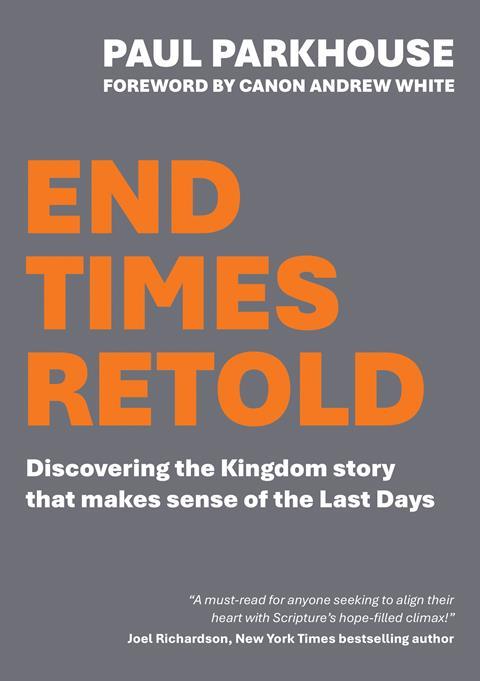
Readable, provocative and theologically astute, End Times Retold challenges Christians to rethink prophecy, Israel and the return of Christ through the wider story of God’s kingdom purposes, says our reviewer

End Times Retold (Verite CM) is undoubtedly the most interesting and stimulating book on the end times that I have encountered. Readable, accessible and warm in tone, Paul Parkhouse argues that if we get the story of the Bible right, we will also understand its ending rightly.
Parkhouse suggests that many of us read the Bible primarily through the lens of the cross – as he puts it, wearing “cross-shaped glasses”. While affirming the centrality of Jesus’ sacrifice, he places it within God’s wider purpose: to fill the earth with his kingdom through humanity. He therefore proposes a shift to “kingdom-shaped glasses”, re-reading end-times prophecy in a way that brings Israel and the Church into a single, coherent framework. This is the book’s greatest strength.
The first half of the book builds its interpretive framework on the principle that the firstborn represents the whole – with Adam as the firstborn representative of humanity. Parkhouse extends this idea to Israel, presenting it as the firstborn representative of the nations, and notes that Jeremiah prophesied God’s new covenant would be made with Israel. Through “cross-shaped glasses”, many assume the Church has replaced Israel. But with “kingdom-shaped glasses”, Parkhouse points instead to Paul’s argument in Romans: that to Israel belong the adoption, the glory, the covenants, the law, the worship and the promises. Rather than replacement, he suggests that faith in Jesus, the King of Israel, brings believers not only into the Church, but into Israel’s community, sharing in these covenant blessings.
In a key and more controversial chapter, Clock by Covenant, Parkhouse examines the timing of Daniel’s prophecy as delivered by Gabriel. He proposes a “countdown clock” reading that, he suggests, points to the Messiah’s death in AD 32 and offers a framework for considering the timing of Christ’s return. He concludes that the final seven years, including the tribulation, will begin when the antichrist brokers a peace treaty with Israel, enabling the rebuilding of the temple in Jerusalem.
Parkhouse also interprets the promise that “all Israel will be saved” as referring to a future moment of national repentance and faith in Jesus as Messiah. Drawing on 2 Peter’s assertion that “with God a day is like a thousand years”, he connects the six days of creation with six millennia, suggesting that Christ’s return may come at the end of this period. While avoiding exact dates, he nevertheless ventures an informed estimate, placing the possible return of Christ in the early 2040s.
The arguments are cogent and logical, but Parkhouse does not offer much critique of alternative interpretations of prophecies. Serious readers who come from a symbolic understanding of the millennium (amillennialists) or those who believe the prophecies have already been fulfilled in the first century (preterists) may feel their viewpoints are dismissed too easily. A slightly more sustained engagement with counter arguments might have usefully amplified the author’s position. However, within the scope of writing for confused lay Christians rather than professional theologians his reasoning is understandable.
In the final three chapters, Parkhouse compares the Great Tribulation to the oppression of Nazi Germany, suggesting that intense economic, spiritual and political pressures will reveal true allegiances. He also offers a provocative – though carefully argued – proposal that the antichrist may be of Islamic origin, with the false prophet emerging as a Jewish figure claiming to be Jesus. These interpretations and speculations may not all be completely accurate or wise, but they are nevertheless coherent and interesting. The narrative then builds to its climax with Christ’s return, ushering in the Millennium, which Parkhouse compellingly portrays as the great Sabbath-rest of history.
Parkhouse weaves together Old and New Testament material in a fascinating way. His parallel between Joseph’s dramatic self-revelation to his brothers and Christ’s long-awaited revelation to Israel is one of the book’s most moving and theologically integrated moments. He closes with a challenge to the Church’s understanding of Jesus’ identity, suggesting that in correcting Israel’s failure to recognise the Messiah, the Church has overcorrected – emphasising Christ as the Lamb more than the Lion, as Saviour more than earthly King.
The book deserves praise for its clarity, freshness and accessibility, as well as its sense of intellectual honesty. Parkhouse presents a persuasive case for premillennialism – the belief that Jesus will return before a literal thousand-year reign. By situating Christ’s return within the wider story of scripture, he will deepen both your understanding of Israel’s role and heighten your anticipation of Christ’s imminent return.
End Times Retold (Verite CM) by Paul Parkhouse is out now

























No comments yet